
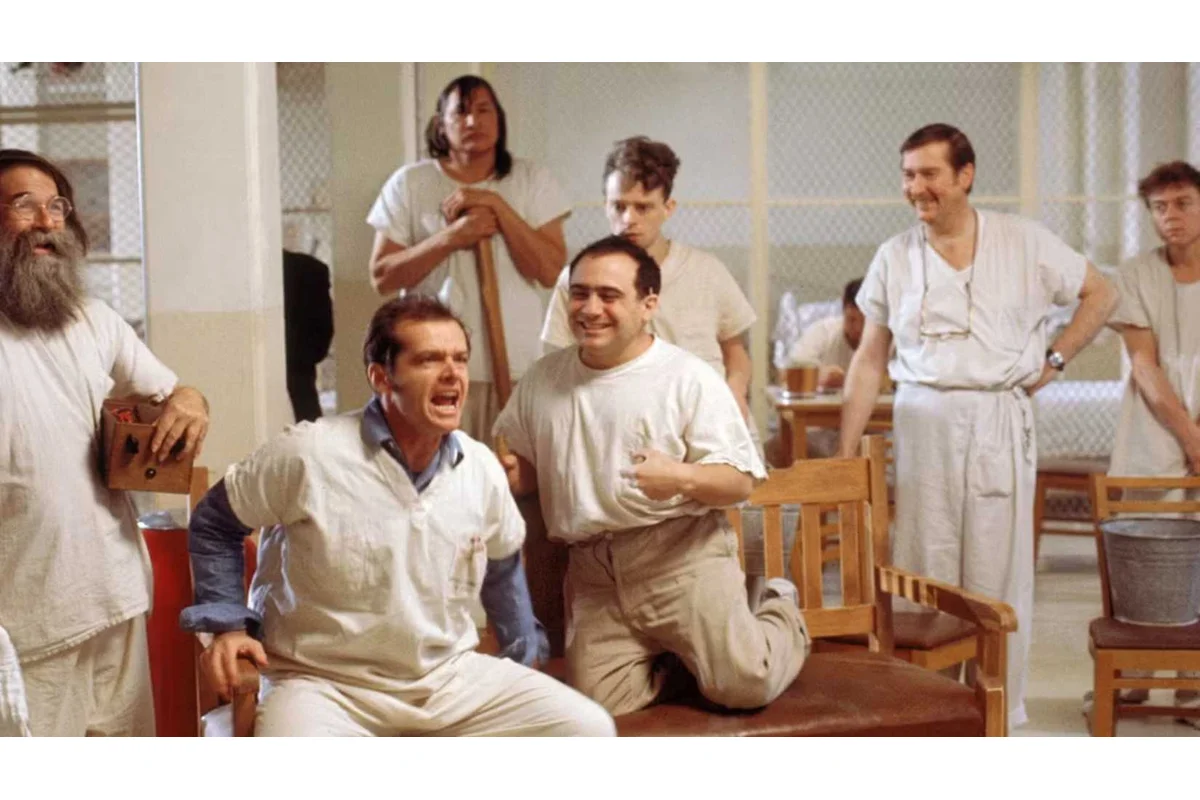
Jack Nicholson’s best performance has long been debated, but fifty years after the release of One Flew Over the Cuckoo’s Nest, his portrayal of R.P. McMurphy remains a pivotal moment in Hollywood history. The film, bringing together Nicholson’s unmatched charisma and intensity, continues to stand out not only as a highlight of Nicholson’s career but also as a significant cultural landmark in American cinema.
How One Flew Over the Cuckoo’s Nest Became Nicholson’s Defining Role
One Flew Over the Cuckoo’s Nest, adapted from Ken Kesey’s novel and directed by Miloš Forman, arrived in 1975 and immediately captivated audiences with its exploration of mental health institutions and anti-authoritarian themes. Nicholson’s R.P. McMurphy—a convict who feigns insanity to avoid prison—confronts the controlling Nurse Ratched, played by Louise Fletcher, and rallies fellow inmates, including characters portrayed by Brad Dourif, Christopher Lloyd, and Danny DeVito. The ensemble’s chemistry is electric, with Will Sampson delivering an iconic finale as Chief Bromden.
The film blended dark comedy with tragedy, offering both sharp social critique and deep empathy for its characters. Its arrival coincided with growing anti-establishment sentiment in the United States, aligning with counterculture movements that questioned existing authority structures, extending from the collapse of sixties idealism into edgier new directions. The institution’s portrayal, both sympathetic and critical, spurred conversations about mental health care in America, complementing contemporary revelations from documentaries like Titicut Follies, which exposed the harrowing reality for many patients during this era.

Riding the wave of its cultural resonance, One Flew Over the Cuckoo’s Nest became a phenomenon—winning the “Big Five” at the Academy Awards: Best Picture, Director, Actor, Actress, and Screenplay. Nicholson’s embodiment of McMurphy was both rebellious and vulnerable, encapsulating the frustration and longing for recognition felt by so many silenced individuals. Within this role, Jack Nicholson gave voice to the voiceless, transforming McMurphy into a symbol of both flawed humanity and resistance to dehumanizing systems.
Nicholson’s performance was recognized with an Oscar for Best Actor. His uniquely volatile and charismatic presence propelled every scene. The chemistry he shared with the supporting cast amplified the film’s power, and his portrayal spoke volumes about the abuse prevalent in mid-20th-century mental health facilities—places designed to hide people away rather than rehabilitate them. Through McMurphy, Nicholson redefined the archetype of the defiant outsider, forever linking that persona to both his career and broader film history.
Nicholson’s Other Stand-Out Performances: Beyond the Cuckoo’s Nest
Though many consider Cuckoo’s Nest as the quintessential Jack Nicholson best performance, his filmography includes several other achievements that have defined eras. In The Shining, Nicholson channeled a chilling intensity as Jack Torrance, delivering a performance that, despite modest initial recognition, has become deeply embedded in pop culture and helped innovate the horror genre. His portrayal in Batman as the Joker stands as another touchstone, infusing the notorious villain with both chaos and charisma in a way that significantly shaped subsequent interpretations of the character across the DC universe.
Nicholson’s ascent began with Easy Rider, in which he captured the freewheeling spirit of the 1960s and earned his first Academy Award nomination. The momentum continued in the early seventies with The Last Detail and Chinatown. In Chinatown, Nicholson took on Jake Gittes, cementing his status in the neo-noir tradition. As his career matured, Nicholson embraced a variety of complex figures, from the introspective lead in About Schmidt—which won him a Golden Globe—to the menacing Frank Costello in The Departed, a role seen by many as a return to the raw and unpredictable energy of his earlier work.
His versatility has ensured a steady stream of both critical and popular acclaim. Whether captivating audiences through fan favorites or winning over critics with more subtle roles, Nicholson’s legacy stretches across genres and decades. Still, One Flew Over the Cuckoo’s Nest stands out not only for its artistic achievement but for its ongoing relevance as social commentary and character study.
The Lasting Relevance and Influence of One Flew Over the Cuckoo’s Nest
Approaching Cuckoo’s Nest today, modern viewers may find aspects of the film difficult, especially when viewed through a contemporary lens. Progressive for its time, its depictions of race and gender can be jarring to a present-day audience. Still, the character of Nurse Ratched, masterfully portrayed by Louise Fletcher, continues to spark conversation about power, gender dynamics, and institution-induced trauma.
To fully appreciate the film’s innovation and impact, audiences must place it in its historical context, recognizing the boundaries it pushed within the cinema of the 1970s. For fans of groundbreaking filmmaking or those tracing the evolution of American film and social attitudes, Cuckoo’s Nest remains essential viewing. Its influence stretches from changing perceptions of mental health institutions to shaping countless antihero archetypes in the decades that followed.
For admirers of Jack Nicholson, One Flew Over the Cuckoo’s Nest is indispensable, providing a showcase for an actor at the height of his powers, able to animate revolt, nuance, and humanity in a system designed to suppress all three. While it is not currently available on streaming platforms, those interested in Nicholson’s finest work can rent or purchase the classic through services like YouTube, Prime Video, or Apple TV.
As the legacy of Jack Nicholson’s best performance continues to evolve, Cuckoo’s Nest endures as both a deeply affecting narrative and a testament to the dynamic range of its star. The film’s cultural resonance, unflinching depiction of institutional control, and Nicholson’s unforgettable McMurphy keep it firmly in the spotlight after half a century—a defining chapter not just in his career, but in the story of American cinema itself.
