
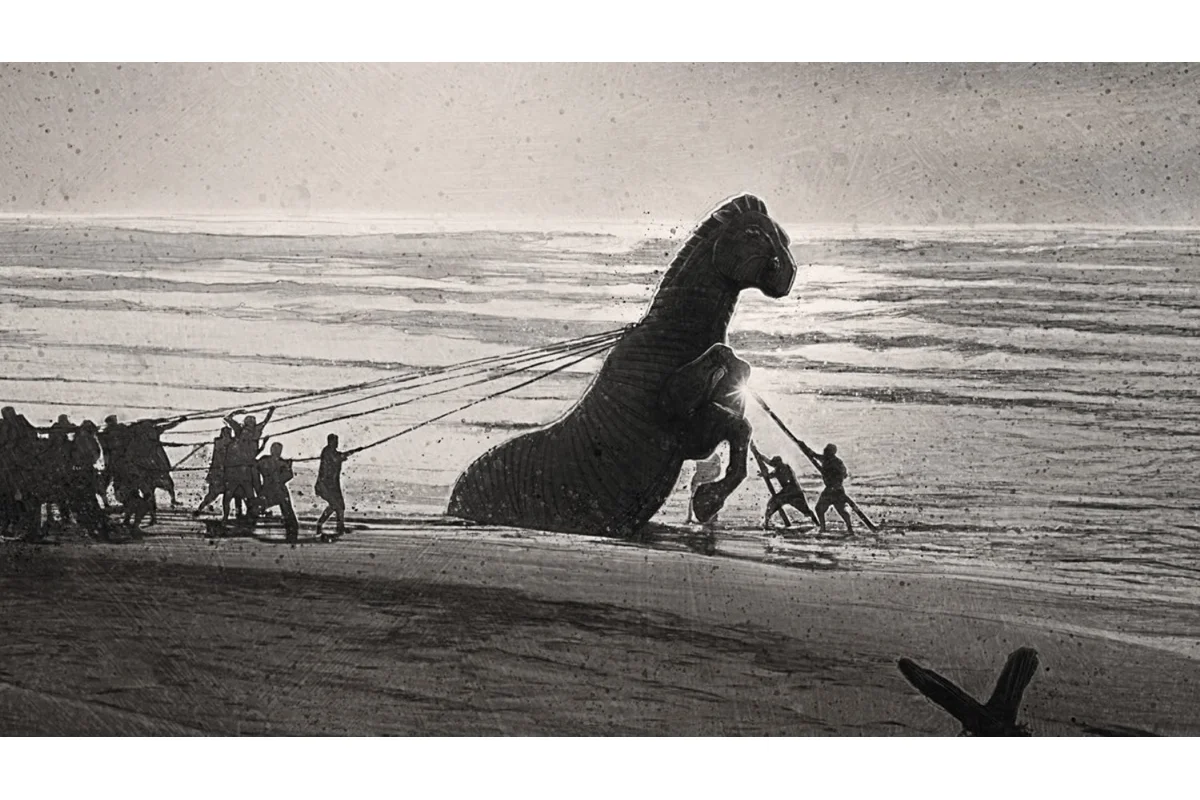
Christopher Nolan‘s new project, an adaptation of The Odyssey, has ignited discussions online long before its planned 2026 release, with early debate centering on its approach and source material. The Christopher Nolan Odyssey controversy is gaining momentum as fans and critics dissect the filmmaker’s interpretation and anticipated creative choices.
Nolan’s Upcoming Epic Fuels Literary and Cultural Debate
Following his celebrated work on Oppenheimer, which grossed close to a billion dollars and earned him his first Best Director Oscar, Christopher Nolan is now tackling Homer’s The Odyssey. The film is expected to be his most ambitious, and early coverage reveals that its adaptation choices are already drawing considerable attention. Although Oppenheimer was widely acclaimed, it sparked controversy over its ethical subject matter. Nolan’s The Odyssey, rooted in Greek mythology, seems poised to generate similarly fervent conversations because of its revered literary origins and enduring cultural influence.
The original Odyssey, accredited to Homer and penned nearly three millennia ago, remains a pillar of ancient literature. Each translation brings unique interpretations, as ancient Greek presents challenges that leave room for modern inflection. Differences from translator to translator are significant—names like Robert Fagles and Peter Green represent distinct traditions, much as various Bible versions reflect unique editorial hands. Recently, it was disclosed that Emily Wilson’s 2018 translation, which gained recognition as the first by a woman, will be the primary reference for Nolan’s adaptation—an announcement that has intensified existing debate.

Emily Wilson’s credentials as a translator are well established, but her version of The Odyssey attracted controversy for its updated approaches and re-examination of inherited assumptions. Wilson was the first to challenge some of the harsher terms historically used for women in previous English editions, arguing that the Greek language was more neutral. Her translation is seen as modern-minded in its ethics—she characterizes Odysseus as a “complicated man,” and corrects what she sees as “unexamined biases” of past editions.
These editorial decisions have provoked attacks labeling her work “woke,” despite substantial academic support for her choices. Such criticism is likely to spill into reaction to Christopher Nolan’s film adaptation, especially if he, like Wilson, frames Odysseus less as an unequivocal hero and more as a morally ambiguous figure facing hard decisions. Greek heroism, after all, denoted exceptional achievement rather than moral perfection. Anticipation also builds that typically demonized characters, such as Circe, may receive a more nuanced portrayal in Nolan’s film, marking a departure from established narrative traditions.
“I don’t think anybody can avoid having biases, preferences, histories, interests, identities, thoughts, judgments, preferences. My point isn’t that translators could or should be “objective,”
Emily Wilson, Translator
This quotation underscores a central theme in the Christopher Nolan Odyssey controversy: that adapting ancient texts is inherently subjective. As Wilson notes, interpreting a work like The Odyssey cannot be purely objective; each adaptation is shaped by its creator’s context and perspective. This approach aligns with the long history of adapting works by Shakespeare, biblical stories, or Tolkien, where every retelling is both a reflection and a reinvention.
With Wilson’s translation providing the source material, Nolan’s Odysseus, the story, and the supporting ensemble will inevitably bear the stamp of the translator’s and the director’s worldviews, ensuring the adaptation remains distinct from prior versions.
Early Criticisms Over Historical Detail and Casting Choices
As is typical with major historical films, even before its release, audiences have pointed out perceived inaccuracies in the early promotional material for The Odyssey. Online dialogue has surged over details such as a particular cup seen in production photos and, notably, the style of helmet worn by Matt Damon as Odysseus. Additionally, there is active discussion over the casting of predominantly white American actors, such as Matt Damon, Tom Holland, Zendaya, and Anne Hathaway, in a story originating from ancient Greece.
Despite this criticism, there is little expectation that these conversations will dent the film’s box office prospects. In fact, as each new set image or casting detail surfaces ahead of its July 2026 release, anticipation and debate are likely to escalate. Christopher Nolan’s historical and literary interpretations will remain under a sharp microscope throughout the film’s journey to theaters, maintaining the Christopher Nolan Odyssey controversy as a focal point of pre-release discourse.
A Closer Look at the Cast of Nolan’s Odyssey
Christopher Nolan has assembled a high-profile cast to reinterpret ancient Greek myth for today’s audiences. Matt Damon is poised to lead as Odysseus, offering his take on the legendary figure at the heart of the story. Tom Holland is set to play Telemachus, adding a dynamic energy as Odysseus’s son. Zendaya and Anne Hathaway are cast in undisclosed roles, but their inclusion signals an intent to infuse the ensemble with well-known, versatile performers. These casting decisions, coupled with the prominence of American actors, continue to fuel debate among fans about authenticity and representation in epic adaptations.
The impending release of Nolan’s Odyssey looks set to spark even deeper conversations about interpretation, translation, and creative license in cinema. As the film’s premiere approaches in July 2026, observers and fans will be watching closely to see how Nolan, influenced by Emily Wilson’s translation, brings this ancient tale to life and how these choices impact contemporary culture and the ongoing Christopher Nolan Odyssey controversy.
