
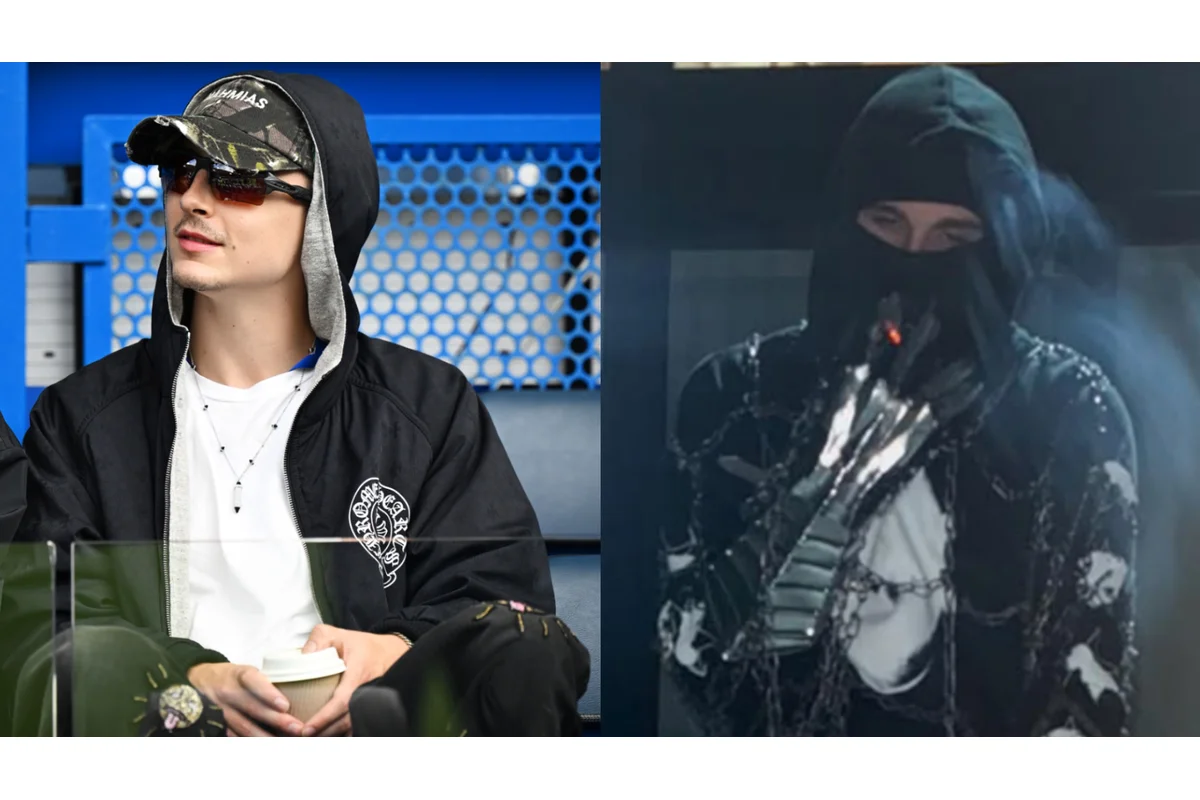
A growing online theory that links the enigmatic Liverpool rapper EsDeeKid to Timothée Chalamet has propelled EsDeeKid’s music catalog into a streaming surge, ultimately earning him his first Billboard 200 chart appearance. The Timothée Chalamet music conspiracy, originating from speculative posts and gaining traction across TikTok, turned a niche rumor into a measurable influence within the music industry during November 2024.
Timothée Chalamet, usually associated with his work in film and an active presence on the Oscar campaign circuit for the upcoming Marty Supreme project, unexpectedly found his name swirling through music circles as a result of internet speculation. EsDeeKid, who has always concealed his identity with a balaclava and kept his persona intentionally enigmatic, first caught major public attention with the release of his track “Bally” featuring Rico Ace in early 2024.
The rumor gained footing after TikTok user @gothauntie0 shared a theory suggesting EsDeeKid and Chalamet might, in fact, be the same person. Though presented without direct evidence and recognized as speculation, this idea sparked a rapid spread across social media platforms, introducing EsDeeKid’s music to tens of thousands of new U.S. listeners. The ensuing buzz was reflected in dramatic streaming upticks documented by industry analysts.

Streaming Numbers Climb as Mystery Deepens
According to Luminate data, EsDeeKid’s catalog accumulated over 5.8 million official on-demand streams during the week of November 7–13, 2024, coinciding with the viral launch of the conspiracy theory. The momentum accelerated the following week, as streams soared to just over nine million—an approximate 54% jump. Over three weeks, this sustained attention translated to a 145% total increase in streams, culminating in EsDeeKid’s debut album “Rebel” entering the Billboard 200 at number 131 on the chart dated November 29, 2024.
Specific tracks experienced particularly sharp growth, with songs like “4 Raws” amassing more than three million on-demand U.S. streams between November 14 and 20—a 56% gain over the prior three weeks. “Phantom” also surged, collecting 2.98 million streams, up 53% over the same period. This wave of discovery carried over to EsDeeKid’s recent Halloween release, “Century,” which earned 1.68 million streams from November 14 to 20, a staggering 156% increase compared to earlier counts.
In response to the speculation, both EsDeeKid and Timothée Chalamet have chosen to remain silent, letting the rumor continue unaddressed. The decision to avoid comment has only fueled further curiosity and debate online.
Other Surge Stories: Bershy’s Video Game Feature Prompts Career Renewal
While the Timothée Chalamet music conspiracy fueled one artist’s record-breaking streams, contrasting stories unfolded elsewhere on Billboard’s charts. Bershy, an artist from Cincinnati whose real name is Brea Shay, experienced an unexpected revival after her 2022 synth-pop track “Radio” was featured in the video game “Dispatch.” Bershy reflected on this dramatic change by posting,
Two weeks ago i didn’t really think i’d make music again,
Brea Shay, Singer-Songwriter.
The inclusion of “Radio” in a pivotal housewarming party scene during the game’s sixth episode introduced the song to a massive new audience. Following the episode’s November 5 release, the song’s streaming numbers jumped from under 2,000 per week to nearly 1.9 million for the week ending November 9, as tracked by Luminate. The attention and success appear to have reversed Bershy’s previous hesitation about continuing her music career.
The development studio behind the game, AdHoc Studio, responded to Bershy’s viral ascent through the official video’s YouTube comments, reinforcing how unexpected opportunities can spark renewed interest and change careers overnight.
AI-Generated Tributes Spark Viral Debate and Streaming Increases
Elsewhere in the streaming landscape, a controversial track seemingly composed and performed by artificial intelligence captured public attention on TikTok. The song, “We Are Charlie Kirk,” was released on September 16, 2024, just six days after the individual for whom it is named was killed. Created by Spaxelma—an AI-associated project with no social media footprint—the song is one of several faith-themed releases under this mysterious name, including the “Charlie Kirk Forever Alive” tribute album dating back to May 2024.
While the track went viral, much of its notoriety resulted from widespread online ridicule, particularly for its AI-generated vocals. During the four-day period of November 14–17, “We Are Charlie Kirk” amassed 56,000 on-demand streams. By the next week, the number shot upward by 656%, reaching over 423,000 new streams. The song’s reach was amplified via TikTok, where the most shared sound included the comment,
this is genuinely the worst song I’ve ever f—king heard in my life bro,
Attributed to a TikTok user.
Despite the backlash and parody, “We Are Charlie Kirk” is the only Spaxelma release to cross the million-stream mark on Spotify so far, raising new questions about the role viral content and AI can play in music discovery and promotion.
Significance of Viral Trends in Music Discovery
The surge generated by the Timothée Chalamet music conspiracy highlights the unpredictable power of social media-driven narratives and speculative theory to launch artists into new commercial territory. The involvement of key entities like EsDeeKid, Timothée Chalamet, and data firm Luminate demonstrates the far-reaching impact of rumors and internet trends not just on branding but on real-world streaming results and chart positions. Additionally, cases like Bershy’s video game feature and Spaxelma’s viral AI tribute illustrate the growing intersections between media, technology, and music discovery.
With streaming platforms and social networks now capable of catapulting unheard songs to viral status almost overnight, the evolving landscape challenges both established and emerging artists to adapt rapidly. As listeners and industry executives continue to monitor these trends, the full effects—whether a fleeting burst or sustained popularity—will unfold over time, shaping the upcoming phases of artist development and chart dynamics. The Timothée Chalamet music conspiracy serves as the latest evidence that in today’s music world, even the most unsubstantiated rumor, when amplified online, can have real and measurable impact.
