
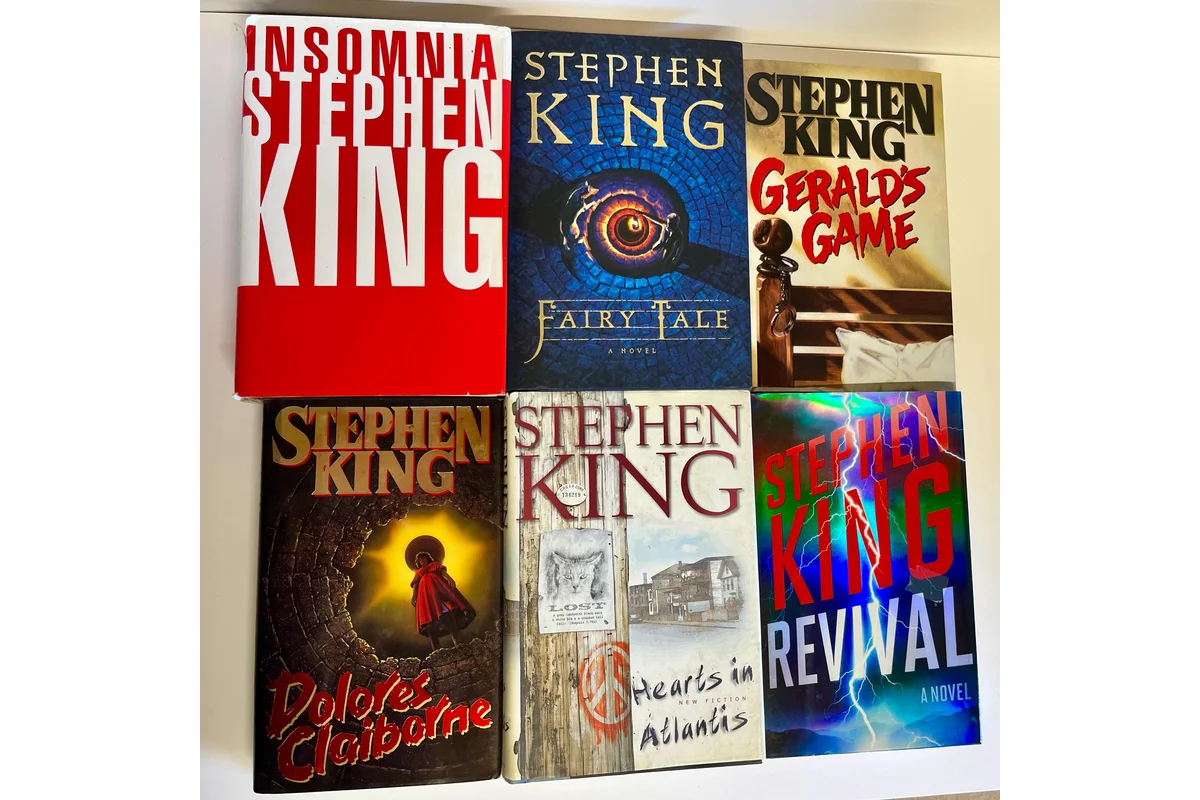
Stephen King has written dozens of books since his 1974 debut, but not every novel is a masterpiece. For devoted readers and newcomers alike, identifying the Best Stephen King Books can help navigate his immense and sometimes uneven bibliography, whether you’re seeking horror classics or genre-defining epics.
With a career spanning over five decades, King’s prolific output includes more than sixty novels plus numerous short stories and collaborations. Some works are heavy tomes, stretching across hundreds of pages and generations, while others are compact yet equally potent. This ranking highlights standout entries that showcase King’s strengths—masterful suspense, memorable characters, and genre innovation—offering ideal starting points and essential reads for any fan.
7: Misery (1987) – A Masterclass in Psychological Tension
Among King’s psychological thrillers, Misery stands out for its intense focus and unrelenting suspense. Primarily set in a single house, the novel traces the chilling ordeal of a popular novelist held captive by Annie Wilkes, one of literature’s most memorable villains, whose fanatic devotion turns dangerously violent.
The confined setting amplifies the tension, with the author’s injuries rendering him nearly completely dependent on his captor. As Wilkes discovers her favorite character’s fate in his novels, she resorts to emotional and physical coercion, driving the protagonist to his limits to resurrect the character she adores. The claustrophobic atmosphere and psychological power plays make for a tight, gripping read that never drags, despite its limited cast and single location.

What solidifies Misery as a standout is the unforgettable antagonist. Annie Wilkes remains one of Stephen King’s most authentic and unsettling adversaries, managing to terrify without any supernatural powers. The novel is considered essential reading for its expertly maintained suspense and exploration of obsession and creativity—qualities that ensure its place among the best of King’s career.
6: Carrie (1974) – The Explosive Debut That Launched a Legacy
Stephen King’s first published novel, Carrie, introduced readers to his knack for blending real-world horrors with supernatural forces. The story centers on Carrie White, a tormented teenager whose strict upbringing and relentless bullying at school eventually trigger her latent telekinetic powers, culminating in an unforgettable, cataclysmic confrontation.
Though concise compared to King’s later works, Carrie is renowned for its tightly woven, epistolary format, which incorporates news clippings, eyewitness accounts, and diverse perspectives to reconstruct the sequence of tragic events. This innovative narrative style injects suspense and emotional depth, while lending the horror elements a tangible credibility often missing from debut novels.
Despite its brevity, Carrie delivers a relentless pace and emotional punch, leaving only the regret that it’s over so quickly. The enduring cultural impact of both the novel and Brian De Palma’s film adaptation underscores its place among King’s must-reads. The book remains a compelling exploration of adolescence, trauma, and revenge, marking a stunning beginning to King’s enduring legacy.
5: The Dark Tower VII: The Dark Tower (2004) – The Grand Finale to An Epic Saga
Closing out the monumental series that spanned two decades, The Dark Tower VII: The Dark Tower represents both a conclusion and a testament to Stephen King’s ambition. The journey of Roland Deschain, whose relentless quest for the enigmatic Dark Tower unites elements of fantasy, horror, and Western genres, finds its ultimate crescendo in this novel.
This climactic volume resists easy summary, not only because of its narrative complexity, but also because appreciating its magnitude requires familiarity with the preceding six books (and arguably the 2012 interquel, The Wind Through the Keyhole). The final book weaves together character destinies, existential themes, and meta-narrative elements reflecting King’s own struggles and anxieties about ending the saga.
Reception among readers is split; some view the risks and unconventional storytelling as the perfect culmination, while others are left divided by the choices made. Regardless, the scope and ambition of the entire Dark Tower series—more than 4,000 pages and over 20 years in the making—secure its position in this list. The concluding volume stands as a monumental achievement in contemporary speculative fiction.
4: 11/22/63 (2011) – Time Travel with Heart and High Stakes
Although Stephen King’s name is nearly synonymous with horror, 11/22/63 demonstrates his versatility as a writer of historical fiction and speculative drama. The novel follows a modern-day English teacher who discovers a portal to 1958, and is tasked with preventing the assassination of President John F. Kennedy, in the hope of averting further national tragedies.
The protagonist’s journey unfolds not in brief leaps but through prolonged immersion in the late 1950s and early 1960s, as he painstakingly navigates the complexities of the past while coping with the limited window through which he can return and set things right. The plausibility of the time-travel mechanism and its limitations heighten the suspense as the narrative approaches the fateful day in 1963.
What sets 11/22/63 apart is its careful blending of historical detail with suspense and emotional resonance. The potential to “jump the shark” is ever-present, yet King maintains narrative discipline, resulting in a novel that is as moving as it is gripping. Frequently cited as King’s best work in the past two decades, it proves his talents extend far beyond the boundaries of horror.
3: The Shining (1977) – Psychological and Supernatural Horror Perfected
King’s 1977 classic The Shining not only inspired the acclaimed Stanley Kubrick film but also stands as a definitive haunted-house—or, rather, haunted-hotel—story in its own right. At its core, the novel revolves around the Torrance family’s terrifying and isolated winter at the Overlook Hotel, where psychological and supernatural dangers blend until neither the characters nor readers can distinguish between reality and hallucination.
King mixes psychological horror with overt supernatural elements, delivering scares on multiple fronts and exploiting the ambiguity between the two. The gradual descent of Jack Torrance into madness is masterfully orchestrated, and the foreboding atmosphere ensures tension is sustained from the first page to the last.
The book’s legendary status owes as much to its disturbing imagery as its emotional complexity, with the location itself looming as a central, memorable character. Its accessible length—especially compared to King’s longest works—makes it a pivotal entry point for readers drawn to horror or psychological drama alike.
2: The Stand (1978) – An Epic Tale of Survival and Society Reborn
Upon its release, The Stand quickly earned recognition as King’s magnum opus, and for many fans, it remains his ultimate exploration of the eternal conflict between good and evil. After a devastating, swiftly spreading plague decimates civilization, the scattered survivors form two ideologically opposed camps, driving the story toward an inevitable confrontation that determines humanity’s future.
The narrative’s scope is vast, spanning cities, rural outposts, and the inner lives of a sprawling cast. King’s world-building shines as the contagion’s aftermath is documented through multiple perspectives, giving the apocalypse a grounded authenticity. The diverse characters—some on journeys of redemption, others drawn to new forms of darkness—make the fate of each group genuinely compelling.
Despite its length, especially in the unabridged edition, the novel’s pacing and ambition remain unmatched. The Stand’s scale and depth cement its place not just as a prelude to The Dark Tower series, but as a standalone epic worthy of repeated reading by any devoted fan.
1: It (1986) – King’s Crowning Achievement in Horror and Imagination
It occupies a unique place in King’s bibliography as his most expansive and multifaceted novel, blending coming-of-age drama, cosmic horror, and a vivid sense of place within the small town of Derry. The novel’s central terror—Pennywise, an ancient creature often assuming the form of a clown—has haunted readers and viewers for decades, but It offers vastly more than just iconic scares.
The structure alternates between childhood and adulthood, revealing how shared trauma and friendship persist across decades. The shifting timelines and perspectives create a rich tapestry, supporting elements of cosmic myth alongside personal, intimate struggles. No adaptation has fully captured the scope and complexity present in King’s original narrative; readers are consistently rewarded with surprises, emotional depth, and the wild, unrestrained creativity that marked King at the height of his powers.
Beyond the surface horror, It stands as a profound meditation on memory, loss, and the enduring bond between friends. Its sheer volume and ambition do not dilute its power—instead, they make its rewards even greater for those willing to undertake the journey. It is considered a defining work, its influence reaching far beyond horror into the greater landscape of American storytelling. If you’ve never ventured into Derry’s depths, this is the Stephen King book not to miss.
Among the memorable characters in It, Pennywise the clown has been portrayed by Bill Skarsgård, while Beverly Marsh was brought to life by Sophia Lillis in recent adaptations—both contributing to the enduring legacy and cultural resonance of King’s tale.
In ranking the Best Stephen King Books, these seven novels reveal not only the evolution of an iconic writer, but also the range and depth that have made his work an enduring fixture in modern fiction. For fans and new readers craving suspense, psychological complexity, and world-altering stakes, this selection represents the essential core of King’s vast, varied, and frequently surprising career.
