
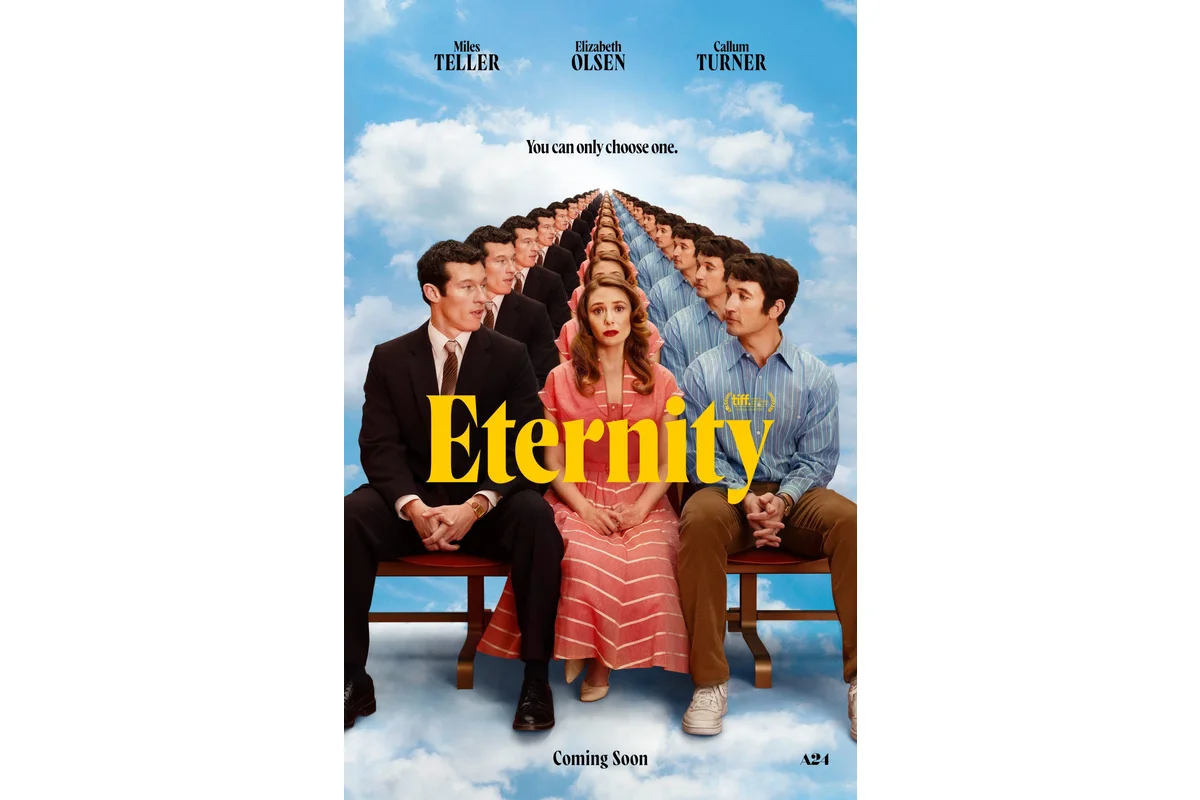
Elizabeth Olsen Eternity performance is at the center of the latest A24 release, as the award-nominated actress takes on a uniquely transformative role in “Eternity.” The film, which recently premiered to acclaim at the Toronto International Film Festival and is now in theaters, sees Olsen leading as Joan—a woman navigating an otherworldly love triangle in a realm called The Junction, where the deceased choose their eternal afterlife.
In “Eternity,” Olsen’s character, Joan, arrives in The Junction following her own death, initially hoping to reunite with her most recent late husband, Larry, portrayed by Emmy-nominee Miles Teller. However, she soon discovers her first husband, Luke—played by Callum Turner—has been waiting for her for nearly seven decades. Joan must ultimately decide which of the two will join her for eternity, forming the emotional core of the story.
Building the World of The Junction: Artistic and Narrative Choices
The Junction, the primary setting for “Eternity,” stands out due to its retrofuturistic and memory-driven aesthetics. Co-writer and director David Freyne discusses the detailed inspiration behind the film’s afterlife environment, emphasizing a space that mirrors one’s memories.
“something that would illustrate how you go into memories,”
— David Freyne, Co-writer/Director
“like a natural history museum of dioramas”
— David Freyne, Co-writer/Director
Freyne envisioned The Junction as a blend between a brutalist structure and a film set’s scenic backlog, where heaven appears as curated vignettes from a person’s life. Sparse yet meaningful elements hint at what the characters remember, frequently depicting idealized or stylized versions of their experiences.
The director also meticulously developed the sequence involving the train tunnel—a passage transporting souls to The Junction. To authentically display the many iterations of Joan, Olsen underwent an unprecedented number of hair and makeup changes in just a single day, creating a record behind the scenes for the most transformations performed in one shoot.
“a record for the amount of hair and makeup changes”
— David Freyne, Co-writer/Director
This challenge, which required a significant effort from the film’s art departments, stands as a testament to the creative ambition fueling Olsen’s performance and the world-building in “Eternity.”
“a lot of them were written into the script”
— David Freyne, Co-writer/Director
Freyne elaborated on the process of designing the afterlife’s many visuals by compiling an extensive spreadsheet of names, taglines, and diorama paragraphs, which he gave to the art department to realize on set.
“the other booths that we pass by”
— David Freyne, Co-writer/Director
“I remember just doing a spreadsheet of names of eternities and taglines and paragraphs and I would give that to the art department, and they did an extraordinary job with what they created. So yeah, I created all those, which were really, really fun, but then there were touches that people would come up with that added to them in great ways as well.”
— David Freyne, Co-writer/Director
Specific rules for the afterlife in “Eternity” lend urgency and framework to the plot. Notably, characters must choose their type of eternity within seven days after arrival, fueling tension in Joan’s decision.
“it gave you an instant ticking clock for Joan to make her decision.”
— David Freyne, Co-writer/Director
The afterlife’s world in “Eternity” also includes its own intricate social structure—those who stay and take jobs, such as Luke as a bartender, can climb or fall within an unusual bureaucracy. This setup generates both drama and humor in the narrative.
“added to the drama for these characters”
— David Freyne, Co-writer/Director
Love Triangle Dynamics: Departing from Traditional Genre Expectations
“Eternity” has drawn comparison to other A24 releases, such as “Materialists,” especially for its exploration of love triangles. However, co-writer/director David Freyne specifically wanted the relationship between Joan’s two husbands, Luke and Larry, to be central—not just as romantic rivals but as characters who form a bond themselves. Developing the connection between Miles Teller’s Larry and Callum Turner’s Luke was deliberate and crucial to the story’s emotional fabric.
“It was really important. I think it was so important to me that the relationship between Joan and her husbands isn’t the only one. It’s between the men. It was so important that you have the competition with them, but there’s a reason she loves both of them. There’s something between them that’s familiar, and it’s really important, particularly later in the film when they’re getting drunk together, and you realize how much they have in common. What they really have in common is that they love this woman. Miles and Callum were just so brilliant with each other. They got on so well, and you feel that chemistry. I think if you have that, you have to explore it. And I think those actors really did. I did a lot of little rewrites, the pre-production and production, just responding to how brilliant they are. That was a lot of fun.”
— David Freyne, Co-writer/Director
The chemistry between the actors who play Joan’s husbands serves as one of the film’s driving forces. Their interactions allow the audience to appreciate the different attributes that each man brings to Joan’s life, making the fantasy storyline more emotionally authentic and providing deeply-felt moments of camaraderie.
Olsen’s Nuanced Transformation and the Evolution of Joan
Elizabeth Olsen’s performance has been described by both critics and her colleagues as exceptionally complex, with nuanced differences appearing in Joan’s interactions with each husband. Freyne credits Olsen for meticulously adjusting every aspect of her character’s behavior depending on the scene partner, reflecting deep collaboration during development.
“She is staggering in this. I think it is such an extraordinarily nuanced performance, and I think that was absolutely it. Myself and Lizzie spoke a lot about not just how she would behave being an older woman in a younger body again, and how that would affect her voice and her posture, but how she is a different Joan with Luke, she’s with Larry, and how she reacts to them and the joy she might have with each of them is different, and she really developed that over. I mean, like you said, her voice changes subtly, her posture changes. How she walks or kind of brushes her hair. Everything is different with each man and I think it’s just a gift. It’s a gift to have an actor of her caliber and her talent come in and craft that with you and, yeah, I can gush all day about Lizzie.”
— David Freyne, Co-writer/Director
“We can do an hour on Elizabeth.”
— David Freyne, Co-writer/Director
Olsen draws on her previous work, including the retro-inspired stylings of “WandaVision,” to inform certain physical and emotional qualities in her portrayal of Joan, although both she and Freyne agree the journey here is distinct.
“I mean, I love WandaVision. I think it’s brilliant. I’m sure it helped a little bit. Yeah.”
— David Freyne, Co-writer/Director
Joan’s evolution through her interactions with Luke and Larry illustrates the subtle shifts in identity that occur in long-lasting relationships. Olsen explains that reconnecting with people from different chapters of life brings out different versions of oneself, an idea she conveyed through voice inflections, body language, and smaller details shared with each co-star.
“I think even without having lost someone, if we haven’t seen someone that was important to us and a moment in our lives, we haven’t seen them in 10 years, when we see them, we kind of return to the people that we were, even if we’re trying not to. So I thought about that a lot with Luke and Joan. She was obviously younger, but also maybe not as sure about what she has to say or how she says it, or her own mannerisms, or making a mistake, or not wanting to, and just being kind of overwhelmed by the butterfly feelings. Whereas with Larry, there’s almost a deflation.”
— Elizabeth Olsen, Actress
“Yeah, a tired feeling, but it’s because of that intimacy that you get from that kind of comfort with someone for so many years. And so there is a difference, I think. I think we’re all slightly different versions of ourselves depending on who we’re with or who’s around. And so I think it was an opportunity to get to show that.”
— Elizabeth Olsen, Actress
Such attention to emotional authenticity strengthens the story, helping “Eternity” resonate with viewers and setting Olsen’s work apart in her filmography.
The Cast’s Perspectives: Heartfelt Storytelling in a Modern Rom-Com
The wide ensemble cast, including Da’Vine Joy Randolph, John Early, and Olga Merediz, contributes depth to “Eternity,” but it is the dynamic performances and chemistry among the three leads—Olsen, Teller, and Turner—that have captured most of the critical praise. Miles Teller reflects on the evolution of romantic comedies and explains how “Eternity” departs from formulaic genre conventions.
“I guess for my generation, it’s even something like You’ve Got Mail. I think that probably came out when I was like 9 or 10. On the earlier side, I think some of the romantic comedies maybe have leaned into the comedy a little more. There’s kind of a lot more one-liners, maybe. And what I loved about this, it felt very character-driven. There’s a real arc here. You really care about the progression of these characters. It’s incredibly heartwarming. And for me, I’ve certainly made some comedies where we’re just going for the biggest laughs possible. But for this one, it just really felt truthful and sincere. And I like movies that treat the audiences with sincerity.”
— Miles Teller, Actor
Callum Turner, whose character Luke has waited decades for Joan in The Junction, brings a layer of vulnerability to the role. He comments on the importance of being a good listener both for his character and as a bartender in The Junction’s peculiar afterlife economy.
“What’d you say? [Laughs]. He’s been in The Junction for 67 years. He has been waiting for a long, long time and I guess he’s incredibly susceptible to everything around him and people that are coming through. People don’t stay for a long time, and he’s managed to build a few relationships with people that have stayed in The Junction to work. But really he’s been waiting for Joan his whole time. And to be a good listener, I guess, is about communication, separate from Luke.”
— Callum Turner, Actor
“Also to be a good bartender. You have to be a good listener. You go there for that sometimes. They listen to a lot of stories.”
— Miles Teller, Actor
The interplay between the actors heightens the film’s emotional realism and draws the audience into the richly imagined world Freyne and his team have built.
Critical and Audience Acclaim: Reception and Ongoing Impact
Upon its festival debut, “Eternity” quickly garnered positive attention. With a Rotten Tomatoes critics’ rating of 76% and an audience approval score of 91% following its theatrical rollout, the film resonates with viewers for its inventive storytelling, striking visuals, and the standout Elizabeth Olsen Eternity performance at its heart.
Critics have highlighted the film for its unique genre blend, balancing fantasy with heartfelt romantic and comedic elements. The universal themes of love, memory, and self-discovery are made immediate and poignant through Freyne’s rules-based afterlife, which gives every character, especially Olsen’s Joan, a dramatic sense of urgency and choice.
With award nominations possible and conversations circulating about the film’s potential for a sequel or an extended exploration of its ending and character arcs, “Eternity” stands out not just as an innovative romantic comedy, but as a project that showcases Elizabeth Olsen’s capacity for emotional transformation and adaptability.
What Lies Ahead for Eternity and Its Cast
As “Eternity” continues its theatrical run, audiences and critics alike are speculating on the future of its unique narrative and characters. Director David Freyne has engaged with media about possibilities for a sequel, as well as providing deeper insights into Joan’s decision at the film’s conclusion.
The film continues to fuel discussions on the afterlife’s representation in cinema, joining the ranks of other notable movies exploring similar themes. Its success reflects the power of inventive storytelling, memorable performances, and effective collaboration between creative minds like Freyne, Olsen, Teller, and Turner.
For fans of Elizabeth Olsen and those seeking a thought-provoking yet heartwarming take on love, memory, and eternity, this film is a standout example—and her performance may be remembered as one of the most transformative in her career to date.
“Eternity” is now screening in theaters nationwide, offering viewers a fresh and emotionally charged perspective on life, love, and what comes after.
