
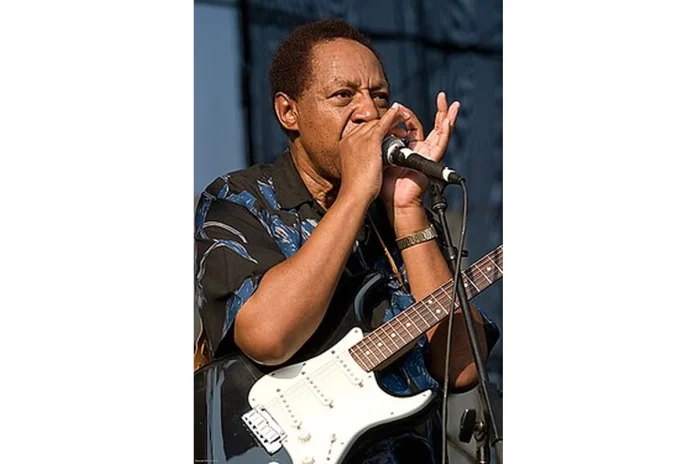
Billy Boy Arnold Bio
William “Billy Boy” Arnold (born September 16, 1935) is an American blues harmonica player, singer, and songwriter from Chicago, Illinois. A self-taught harmonica player, he is widely recognized for his work on the Chicago blues and rhythm and blues scenes, and for original songs later covered by major rock and pop acts. He received informal lessons from neighbor Sonny Boy Williamson I in 1948, and made his recording debut in 1952 with the single “Hello Stranger.”
Arnold played harmonica on Bo Diddley’s 1955 sessions, including “I’m a Man,” and recorded originals such as “I Wish You Would” and “I Ain’t Got You,” both of which were later covered by the Yardbirds and other artists. After recording the 1963 LP More Blues From The South Side, he stepped away from music for non-musical work before returning to festival and international touring in the 1970s. He has since released multiple studio albums and published a memoir, and remains active as a performer of Chicago blues.
Early Life and Background
William Arnold was born on September 16, 1935, in Chicago, Illinois, the United States, and grew up as one of 16 children. He began playing harmonica as a child and developed his style without formal training, making him a self-taught musician. His younger brother is bassist Jerome Arnold, who has also worked in the music industry and with whom Arnold has recorded.
In 1948, Arnold received informal harmonica lessons from his neighbor, Sonny Boy Williamson I, shortly before Williamson’s death. Those early sessions in Chicago helped shape Arnold’s approach to the instrument and connected him to the city’s deep well of blues talent. As a young man, he spent time around Chicago’s South Side clubs, where he honed his craft among seasoned blues performers.
Arnold’s upbringing in a large, working-class Chicago family placed him near the heart of the city’s mid-century blues scene. He absorbed the sounds of harmonica greats who lived and performed in his neighborhood, building the foundation for his own career as a player, singer, and songwriter.
Path to Singer
Arnold’s professional music career began in 1952 with his recording debut, the single “Hello Stranger,” released on the small Cool label. The record company gave him the nickname “Billy Boy” around the same time, and he used it for the rest of his career. The single established him as a young presence on Chicago’s blues circuit.
In the early 1950s, he joined forces with street musician Bo Diddley, an association that led to Arnold playing harmonica on Bo Diddley’s March 2, 1955, recording of “I’m a Man,” released by Checker Records. The same day as the Bo Diddley sessions, Arnold recorded his self-penned “You Got to Love Me,” which remained unreleased until the box set Chess Blues 1947–1967 appeared in 1992.
Arnold signed a solo recording contract with Vee-Jay Records, where he cut the originals of “I Wish You Would” and “I Ain’t Got You.” Both songs were later covered by the Yardbirds, while “I Wish You Would” was also recorded by David Bowie on his 1973 album Pin Ups and by Sweet on their 1982 album Identity Crisis. These covers helped spread Arnold’s songwriting to wider rock audiences.
Billy Boy Arnold Career
Early Career (1952–1963)
Arnold’s first notable work was the 1952 single “Hello Stranger” on the Cool label, which gave him a foothold in the Chicago blues scene. He went on to work with Bo Diddley, Johnny Shines, Otis Rush, Earl Hooker, Howlin’ Wolf, and Muddy Waters, building a reputation as a reliable harmonica sideman. He also signed with Vee-Jay Records and recorded original songs that would become enduring blues and rock standards.
In the late 1950s, Arnold continued to perform in Chicago clubs, and in 1963 he recorded an LP, More Blues From The South Side, for the Prestige label. As playing opportunities dried up, he pursued a parallel career as a bus driver and, later, a parole officer, stepping back from regular recording and touring for a period.
Breakthrough (1970s–1990s)
By the 1970s, Arnold had begun playing festivals and touring Europe, including as part of the American Blues Legends ’75 package organized by Big Bear Music. He recorded a session for BBC Radio 1 disc jockey John Peel on October 5, 1977, and in 1979 he recorded the tracks that later became the Catfish album of 1999, in London with Tony McPhee and the Groundhogs. These international appearances marked his return to a wider blues audience.
His American comeback as a solo recording artist began in 1993 with the album Back Where I Belong, released on Alligator Records. The album was followed by Eldorado Cadillac in 1995, and by Boogie ‘n’ Shuffle in 2001, recorded on Stony Plain Records with the Duke Robillard Band. In 2012, he released Blue and Lonesome, featuring Tony McPhee and the Groundhogs, reinforcing his stature in the traditional blues community.
Notable Works and Milestones
Arnold’s signature works include his 1950s originals “I Wish You Would” and “I Ain’t Got You,” the 1963 LP More Blues From The South Side, and later albums such as Back Where I Belong (1993), Eldorado Cadillac (1995), Boogie ‘n’ Shuffle (2001), and Blue and Lonesome (2012). In 2014, Stony Plain released The Blues Soul of Billy Boy Arnold, a tribute to his catalog. In November 2021, the University of Chicago Press published his memoir, “The Blues Dream of Billy Boy Arnold,” written in collaboration with Kim Field.
Billy Boy Arnold Award Nominations
In 2014, Billy Boy Arnold was nominated for a Blues Music Award in the “Traditional Blues Male Artist of the Year” category, recognizing his long-standing contributions to the Chicago blues tradition.
Billy Boy Arnold Family
Arnold was born in Chicago as one of 16 children. His younger brother is bassist Jerome Arnold, with whom he has recorded.
Personal Life
After his early-1960s recording work, Arnold pursued a parallel career as a bus driver and later as a parole officer before returning to full-time music in the 1970s. He is identified by the nickname “Billy Boy,” given to him by the Cool label early in his recording career, and he continues to perform as an active blues musician.