
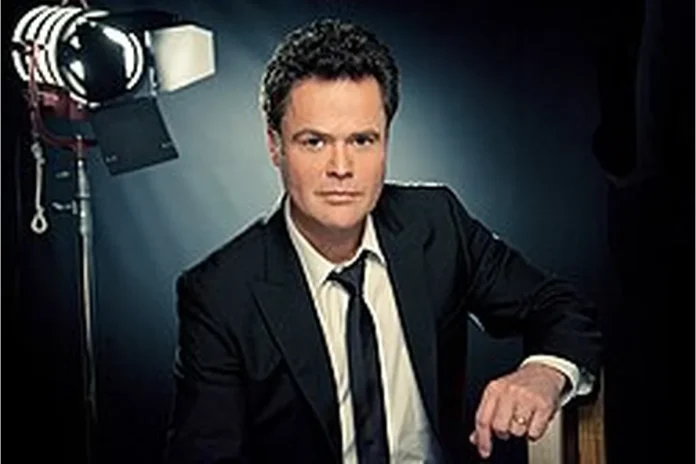
Donny Osmond Bio
Donald Clark Osmond (born December 9, 1957) is an American singer, dancer, actor, and television host who first rose to fame as a teen idol performing with his brothers in the Osmonds. He launched a successful solo music career in the early 1970s and later became a prominent television personality through shows such as The Donny & Marie Show (1976–1979) and Pyramid (2002–2004).
Over the following decades, Osmond expanded his reach into Broadway, film, voice acting, and a long-running Las Vegas residency with his sister, Marie Osmond. He gained new generations of fans by winning season 9 of Dancing with the Stars and finishing as runner-up on season 1 of The Masked Singer. With a career that began in 1963, he remains a celebrated figure in American pop entertainment.
Early Life and Background
Donald Clark Osmond was born on December 9, 1957, in Ogden, Utah, the seventh child of Olive May Davis and George Virl Osmond. He grew up alongside his brothers Virl, Tom, Alan, Wayne, Merrill, Jay, and Jimmy, and his sister Marie, in a large family rooted in music and faith. He was raised as a member of the Church of Jesus Christ of Latter-day Saints alongside his siblings in Utah.
Osmond was born with situs inversus, a rare, benign congenital condition in which several of the body’s major organs are positioned on the opposite side from where they would normally appear. He was also an avid technology enthusiast in his youth, spending free time between rehearsals and homeschooling reading electronics manuals, building electronic kits, and learning sound engineering basics.
His family environment provided an early immersion in performing. Several of his brothers were already appearing on television when he was a young child, setting the stage for his own introduction to the entertainment industry. His two oldest brothers, Virl and Tom, are deaf, and his brother Wayne later experienced hearing loss, experiences that shaped the family’s use of sign language during stage performances.
Path to Acting
Osmond’s path into acting and television began at the age of six, when he made his debut on The Andy Williams Show in 1963, performing alongside his brothers who had joined the program in late 1962. The brothers continued to appear on the show throughout the 1960s, giving Donny an early foundation in front of the camera and on stage. The performance led to guest spots, family television appearances, and a growing fan following.
As a solo artist in the early 1970s, Osmond became a teen idol and a frequent cover subject for magazines such as Tiger Beat, Flip, and 16. His crossover appeal and on-camera charm drew the attention of television executives, including ABC entertainment chief Fred Silverman. After Osmond and his sister Marie co-hosted The Mike Douglas Show for a week in 1974, Silverman offered the siblings their own primetime variety series.
This early momentum launched Osmond’s television career and provided a stepping stone into a wider range of on-camera opportunities. It also set up his transition into film, voice work, hosting duties, and Broadway roles in the decades that followed.
Donny Osmond Career
Early Career (1963–1975)
Osmond’s first notable work came in 1963 with his debut on The Andy Williams Show at age six, singing “You Are My Sunshine.” Throughout the 1960s, he continued performing with his brothers on the program, gaining valuable television experience. By the early 1970s, he had launched a solo music career that produced several top ten hits, including the chart-topping “Go Away Little Girl” in 1971.
His early achievements included sold-out concert tours, gold records, and widespread recognition as one of the biggest teen idols of the era. He also made guest appearances on shows such as Here’s Lucy in 1972, helping to build his profile as a crossover television and recording star before his own primetime debut.
Breakthrough (1976–1979)
Osmond’s breakthrough came with The Donny & Marie Show, a television variety series he co-hosted with his sister Marie on ABC from 1976 to 1979. The program became a defining moment of 1970s pop culture and established the duo as one of the most recognizable sibling acts in American television. The Osmond siblings also released a series of top ten hits and gold albums as a recording duo.
Beyond the variety show, Osmond continued to build his television résumé with guest spots on programs such as Friends, Diagnosis: Murder, and Hannah Montana, along with voice appearances on animated series. He co-starred with Priscilla Barnes and Joan Collins in the 1982 television movie The Wild Women of Chastity Gulch for producer Aaron Spelling, and appeared in the 1978 film Goin’ Coconuts alongside Marie.
He made his Broadway debut in the early 1980s in a revival of the 1904 George M. Cohan show Little Johnny Jones, replacing another former teen idol, David Cassidy. The production closed after one performance in March 1982. His second major Broadway engagement came in September 2006, when he joined Disney’s Beauty and the Beast as Gaston, ultimately extending his run through December and earning praise from New York Post columnist Liz Smith.
Notable Works and Milestones
Osmond’s signature works include The Donny & Marie Show (1976–1979), the Donny & Marie Las Vegas residency at the Flamingo Las Vegas (2008–2019), and his starring role in Joseph and the Amazing Technicolor Dreamcoat, which he performed in Toronto, Chicago, and on tour beginning in 1992 and later reprised in the 1999 film version at the request of creator Andrew Lloyd Webber. His voice work as Shang in Disney’s Mulan (1998) further cemented his place in family entertainment.
Donny Osmond Award Nominations
Throughout his career in entertainment, Donny Osmond has earned recognition for his work across music, television, and live performance. He and Marie Osmond received back-to-back nominations for the Daytime Emmy Award for Outstanding Talk Show Host in 2000 and 2001 for their syndicated talk show Donny & Marie. For his work hosting the game show Pyramid from 2002 to 2004, Osmond was nominated for a Daytime Emmy Award for Outstanding Game Show Host in 2003, an award that ultimately went to Alex Trebek.
Donny Osmond Awards Won
Donny Osmond has collected several notable awards across his decades-long career in entertainment. He and Marie received the Pop Culture Award at the 2015 TV Land Awards in recognition of their impact on American pop culture. He also won the Las Vegas Review-Journal Best of Las Vegas Award for Best Show in 2012 for the Donny & Marie Show, and earned the publication’s Best Singer award in 2013.
He is also recognized for winning season 9 of Dancing with the Stars in 2010, becoming the oldest winner of the competition at that time. He finished as runner-up on season 1 of The Masked Singer in 2019 as the character “Peacock,” earning renewed attention from a new generation of fans.
Donny Osmond Family
Donny Osmond was born into one of America’s most recognizable entertainment families, the seventh child of Olive May Davis and George Virl Osmond. He grew up with brothers Virl, Tom, Alan, Wayne, Merrill, Jay, and Jimmy, as well as his sister Marie, several of whom formed the Osmond Brothers singing group. His older brothers Alan, Wayne, Merrill, Jay, and Donny performed together as part of the group’s popular run.
Several of his family members have continued in entertainment. His sister Marie co-hosted The Donny & Marie Show and the Donny & Marie Las Vegas residency alongside him. His son Chris Osmond is also a musician and appeared on season 2 of the American reality series Claim to Fame, advancing to the final episode. The Osmonds became grandparents in 2005 and have grown to include 16 grandchildren.
Personal Life
On May 8, 1978, Donny Osmond married Debra Glenn of Billings, Montana, in the Salt Lake Temple. Glenn had previously been the girlfriend of Osmond’s brother Jay Osmond before she married Donny. Together they have five sons: Don, Jeremy, Brandon, Chris, and Josh. The couple has remained married and frequently appear together at public events and on television.
Osmond is a member of the Church of Jesus Christ of Latter-day Saints and has continued to share his faith throughout his public career. He has publicly discussed his struggles with social anxiety disorder during his time performing in Joseph and the Amazing Technicolor Dreamcoat, a condition he has since managed with therapy and treatment. He is also an avid technology enthusiast who has incorporated digital audio workstations and, more recently, artificial intelligence tools into his recording and stage work.