
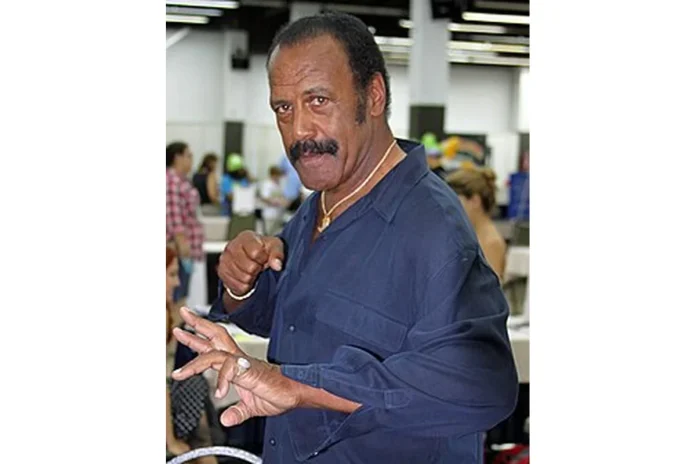
Fred Williamson Bio
Frederick Robert Williamson (born March 5, 1938), widely nicknamed The Hammer, is an American actor, filmmaker, and former professional football player. He built a reputation as a hard-hitting defensive back in the American Football League during the 1960s, starring for the Oakland Raiders and the Kansas City Chiefs. After leaving the sport in 1968, Williamson moved into acting and directing, becoming a recognizable figure in blaxploitation and action cinema in the 1970s. Over the following decades he produced dozens of films through his own company, Po’ Boy Productions, and remained active in front of the camera.
Early Life and Background
Frederick Robert Williamson was born on March 5, 1938, in Gary, Indiana, the only child of Frank Williamson, a welder, and Lydia Williamson. He grew up in the industrial city of Gary, an environment that would shape his tough, physical outlook on competition and performance. Williamson attended Froebel High School in Gary, where he lettered in both football and track and field, graduating in 1956.
His performances on the gridiron and on the track drew the attention of college recruiters, and after high school he left Gary to attend Northwestern University on a track and field scholarship. At Northwestern he also played college football for the Wildcats and earned a degree in architecture. His time at Northwestern marked the formal start of a dual identity as both an athlete and a thoughtful student of design and structure.
Path to Celebrity
Williamson first reached public attention on the football field, signing as an undrafted free agent with the San Francisco 49ers before being traded to the Pittsburgh Steelers. He played one season in the National Football League in 1960, then jumped to the new American Football League, where he joined the Oakland Raiders and became a three-time AFL All-Star in 1961, 1962, and 1963. With the Kansas City Chiefs, he served as a veteran leader and won an AFL Championship in 1966. Across eight professional seasons, he recorded 36 interceptions in 104 games and returned those picks for 479 yards and two touchdowns.
His aggressive, karate-influenced tackling style earned him the lasting nickname The Hammer after a coach told him to stop hammering his own teammates. That reputation for controlled violence carried over directly into his next career, when he retired from football in 1968 and began auditioning for film and television roles. Early guest spots included a part in the original Star Trek episode The Cloud Minders and a recurring role opposite Diahann Carroll on the sitcom Julia.
Fred Williamson Career
Early Career (1968-1971)
After retiring from the Kansas City Chiefs, Williamson made a string of guest and supporting roles on television and in films through the late 1960s and early 1970s. He transitioned into leading man status in 1972, when he starred as the title character in the blaxploitation Western The Legend of Nigger Charley, a performance he later reprised in two sequels. He also appeared in the action film Hammer that same year, drawing on his football nickname to brand himself on screen.
His early 1970s output also included the crime drama That Man Bolt in 1973, building a busy slate of action-driven features. In October 1973, Williamson posed nude for Playgirl magazine, a publicity move that pre-dated a similar appearance by his frequent co-star Jim Brown. These early years established Williamson as a marketable lead in Black action cinema and gave him the leverage to negotiate creative control over his own projects.
Breakthrough (1972-1979)
Williamson’s breakthrough arrived with the 1973 crime film Black Caesar, directed by Larry Cohen, in which he played the rising and ultimately tragic mob boss Tommy Gibbs. The film was a major commercial hit and turned Williamson into one of the most recognizable stars of the blaxploitation era. He immediately reprised the role in the sequel Hell Up in Harlem and went on to headline other 1970s genre staples such as Three the Hard Way (1974) and Bucktown (1975).
During this period Williamson also moved behind the camera, producing and starring in Boss Nigger (1975) and following it with Mean Johnny Barrows (1976), a violent Vietnam veteran story often cited as a predecessor to the Rambo films. He co-starred repeatedly with Jim Brown in titles like Three the Hard Way, Take a Hard Ride, One Down to Two to Go, and Original Gangstas, and began a long on-screen partnership with Bo Svenson in films such as The Inglorious Bastards (1978). In the middle of the decade, Williamson relocated to Rome, Italy, and founded Po’ Boy Productions, which produced action features including Adios Amigo (1976) and Death Journey (1976), both directed by and starring Williamson.
Notable Works and Milestones
Signature works from this era include Black Caesar (1973), The Legend of Nigger Charley (1972), Boss Nigger (1975), and Original Gangstas (1996), each of which showcased Williamson’s combination of physical authority and on-screen charisma. A brief but memorable career milestone came in 1974, when ABC hired Williamson as a color commentator on Monday Night Football, replacing Don Meredith, though his tenure on the broadcast ended quickly. Over the long arc of his career, Williamson has directed more than twenty feature films while continuing to act in both theatrical and direct-to-video releases.
Fred Williamson Award Nominations
Publicly verified award nominations tied directly to Fred Williamson’s career in entertainment are limited in the available records, and specific entertainment industry nominations cannot be confirmed at a high level of certainty from the supplied sources. As a result, detailed lists of nominations are not included here.
Fred Williamson Awards Won
Fred Williamson’s most clearly documented honors come from his professional football career rather than his film work. In 1966 he was part of the Kansas City Chiefs team that won the AFL Championship. He was also selected as an AFL All-Star three times, in 1961, 1962, and 1963, while playing for the Oakland Raiders.
| Award | Wins | Year |
|---|---|---|
| AFL Championship (Kansas City Chiefs) | 1 | 1966 |
| AFL All-Star (Oakland Raiders) | 3 | 1961, 1962, 1963 |
Fred Williamson Family
Fred Williamson was born in Gary, Indiana, as the only child of Frank Williamson, a welder, and Lydia Williamson. He has spoken over the years about the influence of his working-class upbringing in Gary on his competitive temperament and his approach to physical roles in sports and film. Public information about his parents remains limited to these basic details, both of which are well documented in biographical sources.
Personal Life
Williamson has been married twice. His first marriage was to Ginette Lavonda from 1960 until 1967. He later married Linda Williamson in 1988, and the couple has remained together since. Reports differ on the size of his family, with some sources listing three children and others listing at least six, and he has kept much of his personal life out of the public eye.
Since 1997, Williamson has had a home in Palm Springs, California, where he has spent significant time away from the film industry. Outside of his entertainment work, he has occasionally returned to public attention for non-career reasons, including a 2020 report in The Daily Beast that alleged he had attempted to grope an assistant costume designer during a wardrobe fitting, a charge he denied. Williamson has generally avoided discussing his private affairs in interviews, preferring to let his long filmography speak for itself.