
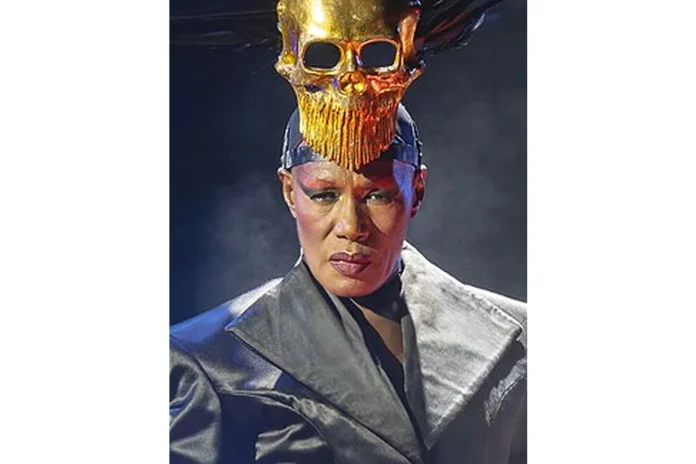
Grace Jones Bio
Grace Beverly Jones, born on 19 May 1948 in Spanish Town, Saint Catherine, Jamaica, is a Jamaican singer, songwriter, model, and actress known for her androgynous appearance, striking visuals, and genre-spanning music. She began as a successful fashion model in New York and Paris before launching a recording career in the late 1970s, becoming a disco icon and later transitioning to a pioneering new wave sound. Working frequently with artist Jean-Paul Goude and the Compass Point All Stars, she blended reggae, funk, post-punk, and art pop into a distinct style. Jones has also acted in films such as Conan the Destroyer and A View to a Kill, and remains an influential figure in music and fashion.
Early Life and Background
Grace Beverly Jones was born on 19 May 1948 in Spanish Town, Jamaica, to Marjorie (née Williams) and Robert W. Jones, a local politician and Apostolic clergyman. She has one brother, Noel Jones, who later became a megachurch preacher. After her parents moved to the United States, Jones and her siblings were left in Jamaica with her maternal grandmother and her new husband, a strict disciplinarian whose treatment she later described as serious abuse. She was raised in her family’s Pentecostal faith, attending the Pentecostal All Saints School before being sent to a nearby public school.
Marjorie and Robert eventually brought thirteen-year-old Grace to live with them in Lyncourt, Salina, New York, near Syracuse, where her father had established the Apostolic Church of Jesus Christ. She continued her schooling and after graduating, enrolled at Onondaga Community College majoring in Spanish. As she grew older, Jones began to rebel against her parents and their religion, wearing makeup, drinking alcohol, and visiting gay clubs with her brother. At college, a drama teacher convinced her to join a summer stock tour in Philadelphia, an experience that drew her toward performance and away from the discipline of her upbringing.
Arriving in Philadelphia, she decided to stay, immersing herself in the counterculture of the 1960s by living in hippie communes, earning money as a go-go dancer, and exploring new freedoms. She moved back to New York at eighteen and signed on as a model with Wilhelmina Models, later relocating to Paris in 1970 to pursue runway work and editorial fashion.
Path to Music
After establishing herself as a model, Jones transitioned into music in 1977, when she was signed by Island Records and placed in the studio with disco producer Tom Moulton at Sigma Sound Studios in Philadelphia. Her debut album, Portfolio, was released that year and featured covers of Broadway standards alongside club-oriented originals, including her first club hit, “I Need a Man.” The follow-up, Fame, arrived in 1978 and performed strongly on the North American club scene, with the “Do or Die” / “Pride” / “Fame” side reaching the top ten on the US Hot Dance Club Play and Canadian Dance/Urban charts.
Jones’s live shows during this period were highly sexualized and flamboyant, earning her the nickname “Queen of the Gay Discos.” Her third album, Muse, completed her disco trilogy before anti-disco sentiment spread across the music industry. With the aid of the Compass Point All Stars, including Sly and Robbie, she transitioned into a new wave sound, releasing Warm Leatherette in 1980 and redefining her artistic direction.
Grace Jones Career
Early Career (1970–1979)
Jones began her professional career in 1970 as a fashion model in Paris, working with designers such as Yves St. Laurent, Claude Montana, and Kenzo Takada, and appearing on the covers of Elle, Vogue Hommes, and Stern. Photographers Helmut Newton, Guy Bourdin, and Hans Feurer captured her striking features, helping her emerge as one of the most prominent Black models of the 1970s. She earned recognition for her androgynous appearance and bold features, and has been cited as influential in early discussions of gender expression.
Her recording career began in 1977 with the release of Portfolio, produced by Tom Moulton and released on Island Records. The album was followed by Fame in 1978 and Muse in 1979, the latter being the final album of her disco phase. During this period she was frequently described as “Disco Queen” in the press, with Jet magazine calling her “the greatest of them all” in 1979.
Breakthrough (1980–1985)
The 1980 release of Warm Leatherette marked Jones’s pivot to a new wave sound, blending reggae, funk, post-punk, and pop music with the Compass Point All Stars. The album included covers of songs by The Normal, The Pretenders, Roxy Music, and Tom Petty and the Heartbreakers, and set the template for her most acclaimed work. By 1981, she had begun collaborating with photographer and graphic designer Jean-Paul Goude, with whom she also had a personal relationship.
Nightclubbing, released in 1981, became her highest-charting album, entering the Top 5 in four countries. It included her famous cover of Iggy Pop and David Bowie’s “Nightclubbing,” as well as original co-writes such as “Pull Up to the Bumper.” The album claimed the number one slot on NME’s Album of the Year list, and Slant Magazine later ranked it among the Best Albums of the 1980s. While promoting the record, Jones famously slapped chat-show host Russell Harty live on air after he turned away to interview other guests.
Her 1982 album Living My Life, recorded in Nassau, Bahamas, concluded her Compass Point trilogy and produced the single “My Jamaican Guy.” During this era she also launched A One Man Show, a performance art and pop theatre presentation devised with Goude, whose video version earned a Grammy Award nomination for Best Long-Form Music Video. In 1984, Jones took on the role of Zula in Conan the Destroyer and was nominated for a Saturn Award for Best Supporting Actress. She followed this in 1985 with the role of May Day in the James Bond film A View to a Kill, earning another Saturn Award nomination for Best Supporting Actress.
Notable Works and Milestones
Jones’s signature works include Warm Leatherette (1980), Nightclubbing (1981), and Slave to the Rhythm (1985), the last of which was produced by Trevor Horn and Stephen Lipson. Her music has been widely discussed for its visual aspect, much of it created in collaboration with Jean-Paul Goude, and she has been cited as an influence on artists including Annie Lennox, Lady Gaga, Rihanna, and Janelle Monáe. She was ranked 82nd on VH1’s 100 Greatest Women of Rock and Roll in 1999.
Grace Jones Award Nominations
Throughout her career, Grace Jones has received several notable award nominations across music and film. Her video collection A One Man Show earned a nomination for Best Long-Form Music Video at the 26th Annual Grammy Awards. She was nominated for a Saturn Award for Best Supporting Actress for her role as Zula in Conan the Destroyer (1984), and received another Saturn Award nomination for her performance as May Day in A View to a Kill (1985). She was also nominated for a Golden Raspberry Award for Worst Supporting Actress for her role in the 1987 film Siesta.
Grace Jones Awards Won
Grace Jones has received recognition for her contributions to music and culture. In 2008, she was honoured with the Q Idol Award for her lasting influence on popular music. In October 2018, the Jamaican government awarded her the Order of Jamaica, one of the country’s highest national honours, in recognition of her distinguished contributions to the arts. Her album Nightclubbing was ranked number 40 on Slant Magazine’s list of Best Albums of the 1980s, and she has been included on numerous all-time lists celebrating her cultural impact.
Grace Jones Family
Grace Jones was born to Marjorie (née Williams) and Robert W. Jones, a local politician and Apostolic clergyman. Her brother, Noel Jones, is a megachurch preacher who appeared on the 2013 reality show Preachers of LA. Her maternal grandfather, John Williams, was also a musician who played with Nat King Cole. Through her relationship with longtime collaborator Jean-Paul Goude, Jones has one son, Paulo, born 12 November 1979. From Paulo, Jones has one granddaughter.
Personal Life
Jones was in a relationship with Jean-Paul Goude from 1977 to 1984, with whom she has her son Paulo. She later spent four years with Swedish actor Dolph Lundgren, her former bodyguard, who appeared as a KGB officer in A View to a Kill at her suggestion. She started dating Danish actor and stuntman Sven-Ole Thorsen in 1990, and the two were in an open relationship as of 2007. In 1996, Jones married Atila Altaunbay, a Muslim from Turkey. In her 2015 memoir I’ll Never Write My Memoirs, she disputed rumors that she had married anyone else, stating that Altaunbay was the only partner she ever wed.