
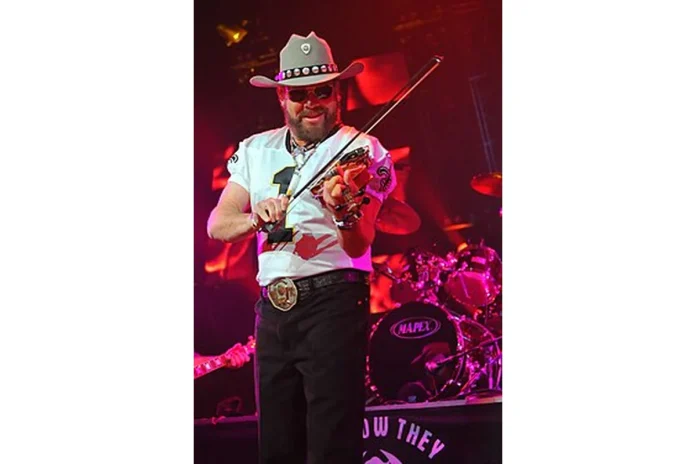
Hank Williams Jr. Bio
Randall Hank Williams (born May 26, 1949), known professionally as Hank Williams Jr. or by the nickname Bocephus, is an American singer-songwriter and musician. The son of country music legend Hank Williams, he began his career performing his father’s classic songs before carving out a distinctive sound that blends country, rock, and blues. A multi-instrumentalist, Williams rose to major stardom in the late 1970s and 1980s with a long run of hit albums and singles. He is also widely recognized for his signature beard, sunglasses, and cowboy hat, a look that emerged after a near-fatal mountain-climbing accident in 1975. Over the course of his career he has collected Grammy Awards, Emmy Awards, and Country Music Hall of Fame honors.
Early Life and Background
Randall Hank Williams was born on May 26, 1949, in Shreveport, Louisiana. His father, country music icon Hank Williams, gave him the childhood nickname Bocephus, inspired by a ventriloquist dummy used by Grand Ole Opry comedian Rod Brasfield. After his father’s death in 1953, young Randall was raised by his mother, Audrey Williams. Growing up in a house filled with music, he was taught various instruments and styles by a parade of visiting musicians, including Merle Haggard, Johnny Cash, Fats Domino, Earl Scruggs, Lightnin’ Hopkins, and Jerry Lee Lewis.
Williams first stepped onto a stage and sang his father’s songs when he was eight years old. He later attended John Overton High School in Nashville, Tennessee, where he frequently brought his guitar to class and performed for pep rallies and choir events. These early years, shaped by family legacy and the steady stream of country and blues talent passing through his home, laid the foundation for his career in music.
Path to Music
Hank Williams Jr. made his recording debut in 1964 with a cover of his father’s classic “Long Gone Lonesome Blues.” That same year, he provided the singing voice of his father in the 1964 film Your Cheatin’ Heart, and he also recorded an album of duets using archival recordings of Hank Williams. His first television appearance came in a December 1963 episode of The Ed Sullivan Show, when, at the age of fourteen, he sang several songs associated with his father. He followed that with a guest spot on the television series Shindig! in 1964.
For several years, Williams worked as a tribute to his father, covering Hank Williams Sr.’s songs and imitating his style. As he struggled to define his own voice, his sound slowly began to evolve. That evolution was interrupted on August 8, 1975, when a fall while climbing Ajax Peak in southwestern Montana nearly cost him his life. Williams spent two years in recovery, re-learning how to talk and sing and undergoing multiple surgeries to repair his skull and reconstruct his face. The experience, later dramatized in the made-for-television film Living Proof: The Hank Williams Jr. Story, redirected his career toward a bolder blend of country rock and outlaw country.
Hank Williams Jr. Career
Early Career (1964–1975)
Throughout the 1960s and early 1970s, Williams built a career largely as a “Hank Williams impersonator,” recording his father’s songs and earning a steady string of country hits. During this period, he also experimented with side projects, recording singles under aliases such as Luke the Drifter Jr., Rockin’ Randall, Bocephus, and Thunderhead Hawkins, exploring rock and roll and blues along the way. He released multiple albums, including Hank Williams Jr. and Friends in 1975, a project often considered a turning point in his development.
His early efforts earned him respect as a custodian of his father’s catalog, even as he grew increasingly determined to find his own musical identity. The move to Alabama, where he began collaborating with Southern rock and outlaw country musicians such as Waylon Jennings, Toy Caldwell, and Charlie Daniels, marked the final stretch of this formative era. The pivotal change in his sound and image came after the 1975 climbing accident, which he survived and used as a catalyst to fully reinvent himself.
Breakthrough (1976–1989)
Following his recovery, Hank Williams Jr. emerged with a fresh identity and a new musical direction, releasing a string of highly successful albums throughout the late 1970s and 1980s. Standout records from this era include Family Tradition, Whiskey Bent and Hell Bound, Habits Old and New, Rowdy, The Pressure Is On, High Notes, Strong Stuff, Man of Steel, Major Moves, Five-O, and Montana Cafe. Between 1979 and 1992, he released 21 albums, including 18 studio albums and three compilations, all of which were certified at least gold by the RIAA. In 1982, he placed nine original albums simultaneously on the Billboard Top Country Albums chart, a remarkable achievement.
Hits such as “Family Tradition,” “Whiskey Bent and Hell Bound,” “Old Habits,” “Ain’t Misbehavin’,” “Born to Boogie,” and “My Name Is Bocephus” repeatedly reached the top of the country charts. Between 1979 and 1990, he charted 30 Top Ten singles on the Billboard Country charts, including eight No. 1 hits, bringing his career total to 44 Top Ten singles, including 10 No. 1s. In 1987 and 1988, he was named Entertainer of the Year by the Country Music Association, and in 1987, 1988, and 1989 he received the same honor from the Academy of Country Music. His 1989 duet with his late father, “There’s a Tear in My Beer,” produced using electronic merging technology, won Video of the Year from both the CMA and ACM and earned him a Grammy Award in 1990 for Best Country Vocal Collaboration.
Notable Works and Milestones
One of Williams’ most iconic songs, “A Country Boy Can Survive,” became an enduring anthem of country identity, and in 2001 he reworked it as “America Can Survive” following the September 11 attacks. He is also widely known for performing the Monday Night Football theme, based on his 1984 hit “All My Rowdy Friends Are Coming Over Tonight,” a role that brought him four Emmy Awards in 1991, 1992, 1993, and 1994. The album Born to Boogie is widely regarded as the pinnacle of his commercial success.
Hank Williams Jr. Award Nominations
Hank Williams Jr. has earned multiple award nominations across country music’s most respected organizations, including the Country Music Association, the Academy of Country Music, and the Grammy Awards. His nominations reflect decades of chart success, industry recognition, and crossover appeal between country, rock, and blues. Beyond his wins, his consistent presence on annual nominee lists has cemented his standing as one of the most nominated figures in modern country music.
Hank Williams Jr. Awards Won
Hank Williams Jr. has collected a wide range of major industry honors throughout his career. He won the Grammy Award for Best Country Vocal Collaboration in 1990, two Country Music Association Entertainer of the Year awards in 1987 and 1988, and three consecutive Academy of Country Music Entertainer of the Year awards in 1987, 1988, and 1989. He also earned four Emmy Awards for his Monday Night Football opening themes between 1991 and 1994. In 2006, CMT honored him with the Johnny Cash Visionary Award, and in 2008 he was named a BMI Icon. He was inducted into the Louisiana Music Hall of Fame in 2015 and into the Country Music Hall of Fame in 2020.
Hank Williams Jr. Family
Hank Williams Jr. is the son of country music legend Hank Williams and his wife, Audrey Williams. He is the half-brother of Jett Williams. He is the father of five children, including musicians Hank Williams III (born Shelton Williams), Holly Williams, and Sam Williams, as well as his late daughter Katherine Williams-Dunning, who passed away in a car crash on June 13, 2020, at age 27. His grandson, Coleman Williams, performs under the name “IV” and continues the family’s musical tradition.
Personal Life
Hank Williams Jr. has been married five times. His first marriage to Sharon Martin lasted from 1969 to 1971, followed by his marriage to Gwen Yeargin from 1971 to 1977, and his marriage to Becky White from 1977 to 1983. He married Mary Jane Thomas in 1990; she died on March 22, 2022, at age 58, following complications from a medical procedure. On September 9, 2023, Williams married his longtime friend Brandi Williams, to whom he became engaged earlier that year on Mother’s Day. Beyond music, he is a registered Republican who has been politically active for decades and has supported numerous federal campaigns.