
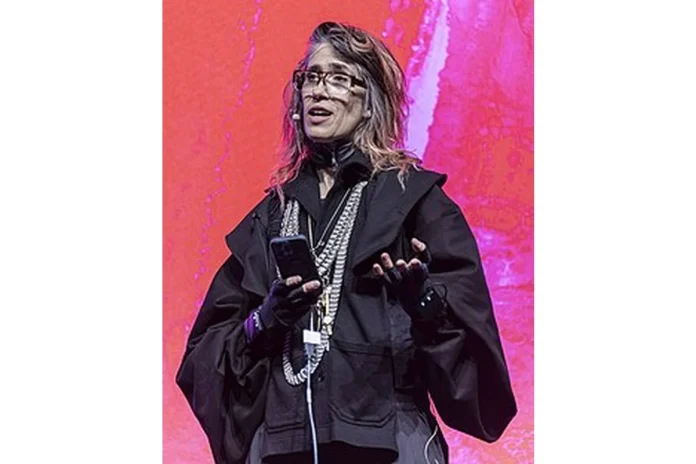
Imogen Heap Bio
Imogen Jennifer Jane Heap (born 9 December 1977) is an English musician, singer, songwriter, record producer, and entrepreneur widely regarded as a pioneer of electropop and music technology. She first attracted attention with her 1998 debut album I Megaphone and as one half of the electronic duo Frou Frou alongside Guy Sigsworth, before achieving solo success with Speak for Yourself (2005) and its international single “Hide and Seek.” Beyond recording, Heap has engineered and produced most of her own catalogue, developed the Mi.Mu musical gloves, launched the blockchain platform Mycelia, and composed music for the West End play Harry Potter and the Cursed Child.
Her career has earned recognition including Grammy Awards, an Ivor Novello Award, a Drama Desk Award, and an honorary doctorate from Berklee College of Music. Heap has also been cited as an influence by pop, hip-hop, and R&B artists ranging from Ariana Grande and Taylor Swift to Pentatonix and Clams Casino, and she remains an active figure in debates about artificial intelligence and the future of music.
Early Life and Background
Imogen Jennifer Jane Heap was born on 9 December 1977 in Romford, London, United Kingdom. She was named after British composer Imogen Holst because her mother, an art therapist, hoped she would become a cellist. Her father worked in construction rock retail, and her parents divorced when she was twelve. Her maternal great-grandfather is the Scottish painter James Paterson of the Glasgow Boys movement, while her sister, Juliet, worked as a town planner in London before her death in Patagonia in November 2019.
Heap grew up in the Round House, a Grade II* listed 18th-century elliptical home in Havering-atte-Bower near Romford that she later purchased from her father in 2006 and converted into a recording studio called the Hideaway. She was diagnosed with osteomyelitis in her left leg as a toddler and learned to play her mother’s piano at the age of two, later becoming classically trained in piano, cello, and clarinet. At around age ten she composed Christmas carols for her school choir, and by thirteen she had begun writing songs.
Heap attended Friends’ School, a Quaker-run boarding school in Saffron Walden, where her music teacher, exasperated by her behaviour, would send her to the school’s music technology room as punishment, where she taught herself sampling. She later taught herself Cubase on an Atari ST computer and, by fifteen, was recording her music on reel-to-reel tape and programming it on a home computer. She was eventually expelled after a confrontation with her matron but was kept on to perform at the end-of-year concert.
Path to Music
At sixteen, Heap enrolled at the BRIT School for Performing Arts & Technology in Croydon, where she first began singing and writing songs on a regular basis. Her recorded debut, “Missing You,” appeared on the BRIT School’s Class of 1994 album, and her performance at a school talent showcase brought her to the attention of manager Mickey Modern. Through Modern she was introduced to songwriter Nik Kershaw, recorded demos for Rondor Music, and at eighteen signed her first contract with independent label Almo Sounds.
In 1996, while still developing as a solo artist, Heap began working as a guest vocalist with British experimental pop band Acacia, whose members included her future collaborator Guy Sigsworth. Her first major live appearance came that same year at the Prince’s Trust Concert in Hyde Park, where she performed between sets by Eric Clapton and The Who, giving her a platform in front of tens of thousands of fans.
Heap’s earliest solo work appeared in 1997 with the single “Getting Scared,” which featured on the soundtrack for the horror film I Still Know What You Did Last Summer. The following year, aged twenty, she released her debut studio album I Megaphone on Almo Sounds. Although the record received radio play and toured the United States and Europe, Almo cut funding for her UK promotion and was soon absorbed by Universal, dropping Heap from the label.
Imogen Heap Career
Early Career (1995–2004)
After the commercial disappointment of I Megaphone, Heap collaborated with the British hip-hop group Urban Species on the 1998 single “Blanket,” which peaked at number 56 on the UK Singles Chart and became her first charting release. In 2000 she and producer Guy Sigsworth formed the electronic duo Frou Frou, releasing their sole studio album Details in July 2002. The duo’s song “Let Go” later found wide recognition after appearing on the soundtrack of Zach Braff’s 2004 film Garden State.
During this period Heap also recorded guest vocals for Jeff Beck’s 2001 album You Had It Coming, and in August 2004 she contributed a rendition of “I’m a Lonely Little Petunia” for HBO’s Six Feet Under, later included on the series’ second soundtrack album. Frou Frou were dropped by Island Records, and Heap declined a solo offer from the label, choosing instead to finance her next project independently.
Breakthrough (2005–2010)
To fund her second album, Heap remortgaged her flat in Waterloo and recorded, produced, mixed, and engineered Speak for Yourself almost entirely on her own, releasing it on her own Megaphonic Records in July 2005. Its lead single “Hide and Seek” gained momentum after being used in the season two finale of Fox’s The O.C., eventually earning gold certification in the United States and silver certification in the United Kingdom and going on to be sampled in Jason Derulo’s 2009 number-one hit “Whatcha Say.”
Heap followed Speak for Yourself with her third studio album, Ellipse, recorded in the basement of her childhood home and released in August 2009. The record debuted at number five on the Billboard 200, producing the single “First Train Home” and earning Heap the Grammy Award for Best Engineered Album, Non-Classical, making her only the second woman to receive the prize. In May 2010 she received the Ivor Novello Award for International Achievement.
During the Sparks era, Heap released a string of standalone singles including “Lifeline,” built from crowdsourced fan audio after the 2011 Tōhoku earthquake and tsunami, and “Telemiscommunications” with Deadmau5. Her fourth studio album, Sparks, arrived on 18 August 2014 through Megaphonic Records, debuting at number one on Billboard’s Dance/Electronic Albums chart and earning a Grammy nomination for Best Boxed or Special Limited Edition Package for its deluxe boxset.
Heap also co-wrote and produced the Taylor Swift song “Clean,” the closing track on Swift’s 2014 album 1989, which won Album of the Year at the 58th Grammy Awards. In October 2015 she unveiled “Tiny Human,” the first release through her blockchain platform Mycelia, while continuing to develop the Mi.Mu wired musical gloves she had first demonstrated at TEDGlobal in 2011.
Notable Works and Milestones
Heap’s signature recordings include I Megaphone (1998), Speak for Yourself (2005), Ellipse (2009), and Sparks (2014), as well as the international hit “Hide and Seek,” which has been certified gold in the United States and silver in the United Kingdom. Her composition for Harry Potter and the Cursed Child earned her a Drama Desk Award, and her production work on Taylor Swift’s “Clean” contributed to a Grammy-winning Album of the Year. She has also been recognised with an honorary doctorate from Berklee College of Music.
Imogen Heap Award Nominations
Throughout her career, Imogen Heap has received a range of nominations from major award bodies. At the 49th Annual Grammy Awards she earned two nominations for Ellipse, including Best Engineered Album, Non-Classical and Best Pop Instrumental Performance for “The Fire,” as well as a nomination for Best Song Written for Motion Picture, Television or Other Visual Media for her contribution to The Chronicles of Narnia: The Lion, the Witch and the Wardrobe soundtrack. Sparks received a Grammy nomination for Best Boxed or Special Limited Edition Package, and her work on Harry Potter and the Cursed Child was nominated for the Grammy Award for Best Musical Theater Album, the Laurence Olivier Award for Outstanding Achievement in Music, and the Outer Critics Circle Award for Outstanding New Score.
Imogen Heap Awards Won
Heap has been honoured with multiple awards across genres and disciplines. Her Grammy wins include Best Engineered Album, Non-Classical for Ellipse and Album of the Year as part of the production team for Taylor Swift’s 1989. She received the Ivor Novello Award for International Achievement in 2010 and, in 2018, the Inspiration Award at the Music Producers Guild Awards. For her composition work on Harry Potter and the Cursed Child she won the Drama Desk Award for Outstanding Music in a Play. Berklee College of Music has awarded her an honorary doctorate in recognition of her contributions to music and technology.
Imogen Heap Family
Heap was raised by parents who divorced when she was twelve; her mother worked as an art therapist and her father worked in construction rock retail. Her maternal great-grandfather is the Scottish painter James Paterson, a member of the Glasgow Boys art movement. Her brother also works in construction rocks, and her sister, Juliet, worked as a town planner in London before her death in November 2019 from injuries sustained in a cycling accident in Patagonia.
Personal Life
Imogen Heap began a relationship with film director Michael Lebor in 2012, and the couple welcomed a daughter, Scout, in November 2014. Heap was diagnosed with attention deficit hyperactivity disorder during the COVID-19 pandemic and, in 2025, publicly came out as pansexual. She lives in Havering-atte-Bower, London, where she continues to work from the Hideaway studio she built in the basement of the Round House.