
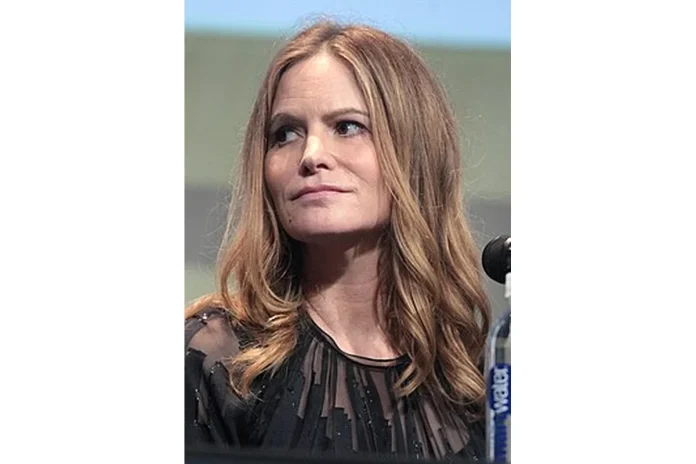
Jennifer Jason Leigh Bio
Jennifer Jason Leigh (born Jennifer Leigh Morrow; February 5, 1962) is an American actress, writer, and director whose career has spanned more than four decades across film, television, and stage. She first drew attention with a memorable role in the teen comedy Fast Times at Ridgemont High (1982) and went on to build a reputation for fearless, often intense performances in independent and mainstream productions. Over the years, she has earned Golden Globe, BAFTA, and Academy Award nominations, along with multiple critics’ prizes and a devoted following among directors who admire her willingness to take creative risks.
Leigh comes from a Hollywood family, the daughter of actor Vic Morrow and screenwriter Barbara Turner, and she grew up surrounded by the craft of storytelling. Beyond acting, she has co-written and co-directed a feature film and contributed voice work to acclaimed animated projects. She continues to balance big-screen dramas with character-driven television roles, including recent work on the FX series Fargo.
Early Life and Background
Jennifer Jason Leigh was born Jennifer Leigh Morrow on February 5, 1962, in Los Angeles, California. Her father, Vic Morrow, was an actor, and her mother, Barbara Turner, was a screenwriter who would later write the 1995 film Georgia for her. Leigh’s parents divorced when she was two, and film director Reza Badiyi later became her stepfather after marrying her mother. She is the younger of two daughters; her older sister, Carrie Ann Morrow, was credited as a technical advisor on Georgia and passed away in 2016, and Leigh also has a half-sister, actress Mina Badie.
Coming from a household where acting and writing were everyday conversations, Leigh gravitated toward performance at an early age. At fourteen, she attended acting workshops taught by Lee Strasberg and trained at the Stagedoor Manor Performing Arts Training Center in Loch Sheldrake, New York. She changed her professional name early in her career, taking the middle name Jason in honor of the actor Jason Robards, a family friend.
Leigh’s family had Jewish roots; her father’s family was from Russia and her mother’s family was from Austria. The entertainment world that surrounded her as a child, combined with her formal training in acting workshops, gave her a strong foundation before she ever stepped onto a professional set. This blend of family heritage and hands-on preparation would shape the thoughtful, risk-taking performer she became.
Path to Acting
Leigh’s first taste of working on set came with a nonspeaking role in the 1973 film Death of a Stranger (also released as The Execution), followed by a part in the 1978 film The Young Runaways. She also appeared in episodes of Baretta and The Waltons, gaining early experience in front of the camera. A 1981 television film, The Best Little Girl in the World, required her to portray an anorexic teenager, a role that demanded significant personal commitment and signaled her willingness to undergo physical transformation for a part.
Her first proper film role came in 1981, when she played a blind, deaf, and mute rape victim in the slasher film Eyes of a Stranger, a difficult part that she took on after leaving school. The following year, she was cast as Stacy Hamilton in Amy Heckerling’s Fast Times at Ridgemont High (1982), and the role became her true breakthrough. The film launched several young careers, and Leigh stood out among the cast.
Throughout the mid-1980s, Leigh built a résumé of edgy, often unsettling characters in low-budget thrillers and horror films, including Flesh and Blood (1985) with Rutger Hauer, The Hitcher (1986) opposite the same actor, the Southern Gothic Sister, Sister (1987), and Heart of Midnight (1989). These early projects established her as a performer drawn to fragile, damaged, or psychologically complex women, a niche that would eventually draw the attention of major critics and directors.
Jennifer Jason Leigh Career
Early Career (1976–1989)
Leigh’s earliest screen work, beginning in the late 1970s, was a mix of small television parts and television films. After her debut, she built a body of work playing vulnerable or troubled young women in horror and thriller productions, including Flesh and Blood, The Hitcher, Sister, Sister, and Heart of Midnight. In 1989, she was named one of America’s 10 Most Beautiful Women by Harper’s Bazaar, recognition that reflected her growing visibility just as more substantial dramatic roles were about to arrive.
Although Leigh did not take home major awards during this stretch, the period laid the groundwork for her later critical reputation. She developed a habit of immersing herself in demanding parts, and her choices signaled a performer more interested in artistic challenge than mainstream safety. By the end of the decade, she was ready for the breakthrough that would soon follow.
Breakthrough (1990–1999)
Leigh’s true breakthrough arrived in 1990, when she won the New York Film Critics Circle Award for Best Supporting Actress and the Boston Society of Film Critics Award for Best Supporting Actress for her work in Last Exit to Brooklyn (1989) and Miami Blues (1990). Reviewer Roger Ebert praised her bravery in Last Exit to Brooklyn, while Entertainment Weekly memorably dubbed her the Meryl Streep of bimbos, capturing her uncanny ability to find depth in characters others might dismiss.
She soon moved into larger studio films, including the firefighter drama Backdraft (1991) and the gritty crime drama Rush (1991), the latter drawing strong notices for her portrayal of an undercover officer who becomes addicted to drugs. Her role in the thriller Single White Female (1992) proved to be a surprise box-office hit and introduced her to a wider mainstream audience. In 1993, she won the MTV Movie Award for Best Villain for Last Exit to Brooklyn, a recognition that highlighted her flair for antagonistic characters.
The mid-1990s brought perhaps her most celebrated work. She played Dorothy Parker in Mrs. Parker and the Vicious Circle (1994), earning a Golden Globe Award nomination for Best Actress in a Motion Picture – Drama, and she won the New York Film Critics Circle Award for Best Actress and the Montreal World Film Festival Best Actress prize for Georgia (1995), a film written by her mother. Her willingness to lose weight and sing live for that role, dropping to 90 pounds, became part of her growing legend as a committed performer. During this decade she also collaborated with major directors including Robert Altman, the Coen Brothers, and David Cronenberg, building a résumé that mixed art-house daring with commercial reach.
Notable Works and Milestones
Signature works from this era include Fast Times at Ridgemont High, Last Exit to Brooklyn, Miami Blues, Single White Female, Mrs. Parker and the Vicious Circle, and Georgia. In 1993 she received a career tribute at the Telluride Film Festival, followed by a special award for her contribution to independent cinema from the Film Society of Lincoln Center in 2002 and a week-long retrospective of her film work held by the American Cinematheque in 2001.
Jennifer Jason Leigh Award Nominations
Jennifer Jason Leigh has earned nominations from many of the most respected awarding bodies in film. She was nominated for the Golden Globe Award for Best Actress in a Motion Picture – Drama for Mrs. Parker and the Vicious Circle in 1994, and she later received Golden Globe nominations for Best Supporting Actress for her work in The Hateful Eight. She was also nominated for the BAFTA Award for Best Actor in a Leading Role for Born on the Fourth of July in 1991, and for the Academy Award for Best Supporting Actress for The Hateful Eight in 2016, along with a BAFTA nomination for the same performance. In addition, she earned an Independent Spirit Award nomination for Georgia and a National Board of Review citation for Excellence in Filmmaking for The Anniversary Party.
Jennifer Jason Leigh Awards Won
Leigh’s career has been recognized with several major prizes. She won the MTV Movie Award for Best Villain in 1993 for her role in Last Exit to Brooklyn. She also received the New York Film Critics Circle Award for Best Supporting Actress for Last Exit to Brooklyn and Miami Blues, the Boston Society of Film Critics Award for Best Supporting Actress for the same pair of films, the New York Film Critics Circle Award for Best Actress for Georgia, and the Montreal World Film Festival Best Actress prize for Georgia. The Genie Award for Best Performance by an Actress in a Supporting Role followed in 2005 for her work in Childstar.
| Award | Wins | Year |
|---|---|---|
| MTV Movie Award for Best Villain (Last Exit to Brooklyn) | 1 | 1993 |
| New York Film Critics Circle Award for Best Supporting Actress (Last Exit to Brooklyn, Miami Blues) | 1 | 1990 |
| Boston Society of Film Critics Award for Best Supporting Actress (Last Exit to Brooklyn, Miami Blues) | 1 | 1990 |
| New York Film Critics Circle Award for Best Actress (Georgia) | 1 | 1995 |
| Montreal World Film Festival Best Actress (Georgia) | 1 | 1995 |
| Genie Award for Best Performance by an Actress in a Supporting Role (Childstar) | 1 | 2005 |
Jennifer Jason Leigh Family
Leigh was born into a creative Hollywood family. Her father, Vic Morrow, was an actor, and her mother, Barbara Turner, was a screenwriter who penned the 1995 film Georgia, in which Leigh starred. Her parents divorced when she was young, and director Reza Badiyi later became her stepfather. She has an older sister, Carrie Ann Morrow, who served as a technical advisor on Georgia, and a half-sister, actress Mina Badie, who has appeared alongside her in The Anniversary Party.
Personal Life
In 1982, Leigh’s father Vic Morrow died in a helicopter accident on the set of Twilight Zone: The Movie, a tragedy that deeply affected the family. Leigh and her sister filed a wrongful death lawsuit that was later settled out of court. She met writer-director Noah Baumbach in 2001 while performing on Broadway in Proof, and the two married on September 2, 2005. Their son was born on March 17, 2010. Leigh filed for divorce in November 2010, and the divorce was finalized in September 2013. She has described herself as shy, introverted, and uninterested in Hollywood publicity, preferring to let her work speak for itself.