
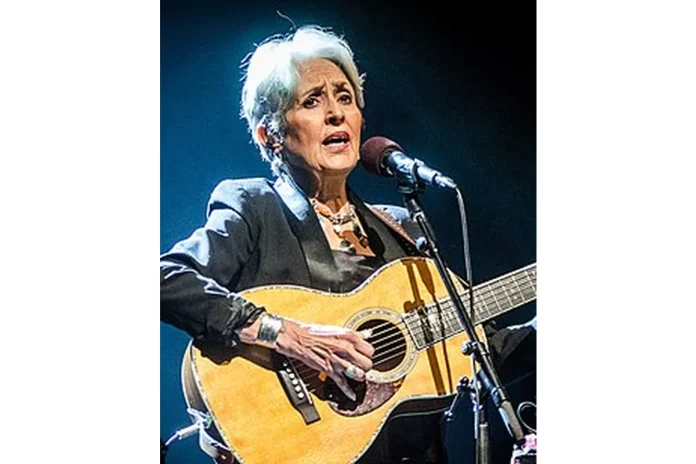
Joan Baez Bio
Joan Chandos Baez, born on January 9, 1941, in Staten Island, New York, is an American singer, songwriter, musician, and activist whose six-decade career has shaped the sound and conscience of contemporary folk music. She began performing publicly in the late 1950s, released her debut album in 1960, and has built a catalog of more than 30 albums. Baez is widely credited with helping to popularize the early work of Bob Dylan and has blended folk with folk rock, country, gospel, and Latin influences. Equally significant is her lifelong activism in civil rights, nonviolence, human rights, and environmental causes.
Early Life and Background
Joan Chandos Baez was born on January 9, 1941, in the Staten Island borough of New York City, the second of three sisters. Her father, Albert Baez, was born in Puebla, Mexico, and later earned a PhD in physics from Stanford University, where he was credited as a co-inventor of the X-ray microscope. Her mother, Joan Chandos Baez, was born in Edinburgh, Scotland, and claimed descent from the Dukes of Chandos. The family converted to Quakerism during Joan’s early childhood, a tradition that shaped her lifelong commitment to pacifism and social issues.
Because of her father’s work with UNESCO, the family moved often, living in towns across the United States as well as in England, France, Switzerland, Spain, Canada, and the Middle East, including Iraq. Growing up, Baez experienced racial slurs and discrimination because of her Mexican heritage, an experience that drew her toward social causes from an early age. She spent much of her formative youth in the San Francisco Bay area, where she graduated from Palo Alto High School in 1958, and during her senior year refused to take part in an air raid drill as her first act of civil disobedience.
Path to Music
When Baez was 13, her aunt took her to a concert by folk musician Pete Seeger, whose music moved her deeply and set her on a path toward folk performance. She soon learned his repertoire and began performing publicly, with one of her earliest appearances taking place at a youth retreat in Saratoga, California. By 1957 she had bought her first Gibson acoustic guitar, and a year later, after her family relocated to Boston, she began performing in the city’s vibrant folk clubs and nearby Cambridge.
Baez briefly attended Boston University before committing to music full-time, and she gave her first concert at the legendary Club 47 in Cambridge. In 1958 she recorded a compilation called Folksingers ‘Round Harvard Square for the small Veritas Records label, and the following year Bob Gibson invited her to duet with him at the 1959 Newport Folk Festival. That performance, in which she was praised as the barefoot Madonna with an otherworldly voice, led to a contract with Vanguard Records and the start of her professional career.
Joan Baez Career
Early Career (1959-1964)
Joan Chandos Baez made her recording debut with Joan Baez in 1960, an album produced by Fred Hellerman of The Weavers and recorded in just four days at the Manhattan Towers Hotel in New York City. The record featured traditional folk ballads and blues sung in her own guitar accompaniment, including a Spanish-language track she would later re-record. Her second album, Joan Baez, Vol. 2 (1961), reached gold status, as did Joan Baez in Concert, Part 1 (1962) and Part 2 (1963), the latter of which contained her first Bob Dylan cover.
On November 23, 1962, Baez appeared on the cover of Time Magazine, a rare honor for a musician at that time. In 1963 she performed We Shall Overcome at the March on Washington for Jobs and Freedom, a moment that permanently linked her to the civil rights anthem. She also founded the Institute for the Study of Nonviolence with her mentor Ira Sandperl and published her first memoir, Daybreak, in 1968.
Breakthrough (1965-1980)
From the mid-1960s on, Joan Chandos Baez stood at the forefront of the American roots revival, introducing her audiences to the then-unknown Bob Dylan and inspiring artists such as Judy Collins, Emmylou Harris, Joni Mitchell, and Bonnie Raitt. Her 1965 single There but for Fortune, a Phil Ochs cover, became a chart hit in the United States and Canada and a top-ten single in the United Kingdom. Albums such as Farewell, Angelina (1965) and her Nashville-recorded David’s Album (1969) demonstrated her willingness to experiment with country and folk rock.
Her profile continued to grow with appearances at the 1965 Selma to Montgomery marches, the 1969 Woodstock Festival, and high-profile collaborations with Bob Dylan on the Rolling Thunder Revue in 1975-76. In 1971 she left Vanguard after eleven years and recorded for A&M, releasing the gold-selling Blessed Are… and the highest-selling album of her career, Diamonds & Rust (1975), which featured her own songwriting as well as covers of work by the Band and others.
Notable Works and Milestones
Joan Chandos Baez’s signature works include her self-titled debut Joan Baez (1960), the Spanish-language Gracias a la Vida (1974), Diamonds & Rust (1975), and her landmark cover of Phil Ochs’s There but for Fortune (1965). Of her fourteen Vanguard albums, thirteen reached the top 100 of Billboard’s pop chart, four of them the top ten. In 2023 Rolling Stone ranked her at number 189 on its list of the 200 Greatest Singers of All Time.
Joan Baez Award Nominations
Joan Chandos Baez’s recording career earned her a steady stream of Grammy recognition over the decades. Her 2018 studio album Whistle Down the Wind was nominated for a Grammy Award, and her early live and studio albums contributed to a long relationship with the Recording Academy that culminated in a Lifetime Achievement honor.
Joan Baez Awards Won
Joan Chandos Baez has received a wide range of honors for her music and her activism. She was presented with the John Steinbeck Award in 2003 for her civil rights work, received the Grammy Lifetime Achievement Award in 2007, and was honored with the Spirit of Americana/Free Speech Award at the 2008 Americana Music Honors and Awards. In 2011 she was the inaugural recipient of the Amnesty International Joan Baez Award for Outstanding Inspirational Service in the Global Fight for Human Rights, and in 2015 she shared the Amnesty International Ambassador of Conscience Award with Ai Wei Wei.
She was inducted into the Rock and Roll Hall of Fame on April 7, 2017, elected to the American Academy of Arts and Sciences in 2020, and recognized as part of the 43rd Kennedy Center Honors in May 2021. In 2024 the President of Slovakia, Zuzana Čaputová, awarded her the Third Class of the Order of the White Double Cross.
| Award | Wins | Year |
|---|---|---|
| John Steinbeck Award | 1 | 2003 |
| Grammy Lifetime Achievement Award | 1 | 2007 |
| Amnesty International Ambassador of Conscience | 1 | 2015 |
| Rock and Roll Hall of Fame | 1 | 2017 |
| American Academy of Arts and Sciences Fellowship | 1 | 2020 |
| Kennedy Center Honors | 1 | 2021 |
| Order of the White Double Cross, Third Class | 1 | 2024 |
Joan Baez Family
Joan Chandos Baez was one of three sisters who were all political activists and musicians. Her older sister was Pauline Thalia Baez Bryan, known later as Pauline Marden, and her younger sister was Margarita Mimi Baez Fariña, better known as Mimi Fariña, who died in 2001. Her father Albert Baez died in 2007, and her mother Joan Chandos Baez died on April 20, 2013, at the age of 100.
Personal Life
Joan Chandos Baez married anti-war activist David Harris on March 26, 1968, in New York City, with Judy Collins singing at the ceremony. The couple had a son, Gabriel, born on December 2, 1969, and they divorced amicably in 1973 after Harris served fifteen months in prison for draft resistance. Gabriel is a drummer who has occasionally toured with his mother and has a daughter, Jasmine, who sang with Joan Baez at Kidztock in 2010. Baez, who dated Apple Computer co-founder Steve Jobs in the early 1980s, has lived in Woodside, California, where she shared a home with her mother until the latter’s death in 2013.