
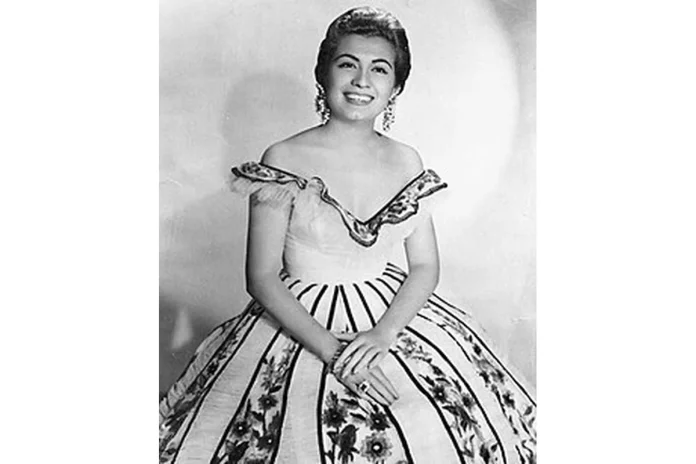
Lola Beltrán Bio
María Lucila “Lola” Beltrán Ruiz (7 March 1932 – 24 March 1996) was a Mexican singer, actress, and television presenter celebrated as one of the foremost interpreters of ranchera and huapango music. Nicknamed Lola la Grande, she became internationally renowned for her renditions of “Cucurrucucú paloma” and “Paloma Negra” and worked with artists including Amalia Mendoza, Juan Gabriel, and Lucha Villa. After moving to Mexico City, she began performing on radio station XEW and later hosted her own television programs. Over a career that began in 1940, she recorded about one hundred albums, appeared in roughly fifty films, and became the first ranchera singer to perform at the Palacio de Bellas Artes.
Early Life and Background
María Lucila Beltrán Ruiz was born on 7 March 1932 in the small town of El Rosario, Sinaloa, Mexico, where she received her early schooling from Carmelite nuns. Her mother enjoyed singing, and her father managed a mine, giving the young Beltrán a household environment where music was part of daily life. She was intrigued by ballads and by the singing she heard in church, and she began entering local singing competitions while still a young woman.
In addition to her musical interests, Beltrán completed secretarial studies during her formative years, a skill set that would later help her secure her first position in the entertainment industry. She eventually left El Rosario with her mother and moved to Mexico City in search of a career as a performer. The decision to relocate marked a decisive turning point in her life and set the stage for her remarkable rise within Mexican popular music.
Path to Singing
After settling in Mexico City, Beltrán found work as a secretary at the influential Mexican radio station XEW. She repeatedly asked the station for a chance to sing, and her persistence was rewarded when the staff and listeners responded enthusiastically to her voice. Within roughly a year, she had her own radio show on the station, an early sign of the connection she would build with audiences throughout Latin America and beyond.
It was at XEW that Beltrán met the songwriter Tomás Méndez, who composed songs for her, including the international hits “Cucurrucucú paloma” and “Tres Días.” These recordings helped establish her as a leading voice in regional Mexican music. Her growing reputation on radio opened the door to film work, and she made her screen debut in 1954 with El Tesoro de la Muerte, beginning a parallel career in Mexican cinema.
Lola Beltrán Career
Early Career (1940s–1950s)
According to available records, Lola Beltrán’s career began in 1940, and she is credited with a film appearance that same year in the Argentine production El cantor del circo. Her first clearly documented Mexican film role came in 1954 with El Tesoro de la Muerte, after which she appeared in dozens of films, most of them musicals. Her early work in radio, recording, and film quickly established her as a versatile entertainer with a powerful stage presence.
During this period she also began performing before foreign heads of state, including French President Charles de Gaulle, building an international profile that few ranchera artists of her era could match. She sang at major venues such as the Olympia Music Hall in Paris, the Tchaikovsky Hall in Moscow, and the Conservatory of Leningrad in the former Soviet Union. These appearances helped carry Mexican ranchera and huapango music to audiences well beyond the country’s borders.
Breakthrough (1960s–1980s)
By the early 1960s, Lola Beltrán had become a major star of Mexican cinema, sharing credits with leading performers such as Emilio Fernández, Ignacio López Tarso, Katy Jurado, María Félix, and Pedro Armendáriz in La Bandida (1962). She was also the first ranchera singer to perform at the Palacio de Bellas Artes, the country’s premier opera house and concert hall, an honor that signaled her arrival at the very top of the Mexican music world.
She expanded into television as a presenter, hosting Noches tapatías in 1976 and her own program El estudio de Lola Beltrán in 1984. These shows featured guest appearances by major figures of regional Mexican music, including Cornelio Reyna, Juan Gabriel, Lucha Villa, La Prieta Linda, and Luis Miguel. Her song “Soy infeliz” was also chosen as the opening music for Pedro Almodóvar’s film Women on the Verge of a Nervous Breakdown, introducing her voice to global cinema audiences.
Notable Works and Milestones
Lola Beltrán’s signature recordings include “Cucurrucucú paloma” and “Paloma Negra,” both of which remain standards of the ranchera repertoire. Among her most recognized screen appearances are La Bandida (1962) and the later film Una gallina muy ponedora (1982), her last film credit, in which she appeared with Columba Domínguez. Her milestone achievements include becoming the first ranchera singer to perform at the Palacio de Bellas Artes, singing for world leaders such as Queen Elizabeth II and several American Presidents, and being honored in 1995 with a Mexican commemorative postage stamp as part of a series recognizing “Popular Idols of Radio.”
Lola Beltrán Award Nominations
Detailed public records of formal award nominations received by Lola Beltrán across her decades-long career in music, film, and television are not available in the verified sources reviewed for this page. As a result, a summary of nominations cannot be presented with confidence and has been omitted.
Lola Beltrán Awards Won
The most clearly documented honor bestowed upon Lola Beltrán during her lifetime was her inclusion in 1995 in a series of commemorative postage stamps issued by the Mexican government under the theme “Popular Idols of Radio.” This recognition acknowledged her lifetime achievement in popular music and her role in spreading an appreciation of Mexican culture around the world. Beyond this tribute, additional verified award wins are not available in the sources reviewed, and any further figures would amount to speculation.
Lola Beltrán Family
Lola Beltrán was married to the matador and film actor Alfredo Leal Kuri, with whom she had a daughter, the singer María Elena Leal Beltrán. Her own upbringing in El Rosario, Sinaloa, was shaped by a mother who enjoyed singing and a father who managed a mine, a family environment that helped nurture her early interest in music. She later made Mexico City her home, where she raised her daughter and built much of her professional life.
Personal Life
After establishing herself in Mexico City, Lola Beltrán lived there for most of her adult life, including during the height of her career as a singer, actress, and television presenter. Her marriage to Alfredo Leal Kuri produced her daughter, María Elena Leal Beltrán, who followed her mother into the music industry. On 24 March 1996, shortly after recording Disco del Siglo with Lucha Villa and Amalia Mendoza, a project produced by Juan Gabriel, Beltrán died of a pulmonary embolism at Hospital Ángeles in Mexico City. Her body was laid on display in the rotunda of the Palacio de Bellas Artes in honor of her cultural importance, and she rests in the Church of Our Lady of the Rosary.