
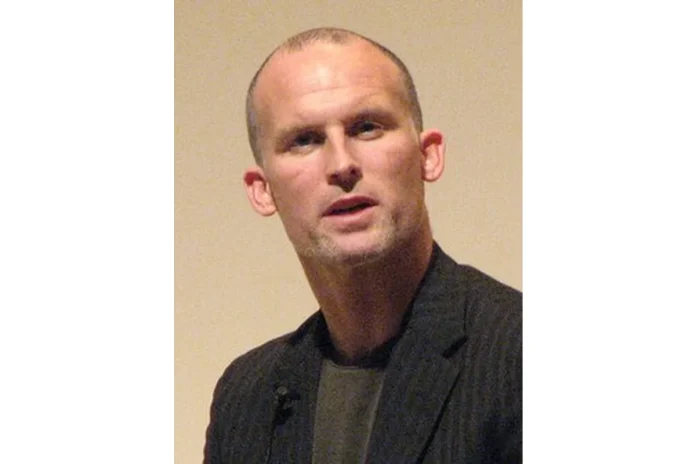
Matthew Barney Bio
Matthew Barney (born March 25, 1967) is an American contemporary artist and film director who builds ambitious projects that combine sculpture, film, photography, and drawing. His work often connects geography, biology, geology, and mythology while exploring themes of sex, the human body, and conflict. He is widely recognized for The Cremaster Cycle, a five-part film project created between 1994 and 2002 that critics have described as one of the most imaginative achievements in avant-garde cinema. Matthew Barney continues to produce large-scale works that blur the boundaries between visual art, performance, and cinema.
Early Life and Background
Matthew Barney was born on March 25, 1967, in San Francisco, California, where he lived until the age of seven. He then moved with his family to Boise, Idaho, where his father took a job administering a catering service at Boise State University. He attended elementary, middle, and high school in Boise, and during this period his parents divorced. His mother, an abstract painter, relocated to New York City, and Barney would visit her there, an experience that introduced him to the art scene at a young age. These early years in San Francisco and Boise, along with exposure to his mother’s painting practice, helped shape his lifelong interest in materials, landscape, and the body.
Barney was recruited to Yale University in 1985, originally to play football, and he planned to study pre-med before focusing on art. He graduated from Yale in 1989, and his earliest works were staged at the university’s Payne Whitney Gymnasium. These student pieces combined physical exertion with sculptural and video elements, laying the foundation for his later Drawing Restraint series and his ongoing interest in athletics as a creative framework.
Path to Director
After graduating from Yale, Matthew Barney moved to New York City in the early 1990s and worked for a time as a catalog model, a job that helped him finance his early sculptures, videos, and performances. His solo debut in 1991 at the Barbara Gladstone Gallery in New York was praised by The New York Times as an extraordinary first show, and that same year he held a solo exhibition at the San Francisco Museum of Modern Art at the age of twenty-four. He was soon included in important international exhibitions, including documenta 9 in Kassel in 1992 and the Whitney Biennial in 1993 and 1995.
In 1993, Barney was awarded the Aperto Prize (also referred to as the Europa 2000 Prize) at the 48th Venice Biennale, an early sign of his rising stature in the international art world. These formative years in New York allowed him to develop the cinematic and sculptural vocabulary that would lead directly to The Cremaster Cycle, his first major statement as a film director. By the mid-1990s, Matthew Barney was being treated by museums and critics as a leading figure in contemporary art, and his transition from gallery-based artist to feature filmmaker was already underway.
Matthew Barney Career
Early Career (1990-1993)
Matthew Barney’s early career began with sculptural installations combined with performance and video. His Drawing Restraint series, started at Yale in 1987, explored the idea that growth occurs through resistance, with the body restrained while attempting to make a drawing. Drawing Restraint 1 through 6 were documented through video and photography, and Drawing Restraint 7, a three-channel video accompanied by drawings and photographs, brought narrative and characterization into the project.
This early phase culminated in Drawing Restraint 7 being shown at the 1993 Venice Biennale, where Matthew Barney won the Aperto Prize. During this period he also staged his first major solo exhibitions in New York and San Francisco and began showing in influential group exhibitions in Europe. These achievements established him as one of the most talked-about young American artists of the 1990s.
Breakthrough (1994-2002)
The breakthrough for Matthew Barney came with The Cremaster Cycle, a self-enclosed aesthetic system of five feature-length films created between 1994 and 2002. The project unfolded not only as cinema but also through related photographs, drawings, sculptures, and installations, with composer Jonathan Bepler producing and arranging the soundtracks. The films draw on biology, biography, mythology, and geology, using the male cremaster muscle as a conceptual departure point.
The Cremaster Cycle was widely exhibited by major museums, with the Solomon R. Guggenheim Museum organizing a full exhibition that premiered at the Museum Ludwig in Cologne in June 2002 before traveling to the Musée d’Art Moderne de la Ville de Paris and the Guggenheim Museum in New York. Jonathan Jones of The Guardian described the cycle as one of the most imaginative and brilliant achievements in the history of avant-garde cinema. By the end of this period, Matthew Barney was firmly established as a major interdisciplinary artist and director.
Notable Works and Milestones
Matthew Barney’s signature achievement is The Cremaster Cycle, a five-film project that expanded the possibilities of art cinema. He received the Hugo Boss Prize, a major recognition of his contribution to contemporary art, and the Europa 2000 Prize at the 1993 Venice Biennale for Drawing Restraint 7. His later films Drawing Restraint 9 (2005), River of Fundament (2014), and Redoubt (2018) extended this ambitious, multi-part approach into new settings and collaborations.
Matthew Barney Award Nominations
Publicly verified nomination records for Matthew Barney are limited, and no detailed tally of nominations across his career can be confirmed from the available sources. As a result, a complete summary of award nominations cannot be presented with full certainty.
Matthew Barney Awards Won
Matthew Barney has received several important awards in recognition of his work in contemporary art and film. He was awarded the Aperto Prize at the 1993 Venice Biennale for Drawing Restraint 7, a prize also referred to as the Europa 2000 Prize. He later received the Hugo Boss Prize, honoring his wider contribution to contemporary art. These honors reflect his standing within both the museum world and the international art community.
| Award | Wins | Year |
|---|---|---|
| Aperto Prize (Europa 2000 Prize), Venice Biennale | 1 | 1993 |
| Hugo Boss Prize | 1 | — |
Matthew Barney Family
Matthew Barney was raised in a household shaped by art and mobility. His father worked in food service administration at Boise State University, while his mother was an abstract painter whose practice introduced him to the art world during visits to New York City. His parents divorced when he was young, and his mother’s relocation to New York gave him an early window into the city’s gallery and museum scene.
Personal Life
In the late 1990s, Matthew Barney met Icelandic musician Björk in the New York art scene, and the two began a relationship. They moved to a penthouse co-op in Brooklyn Heights in 2000, and their daughter was born in 2002. The couple collaborated on the film Drawing Restraint 9, released in 2005, in which Björk acted and contributed musical elements. By September 2013, Barney and Björk had separated, a breakup that Björk later addressed on her 2015 album Vulnicura. Matthew Barney has maintained a studio in Long Island City, Queens, where he continues to develop new projects.