
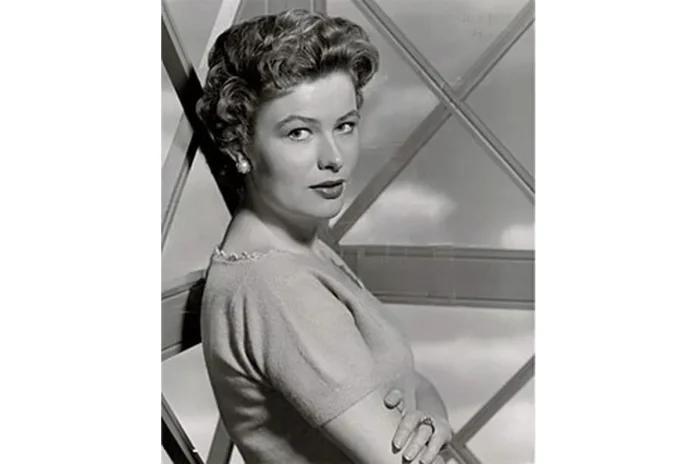
Nancy Olson Bio
Nancy Ann Olson (born July 14, 1928) is an American retired actress whose career spanned more than three decades of postwar Hollywood. She earned her place in film history as Betty Schaefer in the classic Sunset Boulevard (1950), a performance that brought her an Academy Award nomination for Best Supporting Actress. Over the years, she worked alongside leading men such as William Holden, Fred MacMurray, and Glenn Ford, balancing dramatic features with the lighter family entertainment offered by the Walt Disney studio. Olson retired from acting in the mid-1980s, although she has made a small number of brief returns, most recently in 2014. In 2022, she published a memoir titled A Front Row Seat: An Intimate Look at Broadway, Hollywood, and the Age of Glamour.
Born in Milwaukee, Wisconsin, Olson came from a family of Scandinavian heritage, with a Swedish mother and a Norwegian father. After beginning her education in Milwaukee, she later attended the University of Wisconsin before transferring to the University of California, Los Angeles, where a stage performance caught the eye of a talent scout. That discovery launched a film career that would take her from early supporting parts at Paramount Pictures to leading roles in some of the most memorable productions of the 1950s and 1960s.
Early Life and Background
Nancy Ann Olson was born on July 14, 1928, in Milwaukee, Wisconsin, and was raised in the same city alongside her brother, David. Her mother, Evelyn Bertha Bergstrom, was of Swedish descent, while her father, Henry John Olson, was a physician of Norwegian descent. The family environment gave Olson a stable Midwestern upbringing that grounded her even as her future career would carry her far beyond Wisconsin.
Olson completed her elementary and secondary education in Milwaukee public schools. When her family later moved to California, she transferred to the University of California, Los Angeles, after spending a year at the University of Wisconsin. At UCLA, her performance in a campus play caught the attention of a Paramount Pictures talent scout who had come to evaluate the male lead. That single audition would change the direction of her life and open the door to a Hollywood contract.
The combination of a disciplined education and an unexpected break at UCLA set the stage for Olson’s entry into the film industry. Her Midwestern values, paired with the professional training she received through university theater, helped shape the screen presence that would soon earn her a place in classic American cinema.
Path to Acting
Olson was signed to a film contract by Paramount Pictures in 1948, beginning her professional career in the late 1940s. After a series of supporting roles, studio producers began to consider her for more prominent parts. She was briefly considered for the role of Delilah in Cecil B. DeMille’s Samson and Delilah (1949), though she later reflected that the part was not the right fit, and Hedy Lamarr was ultimately cast. Despite this early near-miss, the experience confirmed that Olson was being noticed by some of the most influential filmmakers of the era.
Her first significant role came in the Western Canadian Pacific (1949), co-starring Randolph Scott. Director Billy Wilder then cast her in his upcoming project, Sunset Boulevard (1950), in which she played the optimistic young writer Betty Schaefer opposite William Holden’s doomed screenwriter. The film became one of the most acclaimed productions of the decade, and Olson’s performance earned widespread praise. Her on-screen pairing with William Holden was considered a triumph, leading the studio to place them together in three more films: Union Station (1950), Force of Arms (1951), and Submarine Command (1951). Her growing profile also led to a guest appearance on the radio program Dimension X in the September 15, 1950, episode titled “Hello Tomorrow.”
Nancy Olson Career
Early Career (1948–1950)
Olson’s earliest professional work consisted of supporting assignments at Paramount Pictures following her 1948 contract. As she gained confidence on set, she earned the role of Betty Schaefer in Sunset Boulevard (1950), which proved to be her breakthrough. The performance brought her an Academy Award nomination for Best Supporting Actress and immediately established her as one of the most promising new actresses in Hollywood.
During this period, she also appeared in Union Station (1950), a thriller that reunited her with William Holden and helped solidify her reputation as a dependable leading lady. These early films demonstrated her range, from the sharp intelligence of Betty Schaefer to the dramatic tension of crime-driven storytelling.
Breakthrough (1950–1955)
The success of Sunset Boulevard marked the true turning point of Olson’s career. Her subsequent films for Warner Bros., including Big Jim McLain (1952) with John Wayne, So Big (1953), and Battle Cry (1955), showcased her ability to move between genres with ease. She was particularly effective in socially conscious material, such as Battle Cry, which dealt with the experiences of Marines during World War II.
Olson’s pairing with William Holden in Union Station, Force of Arms, and Submarine Command between 1950 and 1951, while not repeating the success of Sunset Boulevard, demonstrated her consistent appeal as a romantic lead. By the mid-1950s, she had become a recognizable face in postwar American cinema, with credits spanning noir, Westerns, and wartime drama.
Notable Works and Milestones
Olson’s most enduring signature work remains Sunset Boulevard, a film widely regarded as one of the greatest American productions of the twentieth century. Her nomination for Best Supporting Actress at the Academy Awards remains the defining honor of her career. She is also remembered for her popular Disney work in The Absent-Minded Professor (1961) and Son of Flubber (1963), as well as her touching performance as the mother in Pollyanna (1960). Additional credits such as Airport 1975 (1974), Smith! (1969), and Snowball Express (1972) reflect a long and varied filmography that bridged classic Hollywood and the New Hollywood era.
Nancy Olson Award Nominations
Nancy Olson received one Academy Award nomination during her career, for Best Supporting Actress in recognition of her performance as Betty Schaefer in Sunset Boulevard (1950). The nomination came early in her career and remains the most prominent award recognition she has received for her film work.
Nancy Olson Awards Won
No major competitive acting awards are listed among Nancy Olson’s verified honors. Her legacy rests on her body of work and the lasting critical regard afforded to her most celebrated performances, particularly her role in Sunset Boulevard.
Nancy Olson Family
Nancy Ann Olson was born to Henry John Olson, a physician, and Evelyn Bertha Bergstrom, both of Scandinavian descent. She grew up in Milwaukee alongside her brother, David, before her family later relocated to California. In 1950, she became the third wife of lyricist Alan Jay Lerner; the couple had two daughters, Liza and Jennifer, before divorcing in 1957. In 1962, she married Alan W. Livingston, the longtime Capitol Records executive best known for creating Bozo the Clown and for signing The Beatles, Frank Sinatra, and Judy Garland to the label. With Livingston, she had one son, Christopher.
Personal Life
Olson’s personal life has been shaped by two long marriages. Her first marriage to Alan Jay Lerner lasted from 1950 to 1957 and produced two daughters, Liza Lerner and Jennifer Lerner. She later married Alan W. Livingston in 1962, and the couple remained together until his death in 2009. They had one son, Christopher Livingston. Throughout her life, she has balanced the demands of a Hollywood career with a strong family foundation, and her memoir, A Front Row Seat, offers an intimate reflection on her years in entertainment and family life.