
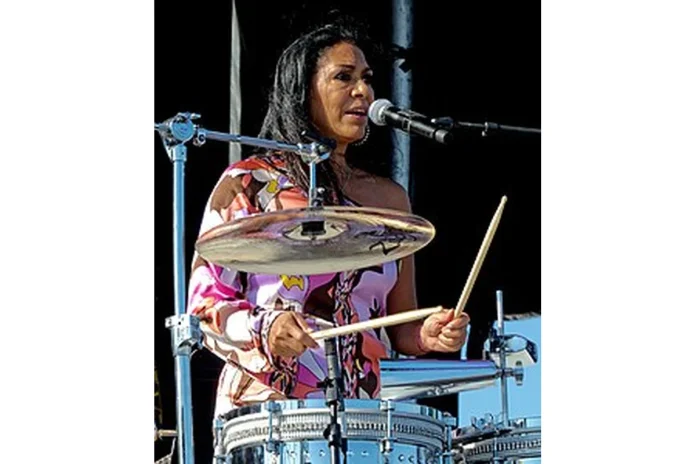
Sheila E. Bio
Sheila Cecilia Escovedo, known professionally as Sheila E., is an American singer, songwriter, percussionist and multi-instrumentalist from Oakland, California. Born on December 12, 1957, she has been professionally active since 1976 and is often referred to as the “Queen of Percussion.” She rose to mainstream fame with her 1984 debut solo album The Glamorous Life, which produced international hits including “The Glamorous Life” and “The Belle of St. Mark.” Over a career spanning nearly five decades, she has built a reputation as one of the most influential female drummers and percussionists in popular music.
Beyond her work as a performer, Sheila E. is also a record producer and actress whose catalog spans R&B, funk, pop, Latin and jazz. She is widely recognized for her long creative partnership with Prince, who produced her early solo work, and for her frequent collaborations with artists such as Herbie Hancock, Marvin Gaye, Ringo Starr and Hans Zimmer. Her work has earned her a Latin Grammy Lifetime Achievement Award, a star on the Hollywood Walk of Fame, and a Grammy Award for Best Global Music Performance.
Early Life and Background
Sheila Cecilia Escovedo was born on December 12, 1957, in Oakland, California. She is the daughter of Juanita Gardere, a dairy factory worker of Creole-French and African descent, and percussionist Pete Escovedo, who is of Mexican-American origin. Raised in a Catholic household, she grew up surrounded by music thanks to her father’s active career as a professional percussionist.
Pete Escovedo often brought his daughter to performances, and she frequently appeared alongside him on stage from a very young age. Her godfather was the legendary percussionist Tito Puente, and her family included several professional musicians, including her uncle Coke Escovedo, who played with Santana and the band Azteca. Other Escovedo relatives include Javier Escovedo, founder of the San Diego punk act the Zeros, and Alejandro Escovedo, founder of the San Francisco-based punk band the Nuns. Her brother, Peter Michael Escovedo, is also a musician, and his daughter is the media personality Nicole Richie.
Growing up in the Bay Area’s vibrant music scene gave Sheila E. early and constant exposure to live performance, Latin jazz, funk and R&B. This environment shaped her sense of rhythm and stagecraft and laid the foundation for her future career as one of the leading percussionists of her generation.
Path to Music
Sheila E. began her professional music career in 1976 as a percussionist with the George Duke Band, a position she held until 1980. During this period, she appeared on several of the band’s studio recordings, including Don’t Let Go, Follow the Rainbow, Master of the Game, and A Brazilian Love Affair. In 1977, she and her father Pete Escovedo released the joint album Solo Two on Fantasy Records, followed by a second collaboration, Happy Together, in 1978.
By the late 1970s, Sheila E. was earning recognition as a session musician beyond the George Duke Band. In 1979, she contributed percussion to Michael Jackson’s hit single “Don’t Stop ‘Til You Get Enough,” and in 1980 she appeared on Herbie Hancock’s album Monster. In 1983, she joined Marvin Gaye’s final tour, the Sexual Healing Tour, as one of his touring percussionists, further establishing her reputation within the industry.
Her career-defining opportunity arrived in 1984, when she signed a solo recording contract with Warner Bros. Records and adopted the stage name Sheila E. Working closely with Prince, whom she had first met in 1977 through her father, she recorded her debut solo album and began her transition into the international pop spotlight.
Sheila E. Career
Early Career (1976-1983)
During her early career, Sheila E. focused primarily on building her craft as a percussionist and session musician. Her work with the George Duke Band exposed her to jazz fusion, funk and R&B audiences, and her collaborations with her father Pete Escovedo helped develop her versatility as a live performer. Her early recordings, including Solo Two and Happy Together, established her as a serious instrumentalist in addition to being a capable vocalist.
Her growing reputation as a sought-after session player led to notable opportunities, including percussion work on Michael Jackson’s “Don’t Stop ‘Til You Get Enough” and Herbie Hancock’s album Monster. Her final pre-solo engagement of this era was her role as a percussionist on Marvin Gaye’s 1983 Sexual Healing Tour, a high-profile assignment that brought her closer to the mainstream pop and R&B world she would soon dominate.
Breakthrough (1984-1992)
On June 4, 1984, Sheila E. released her debut solo album, The Glamorous Life, on Warner Bros. Records. The album peaked at number 28 on the U.S. Billboard 200, was certified gold by the Recording Industry Association of America, and produced the international hit singles “The Glamorous Life” and “The Belle of St. Mark.” The album earned four nominations at the 27th Annual Grammy Awards, including Best New Artist, Best Female Pop Vocal Performance, Best R&B Song and Best R&B Instrumental Performance, cementing her arrival as a major solo artist.
Her second album, Romance 1600, arrived on August 26, 1985, and was also certified gold in the United States. The album’s lead single “Sister Fate” reached the top forty on the U.S. R&B chart, while the final single, “A Love Bizarre,” became an international hit, reaching number eleven in the United States. In November 1985, she appeared as the female lead in the musical comedy-drama film Krush Groove, which opened at number two at the U.S. box office and grossed $11 million. She also contributed the single “Holly Rock” to the film’s soundtrack, which entered the top ten in Belgium and the Netherlands.
Sheila E. released her self-titled third studio album in 1987, featuring the R&B ballad “Hold Me,” which peaked at number three on the U.S. R&B chart. She also served as musical director for Prince’s Sign o’ the Times Tour in 1987 and his Lovesexy Tour from 1988 to 1989. In April 1991, she released her fourth album, Sex Cymbal, whose lead single of the same name peaked at number thirty-two on the U.S. R&B chart. Throughout this period, she also contributed to landmark recordings such as USA for Africa’s “We Are the World” in 1985.
Notable Works and Milestones
Her signature work remains The Glamorous Life (1984), a platinum-era pop-funk album that established her as a leading solo artist and percussionist. The album’s title track became one of the most recognizable songs of the 1980s, and Romance 1600 (1985) further extended her chart success. Beyond her solo output, her role as musical director for Prince’s major tours and her groundbreaking 1998 appointment as the first female musical director of a television talk show on The Magic Hour remain defining career milestones.
Sheila E. Award Nominations
Sheila E. has received a substantial number of nominations across her four-decade career, particularly at the Grammy Awards. Her debut album The Glamorous Life earned four nominations at the 27th Annual Grammy Awards, including Best New Artist, Best Female Pop Vocal Performance, Best R&B Song and Best R&B Instrumental Performance. Her 2024 album Bailar earned a nomination at the 67th Annual Grammy Awards for Best Tropical Latin Album. She has also been recognized across Latin, funk and global music categories throughout her career.
Sheila E. Awards Won
Sheila E. has received major honors recognizing her lifetime contributions to music. In 2021, she was presented with a Latin Grammy Lifetime Achievement Award. In July 2023, she received a star on the Hollywood Walk of Fame. At the 67th Annual Grammy Awards in 2024, her single “Bemba Colorá” from the album Bailar won the Grammy Award for Best Global Music Performance.
| Award | Wins | Year |
|---|---|---|
| Grammy Award for Best Global Music Performance (“Bemba Colorá”) | 1 | 2024 |
| Latin Grammy Lifetime Achievement Award | 1 | 2021 |
| Hollywood Walk of Fame Star | 1 | 2023 |
Sheila E. Family
Sheila E. was raised in a deeply musical family headed by her father, percussionist Pete Escovedo, and her mother, Juanita Gardere. Her brother, Peter Michael Escovedo, is also a musician, and his daughter is the media personality Nicole Richie, making Richie Sheila E.’s niece. Her uncle Coke Escovedo played with Santana and co-founded the band Azteca, while other relatives such as Javier Escovedo and Alejandro Escovedo were notable figures in the punk rock scene.
Her godfather was the renowned percussionist Tito Puente, further cementing her family’s deep ties to Latin music. This rich musical lineage shaped her early life and continues to influence her work and public identity.
Personal Life
In 1975, Sheila E. dated musician Carlos Santana, having met him through her father Pete Escovedo, who played percussion in the rock band Santana. Their relationship ended when she learned that Santana was married to Deborah King. In 1984, she began a romantic relationship with Prince, who was then involved with Susannah Melvoin. The couple became engaged in late 1989 during Prince’s Lovesexy Tour.
Beyond her romantic history, Sheila E. has devoted significant time to philanthropy. In 2001, she co-founded the Elevate Hope Foundation, which supports music education for disadvantaged children, and in 2011, she helped establish Elevate Oakland, a nonprofit providing music and arts programs to public schools in Oakland, California.