
Suzi Quatro Bio
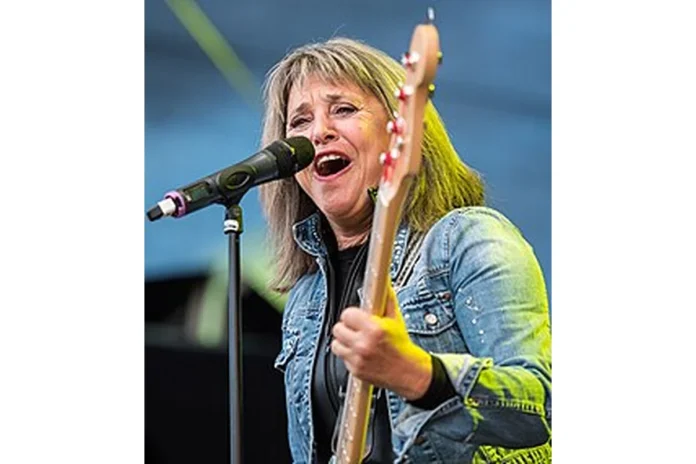
Susan Kay Quatro (born 3 June 1950), known professionally as Suzi Quatro, is an American singer, bass guitarist, songwriter and actress. She rose to international prominence in the 1970s with a string of hits in Europe and Australia, including “Can the Can” (1973) and “Devil Gate Drive” (1974), and reached the US top 40 with the duet “Stumblin’ In” (1978). Distinguished for her leather-clad hard-rock image and as one of the first high-profile female rock bassists and bandleaders, Quatro influenced generations of women in rock.
Active since 1964, she has recorded numerous studio albums, acted (notably as Leather Tuscadero on Happy Days), hosted radio programs, and sold over 50 million records worldwide. She remains active in recording and performing, releasing the duet album Face to Face in 2023.
Early Life and Background
Susan Kay Quatro was born and raised in Detroit, Michigan, United States, on 3 June 1950. Her father, Art Quatro, was a semiprofessional musician who worked at General Motors, and her mother, Helen, was of Hungarian descent. The family name “Quattrocchi,” meaning “four eyes” or “bespectacled,” was shortened to Quatro by her paternal grandfather, an Italian immigrant. She has three sisters, a brother named Michael Quatro, and one older half-sister, and her parents fostered several other children during her upbringing.
Quatro grew up in a musical household, playing drums or percussion from an early age as part of her father’s jazz band, the Art Quatro Trio. She was influenced at the age of six by seeing Elvis Presley perform on television and later cited Billie Holiday as an inspiration. She received formal training in classical piano and percussion, and her first instrument was bongos.
Her sister Patti later joined Fanny, one of the earliest all-female rock bands to gain national attention, and her sister Arlene became the mother of actress Sherilyn Fenn. Quatro taught herself how to play the bass after her sister asked her to learn it for her first band, the Pleasure Seekers. Her father gave her a 1957 Fender Precision Bass guitar in 1964, which she still uses in the studio.
Path to Music
In 1964, after seeing a television performance by the Beatles, Quatro’s older sister Patti formed an all-female garage rock band called the Pleasure Seekers with two friends. Quatro joined under the stage name Suzi Soul, singing and playing bass alongside her sisters Patti and later Arlene. The Pleasure Seekers recorded three singles, including “Never Thought You’d Leave Me” / “What a Way to Die” (1966) and “Light of Love” / “Good Kind of Hurt” (1968) for Mercury Records, and became well-known fixtures in the burgeoning Detroit music community, performing in cabarets and local venues.
The group changed its name to Cradle in late 1969, expanding their sound. Quatro’s brother Michael, who managed the band, persuaded record producer Mickie Most to see Cradle perform. Most, looking for a female rock singer who could fill a creative void, was drawn by Quatro’s skills as a bass guitarist, singer, and performer, and offered to take her to England to develop a solo career. She accepted, although she had also attracted the attention of Elektra Records, who had considered positioning her as a successor to Janis Joplin.
After moving to England, Quatro lived for a year in a hotel, where Most nurtured her development. Her first solo single, “Rolling Stone,” was successful only in Portugal, where it reached number one. It was after this record that Most introduced her to the songwriting and production team of Nicky Chinn and Mike Chapman, who crafted songs specifically to align with her image. This collaboration launched the most successful phase of her recording career.
Suzi Quatro Career
Early Career (1964–1972)
Quatro’s earliest professional performances came with the Pleasure Seekers in 1964, playing bass and singing in Detroit’s local music scene. She also appeared on local television as a go-go dancer in a pop music series during this period. After the transition to Cradle, the band toured the Midwest, refining their hard rock sound and building a regional following.
Following her move to England with Mickie Most, Quatro recorded her first solo single, “Rolling Stone,” and supported artists including Thin Lizzy and headliner Slade on a 1972 UK tour. She auditioned for a backing band and began laying the groundwork for her transition into a polished solo rock act. The 1972 tour was followed by the release of “Can the Can” in May 1973, which became a number-one hit across parts of Europe and in Australia, establishing her as a major international rock artist.
Breakthrough (1973–1980)
Quatro released her self-titled debut album in 1973, and the success of “Can the Can” was followed by three further major hits: “48 Crash” (1973), “Daytona Demon” (1973), and “Devil Gate Drive” (1974), each of which sold over one million copies and was awarded a gold disc. Although these singles dominated European and Australian charts, they met with little success in her native United States, where she had toured as a support act for Alice Cooper.
After a period of declining chart returns, Quatro shifted to a more mellow style and found renewed success with “If You Can’t Give Me Love” (1978), a hit in the United Kingdom and Australia. Later that year, her duet “Stumblin’ In” with Chris Norman of Smokie reached number four in the US, becoming her only song to chart in the American top 40. Both tracks appeared on the album If You Knew Suzi…, released in 1978.
In 1977, Quatro was cast as the bass player Leather Tuscadero on the American sitcom Happy Days, a role offered without audition by producer Garry Marshall after seeing a photograph of her on his daughter’s bedroom wall. The role significantly elevated her profile in the United States. Marshall offered her a Leather Tuscadero spin-off, which she declined to avoid typecasting. During this era, she was awarded six Bravo Otto honors from the German teen magazine Bravo, recognizing her popularity between 1973 and 1980.
Notable Works and Milestones
Quatro’s signature recordings include “Can the Can,” “48 Crash,” “Devil Gate Drive,” and “Stumblin’ In,” establishing her as a defining voice of 1970s glam and hard rock. Her self-titled debut, If You Knew Suzi…, and Rock Hard (1980) all achieved platinum status in Australia. Her work with the songwriting team of Chinn and Chapman produced some of the most recognizable rock singles of the decade, and her leather-clad image and bass-led performances set a template followed by generations of female rock musicians.
Suzi Quatro Award Nominations
Quatro has received recognition from readers’ polls, industry organizations, and cultural institutions throughout her career. Her sustained popularity in German-speaking Europe was reflected in six Bravo Otto honors from the German teen magazine Bravo between 1973 and 1980. She was also selected by BBC Television in April 2009 as one of 12 queens of British pop, underscoring her lasting cultural impact on the British music scene.
Suzi Quatro Awards Won
Quatro has accumulated a broad collection of honors spanning more than four decades. In 2010, she was inducted into the Michigan Rock and Roll Legends online Hall of Fame following a public vote. In 2013, she received the Distinguished Lifetime Achievement Award at the Detroit Music Awards, presented by her sister Patti, and the Woman of Valor Award from Musicians for Equal Opportunities for Women. In 2016, she was awarded an honorary doctorate in music by Anglia Ruskin University in Cambridge, United Kingdom, alongside Dr. Feelgood’s Wilko Johnson. In 2020, she was presented with the Icon Award by the Women’s International Music Network.
| Award | Wins | Year |
|---|---|---|
| Bravo Otto | 6 | 1973–1980 |
| Michigan Rock and Roll Legends Hall of Fame | 1 | 2010 |
| Detroit Music Awards Distinguished Lifetime Achievement Award | 1 | 2013 |
| MEOW Woman of Valor Award | 1 | 2013 |
| Honorary Doctorate in Music, Anglia Ruskin University | 1 | 2016 |
| Women’s International Music Network Icon Award | 1 | 2020 |
Suzi Quatro Family
Quatro was raised in a large Detroit household headed by her father, Art Quatro, a semiprofessional musician and General Motors employee, and her mother, Helen, who was of Hungarian descent and passed away in 1992. She has three sisters, a brother named Michael Quatro, and one older half-sister, and her parents fostered several other children during her upbringing. Her sister Patti played bass in Fanny, an early all-female rock band, and her sister Arlene is the mother of actress Sherilyn Fenn. Her brother Michael is also a musician.
Personal Life
Quatro married her long-time guitarist Len Tuckey in 1976, and the couple had two children together before divorcing in 1992. Their son, Richard Tuckey, has collaborated musically with his mother, including on the 2021 album The Devil in Me and 2019’s No Control. In 1993, Quatro married German concert promoter Rainer Haas, with whom she continues to reside.
She has lived in Essex, England, in Hamburg, Germany, and has sometimes returned to Detroit. Her autobiography, Unzipped, was published in 2007, and an Australian documentary titled Suzi Q, directed by Liam Firmager, premiered in Melbourne in August 2019. Quatro has hosted weekly rock and roll programs on BBC Radio 2 and continues to perform and record.