
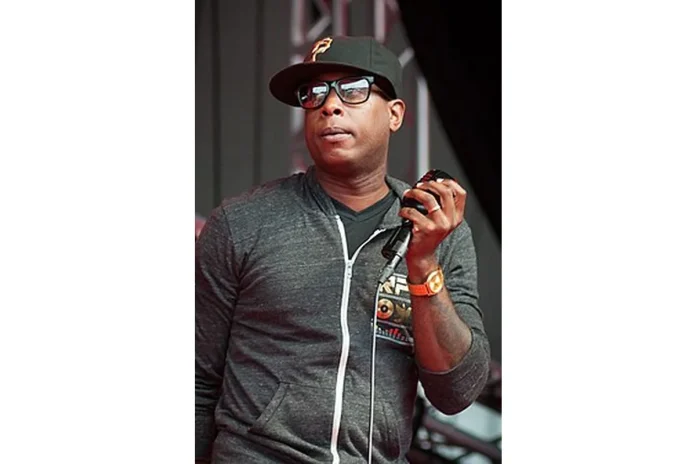
Talib Kweli Bio
Talib Kweli Greene (born October 3, 1975) is an American rapper, songwriter, record producer, entrepreneur, and activist from Brooklyn, New York. Known for socially conscious lyrics and political engagement, he first rose to prominence as one half of the hip-hop duo Black Star alongside fellow Brooklyn rapper Mos Def. Over the course of his career, Kweli has built a reputation as one of the most consistent voices in underground and conscious hip-hop, balancing a steady solo discography with advocacy work on civil-rights issues.
Beyond music, Kweli founded the independent label Javotti Media in 2011 and later expanded into publishing and podcasting, releasing his memoir Vibrate Higher: A Rap Story in 2021. His influence stretches from late-1990s New York hip-hop circles to global activist movements, and he continues to perform, record, and speak on issues ranging from police brutality to educational opportunity.
Early Life and Background
Talib Kweli Greene was born on October 3, 1975, in Brooklyn, New York City, and raised in the Park Slope neighborhood. His mother, Brenda Greene, is an English professor at Medgar Evers College of the City University of New York, and his father is an administrator at Adelphi University. Growing up in a household rooted in education and literature helped shape his early interest in storytelling, language, and music.
As a young listener, Kweli gravitated toward Afrocentric rap groups, particularly De La Soul and other members of the Native Tongues Posse, whom he met while attending high school. He studied at Brooklyn Technical High School before transferring to Cheshire Academy, a boarding school in Connecticut. After completing secondary school, he enrolled at New York University, where he studied experimental theater and continued refining the performance instincts that would later define his stage presence.
His younger brother, Jamal Greene, went on to become a professor of constitutional law at Columbia Law School, a graduate of Harvard University and Yale Law School, and a former clerk to U.S. Supreme Court Justice John Paul Stevens. The brothers’ shared commitment to education and public service has remained a recurring theme in interviews and public appearances.
Path to Music
Kweli made his recorded debut in 1997, appearing on five tracks of Doom, an album by the Cincinnati-based group Mood. The sessions introduced him to producer Hi-Tek, and the two soon began collaborating as the duo Reflection Eternal. Their early underground recordings, including the single “Fortified Live” in 1997 and “B-Boy Document 99/Chaos” in 1999, established Kweli’s reputation within the East Coast underground circuit.
After reconnecting with fellow Brooklyn rapper Mos Def, Kweli formed the duo Black Star in 1997, bringing Hi-Tek on board as producer. In 1998, Black Star released the single “Definition,” which entered the Billboard Hot 100, followed by the self-titled debut album Mos Def & Talib Kweli Are Black Star. The record arrived during a late-1990s resurgence of conscious, Afrocentric hip-hop and earned strong critical praise. That same period, Kweli and Hi-Tek released the Reflection Eternal album Train of Thought in 2000, recorded at Electric Lady Studios.
These early projects laid the foundation for Kweli’s transition from underground collaborator to a central voice in socially aware hip-hop. The acclaim surrounding Black Star helped him secure a solo deal with Rawkus Records and set the stage for a career built on lyricism, collaboration, and activism.
Talib Kweli Career
Early Career (1997–2001)
Kweli’s earliest years in the music industry were defined by collaboration. Alongside Mos Def, he organized the Hip Hop for Respect EP in 2000, a project designed to speak out against police brutality in the wake of the Amadou Diallo shooting. The release assembled forty-one rappers to represent the forty-one shots fired at Diallo, with proceeds directed to the Hip Hop For Respect Foundation. In 2001, he and Mos Def contributed to the Red Hot + Indigo compilation album, a tribute to Duke Ellington that raised funds for AIDS awareness, recording “Money Jungle” with John Patton and Ron Carter.
During this period, Kweli also continued his partnership with Hi-Tek as Reflection Eternal and became an active touring artist in New York’s underground circuit. The buzz surrounding Black Star and Reflection Eternal made him one of the most talked-about lyricists outside the mainstream by the end of 2001.
Breakthrough (2002–2010)
Kweli launched his solo career in 2002 with Quality, his first solo album on Rawkus Records. The album featured production from DJ Quik, Kanye West, and others, and was met with widespread critical acclaim. The Kanye West-produced single “Get By” peaked at number 77 on the Billboard Hot 100, and the album reached number 21 on the Billboard 200 and number 6 on the R&B/Hip-Hop Albums Chart.
In November 2004, Kweli released his second solo album, The Beautiful Struggle, which debuted at number 14 on the Billboard 200. The record included the track “Ghetto Show,” featuring Common and Anthony Hamilton, which served as a lyrical response to Jay-Z’s earlier reference to Kweli on “Moment of Clarity.” In 2005, Kweli launched his own Blacksmith Records imprint, releasing the mixtape Right About Now: The Official Sucka Free Mix CD, which debuted at number 113 on the Billboard 200.
In 2007, Kweli released his third solo album, Eardrum, which debuted at number 2 on the Billboard 200 and was supported by the single “Listen!!!” The album featured production from Kanye West, Just Blaze, will.i.am, Nick Speed, and Pete Rock, and sold 129,000 copies in its first four weeks. That same year, Kweli signed rapper Jean Grae and the group Strong Arm Steady to Blacksmith Records and signed a distribution deal with Warner Bros. Records in 2006. He also released Liberation, his collaborative project with Madlib, first as a free download in 2006 and later for purchase in 2007.
In 2010, Kweli and DJ Hi-Tek released their second Reflection Eternal album, Revolutions Per Minute, recorded at Electric Lady Studios. The album earned generally positive reviews, including an aggregate Metacritic score of 80 out of 100, marking a strong return after a ten-year hiatus from the duo project.
Notable Works and Milestones
Among Kweli’s signature releases are Mos Def & Talib Kweli Are Black Star (1998), Quality (2002), Eardrum (2007), and Revolutions Per Minute (2010). His partnership with Mos Def has been credited with helping revive conscious hip-hop during the late 1990s, while his solo catalog established him as a consistent critical favorite. In 2011, he founded Javotti Media, an independent label whose roster has included Cory Mo, Jessica Care Moore, K’Valentine, and Brazilian MC Niko Is.
Talib Kweli Award Nominations
Across his decades-long career, Talib Kweli has received recognition from a range of music, literary, and cultural institutions for his contributions to hip-hop and his work as an activist author. While individual nominations are widely documented across his discography, a fully verified summary of nominations is not consistently available in the supplied sources, and so no detailed table is included here.
Talib Kweli Awards Won
In 2022, Talib Kweli won the PEN Oakland – Josephine Miles Literary Award for his memoir Vibrate Higher: A Rap Story (Farrar, Straus and Giroux, 2021). The award recognized the book’s contribution to literature and its candid exploration of hip-hop, race, and personal history. Beyond this literary honor, Kweli has also been widely acknowledged by peers and cultural organizations for his role in conscious hip-hop, though specific verified counts of additional awards are not available in the supplied sources.
Talib Kweli Family
Talib Kweli Greene was raised in Brooklyn’s Park Slope neighborhood by his mother, Brenda Greene, an English professor at Medgar Evers College of the City University of New York. His father worked as an administrator at Adelphi University, creating a household rooted in higher education and the literary arts.
His younger brother, Jamal Greene, is a professor of constitutional law at Columbia Law School and a graduate of Harvard University and Yale Law School. Jamal Greene also served as a clerk to U.S. Supreme Court Justice John Paul Stevens, reinforcing the family’s longstanding connection to academia and public service.
Personal Life
Talib Kweli has been widely recognized for his political and social activism, particularly on issues of racial profiling, police brutality, and education. He co-organized the Hip Hop for Respect EP in 2000 with Mos Def in response to the Amadou Diallo shooting, visited the Occupy Wall Street camp in October 2011, and spoke at a 2012 City Hall rally urging the NYPD to end the stop-and-frisk policy. In August 2014, he traveled to Ferguson, Missouri, to join community protests following the shooting of Michael Brown, and in 2015 he hosted benefit concerts marking the one-year anniversary of Brown’s death.
Beyond music and activism, Kweli partnered with Uproxx in June 2019 to launch the weekly podcast The People’s Party alongside co-host Jasmin Leigh, and during the 2020 COVID-19 pandemic he teamed up with Yasiin Bey and Dave Chappelle for the podcast The Midnight Miracle. He continues to live and work in the United States, balancing recording, label operations at Javotti Media, and ongoing public advocacy.