
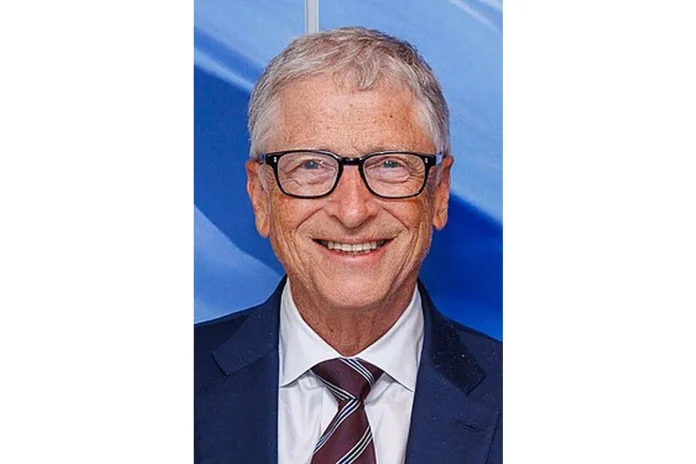
Bill Gates Bio
William Henry Gates III, widely known as Bill Gates, is an American businessman, software developer, and philanthropist best known for co-founding Microsoft in 1975 with his childhood friend Paul Allen. A central figure in the personal computer revolution, Gates led Microsoft through decades of growth, serving as chief executive officer from the company’s earliest days until 2000 and continuing as chief software architect before stepping back to focus on philanthropy. Beyond technology, he co-founded the Bill & Melinda Gates Foundation, one of the largest private charitable organizations in the world, and has directed substantial personal wealth toward global health, education, and climate innovation.
Born and raised in Seattle, Washington, Gates grew into a leader recognized for combining deep technical knowledge with sharp business instincts. He has been named one of the most influential people of the twentieth century and has received honors including the Presidential Medal of Freedom. He continues to invest in clean energy, support global development, and advise Microsoft as a technology advisor.
Early Life and Background
William Henry Gates III was born on October 28, 1955, in Seattle, Washington, to William H. Gates Sr., a prominent attorney, and Mary Maxwell Gates, who served on boards including United Way of America. He grew up in the Sand Point neighborhood of Seattle with two sisters and was the fourth in his family to bear the name, earning the nickname Trey. His family encouraged competition, and his parents initially hoped he would pursue a legal career. As a child, Gates was small for his age and was bullied, experiences that shaped a determined streak.
Gates enrolled at the private Lakeside School, where he discovered his passion for computing. At thirteen, he was introduced to a Teletype terminal linked to a General Electric mainframe, and he wrote his first program, a tic-tac-toe game. He soon joined forces with Paul Allen, Ric Weiland, and Kent Evans to form the Lakeside Programmers Club, earning computer time by finding bugs in local systems. The group built early ventures including Traf-O-Data, a traffic-counting business that marked Gates’s first commercial software project.
After graduating from Lakeside School as a national merit scholar, Gates enrolled at Harvard University in 1973, where he studied mathematics and graduate-level computer science. He left Harvard without completing his degree in 1975 to pursue the opportunity presented by the MITS Altair 8800 microcomputer.
Path to Microsoft Founder
Gates’s path to Microsoft began with a January 1975 issue of Popular Electronics featuring the Altair 8800. Though he and Allen did not yet own the machine, they contacted MITS claiming to have a BASIC interpreter for it. They scrambled to build an Altair emulator and a working interpreter, and their demonstration in Albuquerque convinced MITS to license the software and hire Allen. Gates took a leave of absence from Harvard to join Allen in New Mexico, and within months they founded Microsoft, originally hyphenated as Micro-Soft, with Ric Weiland as their first employee.
The young company quickly grew beyond its Altair roots. After Gates published an open letter defending software developers’ right to be paid, Microsoft became independent of MITS and relocated to Bellevue, Washington, in 1979. Gates personally reviewed and often rewrote code during the company’s first five years before transitioning into a management role, laying the foundation for the operating systems and productivity software that would later dominate personal computing.
Bill Gates Career
Early Career (1972-1980)
Gates’s first professional experience came during his teenage years when he worked with Paul Allen on computer projects through the Lakeside Programmers Club. In 1971, he and Kent Evans automated Lakeside School’s class scheduling system, and the following year Gates served as a congressional page in the United States House of Representatives.
He and Allen officially formed Microsoft in 1975, securing their breakthrough contract with MITS for Altair BASIC. The partnership faced early controversy when Gates’s open letter to hobbyists insisted that software should be paid for, a stance that set Microsoft’s philosophical tone. By the end of 1976, Microsoft was independent, and Gates had committed fully to the company.
IBM Partnership and Operating Systems Breakthrough (1980-1990)
The defining moment of Gates’s early career came in 1980 when IBM approached Microsoft to write software for its upcoming personal computer. Gates’s mother had introduced IBM’s chief executive to the small company, and after IBM failed to license an operating system from Digital Research, Gates and Allen secured 86-DOS from Seattle Computer Products and adapted it for IBM. The result was PC DOS, delivered for a modest fee, but the prestige of being on IBM’s platform turned Microsoft into a leading software company.
Gates restructured Microsoft in 1981, becoming president and chairman of the board. The launch of Microsoft Windows in 1985 and the company’s 1986 initial public offering cemented Gates’s fortune; at thirty-one he became the world’s youngest self-made billionaire. Throughout the late 1980s, he oversaw the development of applications that made personal computers essential tools for businesses and consumers.
Antitrust and Windows Era (1990-2008)
During the 1990s Gates guided Microsoft through the era of Windows 95, the browser wars, and the United States antitrust case. He stepped down as chief executive officer in 2000, handing the role to Steve Ballmer, and shifted to the role of chief software architect. His public image began evolving as he redirected his attention toward philanthropy, formally transitioning out of day-to-day duties by June 2008.
He continued to write code that shipped with Microsoft products as late as 1989, and his hands-on reputation shaped the engineering culture of the company. Gates’s pattern of deeply reviewing proposals and pushing subordinates to defend their work became a defining feature of Microsoft’s early corporate identity.
Philanthropy and Beyond Era (2008-Present)
After stepping down as chief software architect, Gates became chairman of the board and later, in 2014, transitioned to the role of technology advisor at Microsoft. He also chaired the Bill & Melinda Gates Foundation, focusing on global health, education, and poverty alleviation, and later launched Breakthrough Energy to fund clean-energy startups. In 2020 he resigned from the boards of both Microsoft and Berkshire Hathaway to devote himself fully to philanthropy and climate innovation.
Beyond Microsoft, Gates serves as chairman and founder of Cascade Investment, TerraPower, and Gates Ventures. He has invested in ventures spanning nuclear energy, digital media, and artificial intelligence, and he continues to advocate innovation-driven approaches to global challenges including pandemics and climate change.
Notable Events and Milestones
Gates’s career-defining moments include the 1975 founding of Microsoft, the 1980 IBM deal that standardized MS-DOS, and the 1986 public offering that made him a billionaire at thirty-one. He was the world’s richest person for eighteen of twenty-four years between 1995 and 2017 and became the first centibillionaire in 1999, when his wealth briefly surpassed one hundred billion dollars.
Bill Gates Career Wins
Gates’s career is marked by sustained leadership, transformative products, and the creation of two of the world’s most influential organizations: Microsoft and the Bill & Melinda Gates Foundation.
Career Highlights
From the launch of Altair BASIC to the global rollout of Windows and Office, Gates helped shape the modern software industry. His early conviction that software should be paid for established business models that powered decades of innovation, and his decision to retain rights to MS-DOS allowed Microsoft to license the operating system to IBM-compatible manufacturers, multiplying revenue. In philanthropy, Gates has donated more than one hundred billion dollars to charitable causes, with sixty billion directed through his foundation to global health, education, and development.
More recently, he co-founded Breakthrough Energy and TerraPower to advance clean-energy research and nuclear innovation. His 2022 memoir How to Prevent the Next Pandemic and his 2025 memoir Source Code reflect a continued commitment to public discourse on global challenges.
Other Wins and Achievements
Beyond software and philanthropy, Gates partnered with Roger Federer to win the Match for Africa charity tennis events in 2017 and 2018, raising millions for children’s education in Africa. He and Warren Buffett launched the Giving Pledge in 2010, committing to give at least half their wealth to philanthropy and inspiring similar commitments from other billionaires.
Bill Gates Family
Family Background and Lineage
Gates was raised in an accomplished family. His father, William H. Gates Sr., was a leading Seattle attorney and later co-chair of the Bill & Melinda Gates Foundation. His mother, Mary Maxwell Gates, served on corporate and nonprofit boards and introduced her son to IBM executives, helping to open the door to the personal computer partnership. His ancestry includes English, German, and Irish roots, and he has two sisters, Kristi and Libby.
Personal Life
Gates married Melinda French Gates on January 1, 1994, on the Hawaiian island of Lānaʻi. The couple had three children: Jennifer, Rory, and Phoebe. They announced their divorce on May 3, 2021, and it was finalized on August 2, 2021. In 2023 Gates confirmed he was in a relationship with Paula Hurd, widow of former Oracle chief executive Mark Hurd. He resides in Medina, Washington, and is known for his avid reading, bridge, golf, and tennis.