
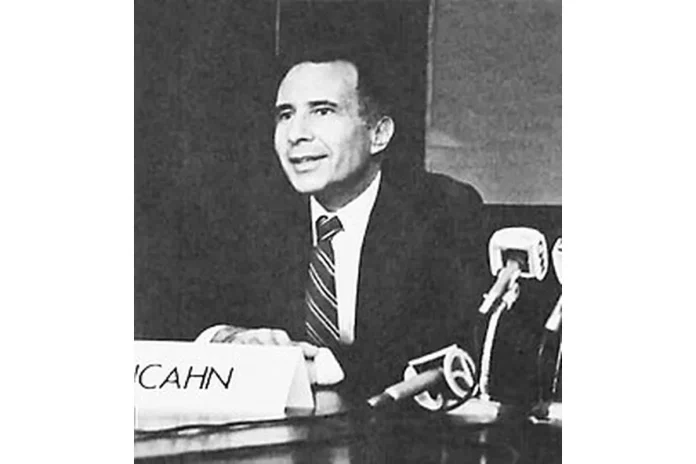
Carl Icahn Bio
Carl Celian Icahn (born February 16, 1936) is an American businessman, investor, and philanthropist recognized for founding and controlling Icahn Enterprises, a public diversified holding company. He is widely regarded as one of the pioneers of shareholder activism, an investment approach in which large stakeholders pressure company leadership to pursue strategic or governance changes intended to lift shareholder value. In the 1980s, Icahn earned a reputation as a high-profile “corporate raider” through a series of hostile takeover attempts and proxy battles across multiple industries. He has served in public policy roles, including as a special advisor on regulatory reform to President Donald Trump.
Early Life and Background
Carl Icahn was born on February 16, 1936, in Brooklyn, New York, and raised in the Far Rockaway neighborhood of Queens. He grew up in an Ashkenazi Jewish family shaped by modest means. His father, Michael Icahn, was a self-described atheist who had earlier worked as a cantor and later served as a substitute teacher. His mother, Bella, née Schnall, also worked as a schoolteacher. Icahn attended Far Rockaway High School, where he graduated before moving on to higher education.
Icahn went on to Princeton University, where he earned a Bachelor of Arts in philosophy in 1957 after completing a senior thesis on the empiricist criterion of meaning. Following his undergraduate studies, he enrolled at the New York University School of Medicine, but left after two years to serve in the Army Reserve. The combination of analytical training in philosophy and early exposure to competitive environments laid the groundwork for his later career on Wall Street, where strategic thinking and persuasion would become his trademarks.
Path to Becoming a Corporate Raider
Icahn began his Wall Street career in 1961 as a stockbroker at Dreyfus Corporation before moving to Tessel, Patrick & Co. as an options manager in 1963, and then to Gruntal & Co. In 1968, with $150,000 of his own money and a $400,000 investment from his uncle, M. Elliot Schnall, he purchased a seat on the New York Stock Exchange and formed Icahn & Co., concentrating on risk arbitrage and options trading. This early period allowed him to develop the deal-making instincts and financial discipline that would define his later takeover activity.
His first takeover attempt came in 1978, when he acquired a controlling stake in Tappan and forced its sale to Electrolux, doubling his investment. In 1979, he acquired Bayswater Realty & Capital Corporation, and in 1983 he took control of ACF Industries, selling those shares to Phillips Petroleum two years later for a $50 million profit. These early wins built the capital base and the public reputation that positioned him for the much larger transactions of the mid-1980s and the breakthrough TWA deal that would make him a household name in American finance.
Carl Icahn Career
Early Career (1961–2005)
From 1961 through the early 1980s, Icahn built his reputation as a risk arbiter and options trader, expanding from brokerage work into hostile takeovers. His earliest major score came in 1978 with Tappan, followed by the 1983 acquisition of ACF Industries and a profitable 1985 sale to Phillips Petroleum. During this stretch he also moved into real estate, acquiring Bayswater Realty & Capital Corporation in 1979, and laid the foundation for the leveraged-buyout playbook he would later refine.
In 1985, Icahn acquired a 50% stake in Trans World Airlines by pooling his own capital with investor funds and bank borrowings, and he completed a leveraged buyout of the airline in 1988. He then systematically sold TWA’s assets to repay his debt, a strategy described as asset stripping that cemented his image as a corporate raider. In 1991, he sold TWA’s London routes to American Airlines for $445 million, booking a $469 million profit while leaving the airline with $540 million in debt. He launched an unsuccessful $8 billion hostile bid for U.S. Steel in 1986, eventually selling his stake in 1991 for $1 billion and a $200 million profit, and in 1989 he sold his Texaco position for $2 billion, a $700 million gain.
Corporate Raider Era and 1990s Breakthrough (1985–2000)
The mid-1980s through the late 1990s marked the height of Icahn’s takeover era. After the TWA episode, he pursued a string of high-profile transactions, including the 1991 attempt to acquire Pan Am for $375 million, a 1997 sale of his 7.3% RJR Nabisco stake for a $125 million profit, and a 1997 takeover of Marvel Comics during a rivalry with Ronald Perelman. In 1998, he returned to RJR Nabisco with a 5% investor group stake and pressed management to split its tobacco and food units. He also pursued a second, smaller bid for Pan Am in 1998 and, in 2001, lent $100 million to Genesisintermedia in exchange for stock options.
By the early 2000s, Icahn was branching into new sectors. In 2004, he raised $3 billion to form Icahn Partners, a hedge fund, and took ownership stakes in Blockbuster Video and Time Warner. That same year, after Mylan announced a $4 billion stock deal to acquire King Pharmaceuticals, Icahn purchased a large block of Mylan shares and threatened a proxy fight, ultimately forcing Mylan to abandon the deal in February 2005. These deals showcased the breadth of his later playbook, which combined proxy fights, board pressure, and strategic stakes well beyond the asset-stripping approach of his TWA years.
2005–2010 Expansion and Proxy Battles
Between 2005 and 2010, Icahn extended his reach across technology, biotech, gaming, and media. In 2005, he moved to buy the wired portion of XO Communications for $700 million, a transaction later blocked in court over conflict-of-interest concerns. In 2006, he built a stake in Take-Two Interactive, growing it to 11.3% by 2009. In 2007, his Lear Corporation bid was accepted at $2.3 billion, he increased his BEA Systems stake to 13.22%, and he began accumulating shares in Biogen. The same year, he sold a portfolio of Nevada casinos to a Goldman Sachs unit for $1.3 billion, well above his cost basis.
In 2008, Icahn sued Motorola in a push for board seats and a sale of its mobile business, and he later took a large position in Yahoo!, forcing an agreement to expand Yahoo’s board to eleven members, three of whom were his picks. He launched a blog, The Icahn Report, in June 2008, and took part in the failed ImClone-Bristol-Myers Squibb transaction that ended in a $6.5 billion sale to Eli Lilly. In 2010, he acquired the unfinished Fontainebleau Las Vegas for about $150 million and joined a lender group that purchased Tropicana Casino & Resort Atlantic City out of bankruptcy for $200 million.
2010–2015 Era of New Activist Campaigns
The early 2010s brought a string of new activist positions. In 2011, Icahn offered $10.2 billion for Clorox, building a 9.08% stake, and pursued Mentor Graphics with an offer near $1.86 billion that did not succeed. In 2012, he disclosed a 10% stake in Netflix and mounted a board fight at Oshkosh Corporation. In 2013, Forbes named him one of the 40 highest-earning hedge fund managers, he sued Dell to derail a $24.4 billion management buyout, and he sold roughly half his Netflix shares for more than $800 million in profit. He also accumulated 61 million shares of Talisman Energy and a 12.5% stake in Hologic.
In 2014, Icahn invested another $500 million in Apple and pressed eBay to spin off PayPal, a proxy fight settled by April 2014. He took a position in Talisman Energy in late 2014 and exited two months later after the stock dropped 71%. The period reinforced his shift from outright hostile takeovers toward high-profile shareholder campaigns at large public companies, with Apple, eBay, and Netflix becoming the most prominent stages for his modern activist approach.
2015–Present Era
From 2015 onward, Icahn continued to make large, headline-grabbing investments. He put $100 million into Lyft in May 2015, later swapped eBay for PayPal shares, disclosed a 7.13% stake in Xerox, and offered to acquire Pep Boys. In 2016, he raised his Herbalife stake to 21%, closed the Trump Taj Mahal Casino in Atlantic City, and increased his Hertz holdings. In 2017, he sold the unfinished Fontainebleau Las Vegas for $600 million, more than four times his cost. In 2020, he sold his entire Hertz position for 72 cents a share, losing nearly $2 billion.
In 2022, Icahn nominated two directors to the McDonald’s board, beginning a proxy fight over pig-raising conditions, but only about 1% of shareholders backed his nominees, and McDonald’s defeated his campaign. In May 2023, Hindenburg Research released an analysis of Icahn Enterprises alleging it was overvalued, sending the share price down 20% in a single day. Since 2011, Icahn has no longer managed money for outside clients, focusing on his holdings in Icahn Enterprises, the diversified holding company he founded and continues to control.
Notable Events and Milestones
Icahn’s signature moment was the 1985 leveraged buyout and subsequent asset-stripping of Trans World Airlines, a transaction that made him a defining figure of the 1980s takeover era. In 1989, his $2 billion sale of Texaco for a $700 million profit set a record for share sales on the New York Stock Exchange at the time. His 2017 sale of the Fontainebleau Las Vegas for $600 million and his 2014 push to spin off PayPal from eBay both stand out as major modern wins, while his 2020 Hertz loss illustrates the scale of risk in his activist strategy.
Carl Icahn Career Wins
Across more than six decades on Wall Street, Carl Icahn has compiled a record of high-profile wins through hostile takeovers, proxy battles, and large activist stakes. His most celebrated victories include doubling his money on the 1978 sale of Tappan to Electrolux, the $50 million profit on the 1985 sale of ACF Industries, the $469 million profit from TWA, the $700 million gain on Texaco, the $1 billion sale of his U.S. Steel stake, and a $125 million profit on RJR Nabisco. In later years, his Netflix trade produced more than $800 million in profit, and his PayPal campaign helped force a successful eBay spin-off.
Career Highlights
Icahn’s first major takeover win came in 1978 with Tappan, and his most recent high-profile victories include the 2017 Fontainebleau Las Vegas sale and the 2014 eBay-PayPal proxy fight. The most recent win is the 2017 Fontainebleau Las Vegas sale, where he earned more than four times his original investment. Across his career, he has been one of the first and most influential activist shareholders, helping make that investment strategy a mainstream tool for hedge funds, and he has remained on the Forbes 400 with a net worth in the multi-billion-dollar range.
Other Wins & Achievements
Beyond his takeover and proxy fights, Icahn has excelled in arbitrage, options trading, and the operational management of a diversified conglomerate through Icahn Enterprises. He was one of the first activist shareholders and is credited with helping make that approach mainstream for hedge funds. In philanthropy, he joined the Giving Pledge in 2010, promising to give away more than half his fortune, and he has funded major facilities at Princeton University, Mount Sinai, and elsewhere.
Carl Icahn Family
Family Background and Business Lineage
Icahn was born to Michael Icahn, a former cantor and later substitute teacher who identified as a sworn atheist, and Bella Schnall, a schoolteacher. His uncle, M. Elliot Schnall, provided the $400,000 investment that helped him buy a seat on the New York Stock Exchange in 1968 and launch Icahn & Co. His nephew, Rick Schnall, is part of the broader family network that has remained connected to his business world.
Personal Life
In the summer of 1978, Icahn met Liba Trejbal, a ballerina from the former Czechoslovakia, and the couple married in March 1979. They had two children, Brett Icahn and Michelle Celia Icahn Nevin, before separating; the divorce was settled in July 1999. In 1999, Icahn married his longtime assistant and former broker, Gail Golden, who has two children from a previous marriage; the couple separated in 2025.