
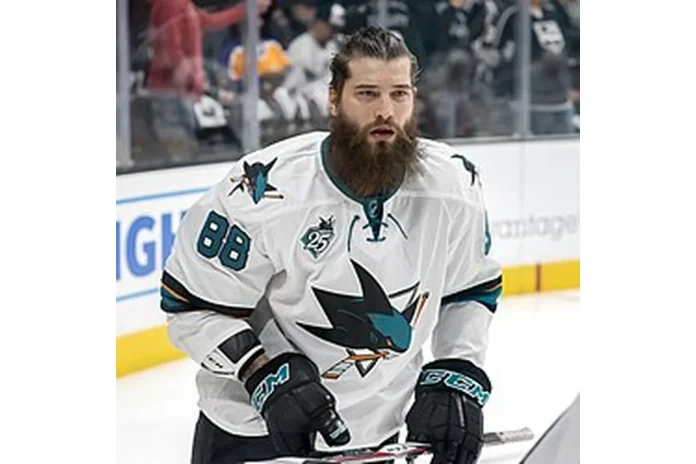
Brent Burns Bio
Brent Burns is a Canadian professional ice hockey player who is a defenceman for the Colorado Avalanche of the National Hockey League (NHL). Drafted as a right wing, 20th overall, at the 2003 NHL Entry Draft by the Minnesota Wild, he was converted into a defenceman upon turning professional. Burns is recognized as a dynamic offensive player, and although he mostly plays defence, he has been used as a forward at several points during his long NHL career.
Following the retirement of Marc-André Fleury, Burns is the last active player in the NHL to have appeared in the league before the 2004–05 lockout, having debuted in 2003–04. Over more than two decades, he has built a reputation for powerful skating, a heavy shot, and one of the most unusual personal collections of animals among modern professional athletes.
Early Life and Background
Brent Burns was born on March 9, 1985, in Barrie, Ontario, Canada. He grew up in a hockey environment and spent much of his minor hockey career with the Barrie Icemen and the Ajax Knights of the Ontario Minor Hockey Association. Burns later moved on to two seasons in the Metropolitan Toronto Hockey League, now called the Greater Toronto Hockey League, where he played for the North York Canadiens alongside fellow future NHL players Anthony Stewart and Geoff Platt.
His progression through Ontario’s junior system shaped him as a right winger rather than a defenceman. Burns played his Ontario Hockey League career with the Brampton Battalion in the 2002–03 season. He led the team in playoff scoring with five goals and six assists in 11 games and was runner-up for the OHL’s Most Improved Player award as voted on by the league’s coaches.
Path to Hockey
Burns was drafted by the Minnesota Wild in the first round, 20th overall, in the 2003 NHL Entry Draft. Because of his scoring touch and skating ability at the junior level, the Wild viewed him as a high-upside forward. Upon turning professional, Minnesota’s defensively minded head coach Jacques Lemaire converted Burns to defence, a move that ultimately defined the rest of his career.
He made his NHL debut on October 8, 2003, against the Chicago Blackhawks and scored his first NHL goal in his third game against the San Jose Sharks. After spending the 2004–05 lockout in the American Hockey League with the Houston Aeros, Burns returned to the NHL as a full-time defenceman and earned a regular place on the Minnesota roster from 2005–06 onward.
Brent Burns Career
Early Career (2003–2007)
Burns appeared in 36 games for the Wild during his rookie 2003–04 season, showing flashes of natural ability in rushing from the blueline. After the cancellation of the 2004–05 season, he returned to the NHL lineup as a steady contributor and posted 16 points in 72 games in 2005–06. The following season, he eclipsed his previous points total with 25, scored back-to-back overtime winners in March, and engaged in two fights during the 2007 Stanley Cup playoffs, signaling his willingness to play a physical game.
On October 25, 2007, Burns signed a four-year contract extension with the Wild and emerged as one of the club’s top defencemen, recording a career-high 15 goals and 43 points in 2007–08. His strong two-way play also earned him recognition on the international stage, where he was named Best Defenceman at the 2008 IIHF World Championship as Canada captured a silver medal.
Minnesota Wild Breakthrough (2008–2011)
During the 2008–09 season, Burns was regularly shifted between forward and defence, but a late-season concussion limited him to 27 points and cost him the final 19 games. A second concussion briefly into the 2009–10 season kept him out for an extended stretch, and he finished that year with 20 points in 47 games. On November 12, 2010, he was suspended two games for striking Florida’s Steve Bernier with the knob of his stick.
During the 2011 NHL Entry Draft, Burns, along with a 2012 second-round pick, was traded to the San Jose Sharks in exchange for Devin Setoguchi, Charlie Coyle, and a 2011 first-round pick. With a year remaining on his existing contract, he signed a five-year extension on August 1, 2011, paying him $28.8 million, with an average annual value of $5.76 million.
San Jose Sharks Era (2011–2022)
Burns began his Sharks tenure as a defenceman before the team moved him to forward during the shortened 2012–13 season, where he produced 20 points in 23 games. In 2013–14, after missing time due to a sore-gum issue, he recorded his first career hat-trick on November 29 against the St. Louis Blues in a 6–3 victory. The Sharks returned Burns to defence in August 2014, and he responded with 17 goals and 60 points, tying for second among NHL defencemen in scoring, while also winning the NHL Foundation Player Award for his charitable work.
His 2015–16 season marked his true offensive breakout, as he finished with 75 points on 27 goals and 48 assists. He added 24 points in 24 playoff games to help San Jose reach the Stanley Cup Final for the first time in franchise history. On November 22, 2016, Burns signed an eight-year, $64 million contract extension with an average annual value of $8 million, and at the end of 2016–17 he won the James Norris Memorial Trophy as the NHL’s best defenceman. He was also nominated for the Ted Lindsay Award that same year. Burns played his 1,000th career NHL game on December 27, 2018, in a 4–2 win over the Anaheim Ducks.
Carolina Hurricanes Era (2022–2025)
On July 13, 2022, the Sharks traded Burns and Lane Pederson to the Carolina Hurricanes in exchange for Steven Lorentz, goaltending prospect Eetu Mäkiniemi, and a third-round pick in the 2023 NHL Draft. Burns continued to serve as a veteran offensive defenceman and reached his 1,300th NHL game on January 29, 2023. His stay in Carolina added to his reputation as a durable, two-way presence capable of logging top-four minutes deep into his thirties.
Colorado Avalanche Era (2025–Present)
On July 3, 2025, Burns signed a one-year contract with the Colorado Avalanche, beginning a new chapter late in his career. On October 11, 2025, he skated in his 1,500th NHL game, becoming just the 23rd player in league history to reach that milestone. His move to Colorado paired his experience with a contending roster as the team looked to bolster its defensive depth for a deep playoff run.
Driving Style and Strengths
Burns is widely known for his booming slap shot, strong puck-rushing ability, and unusual poise for a player standing 6 ft 5 in and weighing 230 lb. Coaches have regularly trusted him to quarterback a top power-play unit, while his heavy frame allows him to win board battles and clear the front of the net. Throughout his career, he has shown the rare flexibility to play both forward and defence without a noticeable drop in production.
Notable Events and Milestones
Signature moments include his first career hat-trick against the St. Louis Blues in 2013, his Norris Trophy-winning 2016–17 campaign, his 1,000th NHL game in 2018, his trade to Carolina in 2022, and his 1,500th NHL game in 2025. He also helped San Jose reach its first Stanley Cup Final in 2016 and represented Canada at multiple IIHF World Championships, earning Best Defenceman honors in both 2008 and 2015.
Brent Burns Career Wins
Across his NHL career, Brent Burns has accumulated more than 20 NHL seasons of service with three different franchises, cementing himself as one of the most productive offensive defencemen of his generation. His career is highlighted by major individual trophies, deep playoff runs, and a series of games-played milestones that place him among the all-time leaders in longevity.
NHL Highlights
Burns won the James Norris Memorial Trophy in 2017 as the league’s top defenceman, was a Ted Lindsay Award finalist the same year, and captured the NHL Foundation Player Award in 2014. He reached the Stanley Cup Final with San Jose in 2016 and played his 1,000th, 1,300th, and 1,500th NHL games in 2018, 2023, and 2025, respectively. He also tallied his first NHL hat-trick in 2013 and posted a career-best 75 points in 2015–16.
International Highlights
Burns represented Canada at several IIHF World Championships, earning Best Defenceman honors in 2008 and again in 2015, when he was also named to the tournament all-star team during Canada’s gold-medal performance. He was part of Canada’s summer camp roster for the 2010 Winter Olympics, although he did not make the final Olympic team.
Brent Burns Family
Family Background and Personal Life
Brent Burns grew up in Barrie, Ontario, where he developed his lifelong love of animals and the outdoors. He married his wife, Susan Holder, in July 2009, and the couple has three children. Burns splits his summers between Barrie and Lake Elmo, Minnesota, and owns a ranch in Texas where he raises exotic species, including wildebeest and fallow deer.
His suburban Saint Paul home became known as “Burns Zoo” because of his collection of dogs, cats, and dozens of reptiles, mainly snakes. For his 1,000th NHL game, his San Jose Sharks teammates bought him two antelopes to add to the collection. Burns also purchased a suite at the Xcel Energy Center for members of the military and their families to attend Minnesota Wild home games, and he made a brief acting debut with a two-episode role in season 6 of Vikings as a raider named Skane.
2025 Season Performance
The 2025 NHL season marked a significant new beginning for Burns after he signed a one-year contract with the Colorado Avalanche on July 3, 2025. Joining a contending Avalanche roster, he provided veteran leadership and top-four defensive minutes while continuing to play a meaningful role on the power play.
His most memorable moment of the season came on October 11, 2025, when he skated in his 1,500th NHL game, becoming the 23rd player in league history to reach the milestone. The achievement underscored his remarkable durability and longevity across more than two decades in the NHL.
With Colorado pushing for another deep playoff run, Burns was relied upon to mentor younger defencemen while still contributing offensively. As the season progressed, he remained a steady presence on the back end, helping the Avalanche maintain one of the league’s strongest blue-line groups heading into the postseason.