
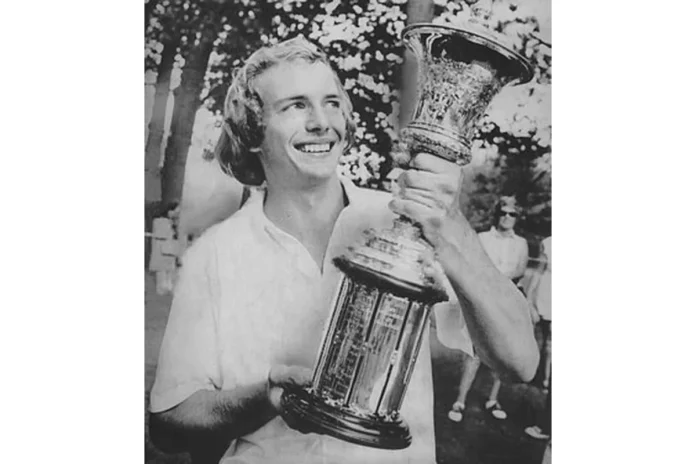
Jerry Pate Bio
Jerome Kendrick Pate (born September 16, 1953) is an American professional golfer who built his reputation as one of the most successful rookies in the history of the game. He plays on the PGA Tour Champions, having previously spent many years on the PGA Tour. In 1976, at just 22 years of age, Pate captured the U.S. Open in his rookie season, immediately establishing himself among the elite players of his generation.
Over the course of his career, Pate collected multiple PGA Tour titles, contributed to United States team victories in international competition, and later transitioned into course design, broadcasting, and senior golf. He remains a respected figure in American golf, recognized for both his playing accomplishments and his contributions off the course.
Early Life and Background
Jerome Kendrick Pate was born in Macon, Georgia, on September 16, 1953. He was one of six children in his family, and his introduction to golf came at an early age. Pate’s father and grandfather introduced him to the game, and the family spent summers in Jacksonville Beach, Florida, playing golf together.
During his youth, Pate’s family moved to Alabama, where he learned the sport at Anniston Country Club. In 1967, the family relocated once more, this time to Florida, due to his father’s work. Pate grew up in the panhandle region, in the city of Pensacola, which remains closely tied to his personal identity and where he continues to reside.
His early years were shaped by constant exposure to golf through family and community, and the moves between Georgia, Alabama, and Florida gave him a varied set of experiences on different courses. These formative years laid the foundation for a competitive career that would later take him to the highest levels of the sport.
Path to Golf
Pate attended the University of Alabama in Tuscaloosa, where he played on the Crimson Tide golf team. His college years provided the structure and competition needed to refine his game, and he soon emerged as one of the top amateur players in the country.
In 1974, Pate won the U.S. Amateur, a defining moment that confirmed his status as a rising star. That same year, he was a member of the victorious United States team at the Eisenhower Trophy competition, where he also won the individual title. A few months later, in May 1975, he played on the winning American side at the Walker Cup held at St Andrews in Scotland.
Shortly after the Walker Cup, Pate tied his teammate Jay Haas of Wake Forest for low amateur honors at the U.S. Open, finishing in a six-way tie for eighteenth place at Medinah, outside Chicago. His amateur achievements positioned him for a smooth transition into the professional ranks, which began in 1975.
Jerry Pate Career
Early Career (1975-1976)
Jerry Pate turned professional in 1975, and late in the year he earned medalist honors at the Fall 1975 PGA Tour Qualifying School, securing his place on the tour. His rookie season in 1976 became one of the most remarkable debut years in PGA Tour history.
That season, Pate won the U.S. Open, becoming one of the youngest champions of the event. He also captured the Canadian Open, closing with a 63 to defeat runner-up Jack Nicklaus by four strokes. These early victories announced his arrival on the professional stage and set the tone for a career marked by both talent and confidence.
PGA Tour Breakthrough (1976-1982)
Following his rookie success, Pate added six more PGA Tour titles over the ensuing years, compiling eight total tour victories. He also won several tournaments around the world, extending his reputation beyond the United States. His competitive record included a PGA Tour playoff mark of 1-2.
Pate was a member of the victorious United States Ryder Cup team in 1981, contributing to one of the most prestigious team events in golf. However, shoulder injuries began to curtail his playing career. His final PGA Tour win came at age 28, at the 1982 Tournament Players Championship, the first held at TPC at Sawgrass. After that victory, Pate famously threw course designer Pete Dye and PGA Tour commissioner Deane Beman into the lake adjacent to the 18th green, before jumping in himself. He had also jumped into the water the previous June, after a victory that ended a near three-year winless stretch.
PGA Tour Champions Era (2006-Present)
After his prime years on the PGA Tour, Pate transitioned into senior golf. In 2006, he earned his first Champions Tour win at the Outback Steakhouse Pro-Am, signaling a new chapter in his playing career.
Health concerns, including arthroscopic left-knee surgery in 2010, forced Pate to begin limiting his Champions Tour appearances. Despite these challenges, he has continued to compete occasionally, and he remains active on the PGA Tour Champions circuit. He also serves as a golf broadcaster for ABC, CBS, and BBC, sharing his insight with audiences.
Driving Style and Strengths
Jerry Pate was known for a composed and accurate approach, paired with the resilience required to win major championships as a rookie. His competitive temperament, refined through amateur and international play, allowed him to handle pressure at the highest level. These qualities helped him deliver clutch performances in the U.S. Open and the Canadian Open during his rookie season.
Notable Events and Milestones
Among Pate’s most memorable moments was his 1976 U.S. Open victory as a 22-year-old rookie, a feat rarely matched in the modern era. His celebration at the 1982 Tournament Players Championship, where he tossed Pete Dye and Deane Beman into the lake, remains one of the most iconic images in PGA Tour history. His participation on the 1981 Ryder Cup team further cemented his place among the notable American players of his era.
Jerry Pate Career Wins
Throughout his career, Jerry Pate accumulated multiple professional titles across various tours, establishing a strong record of competitive success. His wins span the PGA Tour, the Champions Tour, the PGA of Japan Tour, and the South American Golf Circuit, reflecting a global reach in professional golf.
PGA Tour Highlights
Jerry Pate collected 8 PGA Tour victories, with his first coming at the 1976 U.S. Open during his rookie season. His final PGA Tour win occurred at the 1982 Tournament Players Championship at TPC at Sawgrass, where his now-famous celebration took place. These wins include both major championships and regular tour events, demonstrating versatility across different formats and course types.
Other Wins and Performances
Beyond the PGA Tour, Pate secured 2 wins on the Champions Tour, 2 on the PGA of Japan Tour, and 2 on the South American Golf Circuit, bringing his total professional wins to 15. These international and senior titles reflect a career that extended well beyond the borders of the United States and continued into the later stages of his playing days.
| Series | Wins | Top Tens | Poles |
|---|---|---|---|
| PGA Tour | 8 | N/A | N/A |
| Champions Tour | 2 | N/A | N/A |
| PGA of Japan Tour | 2 | N/A | N/A |
| South American Golf Circuit | 2 | N/A | N/A |
Jerry Pate Family
Family Background and Racing Lineage
Jerry Pate was raised in a large family as one of six children. His father and grandfather introduced him to golf at a young age, and the family’s summers in Jacksonville Beach, Florida, were spent playing the game together. These early family experiences established golf as a central part of his life and helped shape his future career.
Personal Life
Jerry Pate is married to Soozi Nelson Pate. He returned to the University of Alabama in the late 1990s to complete his bachelor’s degree in administrative science, and his daughter, Jenni, received her degree at the same graduation ceremony in 2001. Pate resides in Pensacola, Florida, the city where he grew up.
2025 Season Performance
As Jerry Pate continues to compete selectively on the PGA Tour Champions, the 2025 season reflects his ongoing relationship with senior golf, even as he manages age-related and health-related limitations. His appearances remain limited, but he maintains status as a past champion on the tour.
Pate’s 2025 calendar is shaped by a selective schedule, allowing him to participate in events where he feels competitive while managing his physical condition. His past Champions Tour win at the 2006 Outback Steakhouse Pro-Am remains a touchstone for his play on the senior circuit.
Looking ahead, Pate’s role in 2025 is likely to balance limited tournament play with his continued work in broadcasting and golf course design. His legacy as a major champion and his contributions to the sport ensure that his presence on the Champions Tour remains notable, regardless of the number of events he enters.