
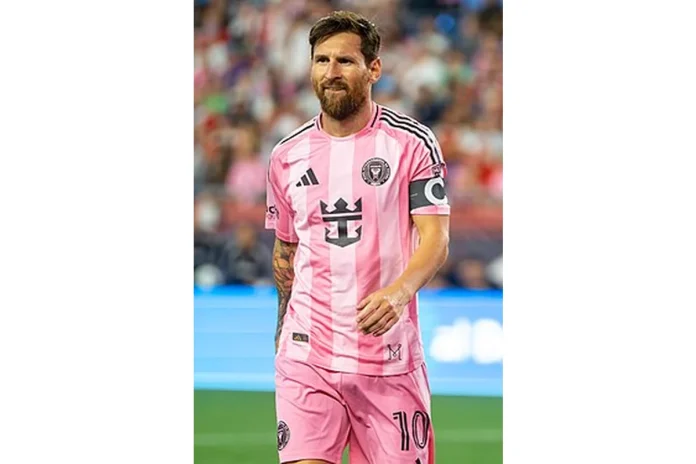
Lionel Messi Bio
Lionel Andrés Messi is an Argentine professional footballer widely regarded as one of the greatest players in the history of the sport. Born on 24 June 1987 in Rosario, Santa Fe Province, he plays as a forward and currently captains both Major League Soccer club Inter Miami and the Argentina national team. Across his senior career, Messi has scored over 890 goals and provided more than 400 assists for club and country, producing over 1,300 career goal contributions, the highest total ever recorded in the sport.
At club level, Messi is the most decorated player in professional football history, having won 46 team trophies. His collection includes ten La Liga titles and four UEFA Champions League crowns with FC Barcelona, two Ligue 1 titles with Paris Saint-Germain, and the 2023 Leagues Cup and 2025 MLS Cup with Inter Miami. With Argentina, he has captained the national team to three major international titles, including the 2022 FIFA World Cup, cementing his legacy at both the club and international level.
Early Life and Background
Lionel Andrés Messi was born on 24 June 1987 in Rosario, Santa Fe Province, Argentina. He was the third of four children of Jorge Messi, a steel factory manager, and his wife Celia Cuccittini, who worked in a magnet manufacturing workshop. On his father’s side, he is of Italian and Spanish descent, while on his mother’s side he has primarily Italian ancestry. Growing up in a tight-knit, football-loving family, Messi developed a passion for the sport from an early age, playing constantly with his older brothers Rodrigo and Matías, and his cousins Maximiliano and Emanuel Biancucchi, both of whom became professional footballers.
At the age of four, Messi joined local club Grandoli, where he was coached by his father. Another early influence came from his maternal grandmother Celia, who accompanied him to training and matches. He was greatly affected by her death shortly before his eleventh birthday. Since then, as a devout Catholic, he has celebrated his goals by looking up and pointing to the sky in tribute to his grandmother.
As a young player in Argentina, Messi attracted attention from several clubs. Because his family had relatives in Catalonia, they arranged a trial with FC Barcelona in September 2000. First-team director Carles Rexach immediately wanted to sign him, and on 14 December 2000, offered a contract on a paper napkin after issuing an ultimatum. In February 2001, the family relocated to Barcelona, where they moved into an apartment near the club’s Camp Nou stadium.
Path to Professional Soccer
After a year at Barcelona’s youth academy, La Masia, Messi was finally enrolled in the Royal Spanish Football Federation in February 2002, allowing him to play in all official competitions. He quickly befriended his teammates, among whom were Cesc Fàbregas and Gerard Piqué. After completing his growth hormone therapy at 14, Messi became an integral part of the “Baby Dream Team,” Barcelona’s greatest-ever youth side. During his first full season in 2002–03, he was top scorer with 36 goals in 30 games for the Cadetes A, who won an unprecedented treble of the league, the Spanish cup, and the Copa Catalunya.
Messi continued to progress rapidly through the club’s ranks, debuting for four youth teams during the 2003–04 season. He was named player of the tournament in four separate international pre-season competitions with the Juvenil B before being promoted to the Juvenil A, where he scored 18 goals in 11 league games. He was then called up to strengthen a depleted first team during the international break, and his performances in training with Frank Rijkaard’s senior squad drew widespread praise. French winger Ludovic Giuly recalled that Messi “destroyed us all” and that even the team’s starting centre-backs were nervous, calling him “an alien.”
At 16 years, four months, and 23 days old, Messi made his first-team debut in a friendly against Porto on 16 November 2003. His performance created two chances and a shot on goal, impressing the technical staff. After his first training session with the senior squad, star player Ronaldinho told his teammates that the 16-year-old would become an even better player than himself. Ronaldinho soon befriended Messi, whom he called “little brother,” greatly easing his transition into the first team.
Lionel Messi Career
Early Career (2003–2007)
To gain further match experience, Messi joined Barcelona C in addition to the Juvenil A, helping save the third team from the relegation zone of the Tercera División with five goals in ten games. His progress was reflected in his first professional contract, signed on 4 February 2004, which lasted until 2012 and contained an initial buyout clause of €30 million. A month later, on 6 March, he made his debut for Barcelona B in the Segunda División B, and his buyout clause automatically increased to €80 million.
Messi began the 2004–05 season as a guaranteed starter for Barcelona B, but after lobbying by the senior players, he was promoted to the first team by manager Frank Rijkaard. He made his La Liga debut for Barcelona on 16 October 2004 against Espanyol and scored his first senior goal on 1 May 2005 against Albacete from an assist by Ronaldinho, becoming at that time the youngest-ever scorer for the club. At 17 years, three months, and 22 days old, he was also the youngest player to represent Barcelona in an official competition, and the club won the league title during that season. During the 2005–06 campaign, Barcelona won La Liga and the UEFA Champions League, although Messi did not play in the final due to injury. The following season, he scored his first hat-trick in a Clásico against Real Madrid, the first player to do so in 12 years.
Barcelona Breakthrough (2008–2012)
At the beginning of the 2008–09 season, his first under new manager Pep Guardiola, Messi was given the number 10 shirt. He effectively became the tactical focal point of Guardiola’s possession-based system, increasing his goalscoring rate as a result. During that season, he scored 38 total goals and, alongside Samuel Eto’o and Thierry Henry, contributed to a total of 100 goals in all competitions, a club record at the time. Barcelona won La Liga, the Copa del Rey, and the Champions League, achieving the first treble in the history of Spanish football.
During the 2009–10 season, Barcelona also won the Supercopa de España, UEFA Super Cup, and FIFA Club World Cup, becoming the first club to achieve the sextuple. Messi finished as the Champions League top scorer, the youngest in the tournament’s history, and won his first Ballon d’Or and FIFA World Player of the Year award. In the 2010–11 campaign, he won the Supercopa de España, Champions League, and a third consecutive La Liga title, earning his second consecutive Ballon d’Or. He also became Barcelona’s all-time single-season top scorer with 53 goals.
During the 2011–12 season, Messi became Barcelona’s all-time top scorer at age 24, overtaking César Rodríguez’s 57-year record of 232 goals with a hat-trick against Granada. He finished the campaign as league top scorer in Spain and Europe for a second time, with 50 goals, a La Liga record, while his 73 goals in all competitions made him the single-season top scorer in the history of European club football. The team also won the Copa del Rey that season, their 14th trophy under Guardiola, who resigned following the campaign.
Records and Captaincy (2012–2021)
For his efforts in 2012, Messi scored a record 91 goals in all competitions for Barcelona and Argentina, surpassing Gerd Müller’s record of most goals in a calendar year. He again won the FIFA Ballon d’Or, becoming the first player in history to win the award four times. During the 2014–15 season, under new coach Luis Enrique, Messi formed the famed ‘MSN’ attacking trio with Luis Suárez and Neymar, leading Barcelona to a historic second continental treble and a fifth Ballon d’Or. He surpassed Telmo Zarra’s 59-year record of 251 La Liga goals to become the all-time top scorer in the league.
Messi won the FIFA Ballon d’Or for a record fifth time in January 2016. With the departure of former captain Andrés Iniesta in May 2018, he was named the team’s new captain for the 2018–19 season. He lifted his first trophy as captain, the Supercopa de España, and helped Barcelona clinch a tenth La Liga title, his first as captain. He won his sixth Ballon d’Or in 2019, but the subsequent 2019–20 season saw Barcelona go trophyless for the first time since 2007–08. During the 2020–21 campaign, he surpassed Xavi’s record to reach a club record of 768 appearances and led the team to victory in the Copa del Rey final.
Messi became a free agent after his contract expired, with negotiations on a new deal complicated due to Barcelona’s financial issues. The club eventually announced that Messi would not stay, citing financial and structural obstacles posed by La Liga regulations. In a tearful press conference held at the Camp Nou, Messi confirmed he would leave Barcelona after winning a club-record 34 trophies, including ten La Liga titles and four Champions Leagues.
Paris Saint-Germain Era (2021–2023)
Financial difficulties at Barcelona led to Messi signing with French club Paris Saint-Germain in August 2021. He won the Ligue 1 title during both of his seasons there, forming part of a star-studded forward line in the French capital. In 2022, he led Argentina to victory at the FIFA World Cup in Qatar, the country’s first world title in 36 years. Following his World Cup win with Argentina and Ligue 1 trophy with PSG, he was awarded a record-extending eighth Ballon d’Or on 30 October 2023.
Inter Miami Era (2023–Present)
Major League Soccer club Inter Miami CF announced the signing of Messi on a two-and-a-half-year contract on 15 July 2023. His arrival in the United States was credited with helping to raise the profile of MLS both domestically and abroad, with the frenzy over his signing dubbed “Messimania.” Messi made his 2023 debut in a Leagues Cup match against Cruz Azul, scoring with a free-kick in stoppage time for a victory, and went on to lead the team to the club’s first-ever trophy, the Leagues Cup, in his sixth appearance. He was named team captain after DeAndre Yedlin gave him the armband.
During the 2024 season, Messi broke the record for the most assists in a single MLS game with five assists, and the record for the most goal contributions in an MLS game with six, in a 6–2 win over the New York Red Bulls. He scored a brace in a 3–2 win over the Columbus Crew on 2 October, clinching the Supporters’ Shield, and finished the regular season with 20 goals and 16 assists in 19 matches, becoming Inter Miami’s all-time top goalscorer. He was named the MLS Most Valuable Player following the conclusion of the regular season.
During the 2025 season, Messi became the fastest player to reach 40 goals in MLS history. He ended the campaign winning the MLS Golden Boot as the league’s top scorer, with 29 goals and 19 assists in 28 games. On 23 October 2025, he signed a three-year contract extension with the club through 2028. In the Eastern Conference final against New York City FC, an assist from Messi put his career total at 405, surpassing Ferenc Puskás for the most career assists of all time. He led Miami to MLS Cup 2025, which they won 3–1 over the Vancouver Whitecaps to claim the club’s first MLS Cup title.
Driving Style and Strengths
Although best known for his extraordinary dribbling ability, vision, and goal-scoring prowess, Messi has consistently evolved his game across more than two decades at the elite level. He began as a direct right winger at Barcelona before transitioning into a false nine role under Pep Guardiola, becoming the tactical focal point of a possession-based system. He later reinvented himself as a deeper playmaker, where his passing range and creativity have allowed him to continue dictating games into his late thirties.
Notable Events and Milestones
Among Messi’s most celebrated milestones are his 91 goals in a calendar year in 2012, his 672 goals for FC Barcelona, his record 474 La Liga goals, and his status as the most-capped player and all-time leading goalscorer for Argentina. He is also the record holder for most goal contributions in FIFA World Cup history with 21, and most goal contributions in the Copa América with 32. In 2020, he was named to the Ballon d’Or Dream Team and became the second footballer to surpass $1 billion in career earnings.
Lionel Messi Career Wins
Across his senior career, Lionel Messi has established himself as the most decorated player in the history of professional football, having won 46 team trophies. His collection spans La Liga, the UEFA Champions League, Ligue 1, the Leagues Cup, the MLS Cup, the Copa América, and the FIFA World Cup. He has also collected a record eight Ballon d’Or awards, six European Golden Shoes, and was named the world’s best player by FIFA on eight occasions.
Barcelona Highlights
Messi made his competitive debut for Barcelona at age 17 in October 2004. During his 17-year association with the club, he won a club-record 34 trophies, including ten La Liga titles, four Champions League crowns, seven Copa del Rey titles, and three FIFA Club World Cups. He also became Barcelona’s all-time top scorer in both La Liga and overall competition, netting 672 goals for the club across all competitions.
International Highlights
An Argentine international, Messi is the national team’s all-time leading goalscorer and most-capped player. After winning the gold medal at the 2008 Summer Olympics, he assumed the captaincy in 2011 and led Argentina to three consecutive finals between 2014 and 2016, all of which they lost. He helped his country end a 28-year trophy drought by winning the 2021 Copa América and later captained them to the 2022 FIFA World Cup title in Qatar. He was victorious at the 2024 Copa América, securing his third major international title.
Lionel Messi Family
Family Background and Soccer Lineage
Messi was born into a tight-knit, football-loving family in Rosario. His father, Jorge Messi, worked as a steel factory manager, while his mother, Celia Cuccittini, worked in a magnet manufacturing workshop. On his father’s side, he is of Italian and Spanish descent, and on his mother’s side, he has primarily Italian ancestry. His cousins Maximiliano and Emanuel Biancucchi both became professional footballers, continuing the family’s deep ties to the sport.
Personal Life
Messi is married to Antonela Roccuzzo, his childhood sweetheart from Rosario. The couple has three sons, including Thiago, born in 2012. The family relocated with Messi throughout his career, from Barcelona to Paris and later to Miami, where they have been based since his move to Inter Miami in 2023. His wife and children have regularly been seen at his matches and major career events.
2025 Season Performance
During the 2025 MLS season, Lionel Messi produced one of the most dominant individual campaigns in league history. He became the fastest player to reach 40 goals in MLS history and ended the regular season as the league’s top scorer, winning the MLS Golden Boot with 29 goals and 19 assists in 28 games. He was named the league’s Most Valuable Player for the second consecutive year, extending his record of back-to-back MVP awards in 2024 and 2025.
Messi’s form carried into the postseason, where he led Inter Miami on a deep playoff run. In the Eastern Conference final against New York City FC, he delivered an assist to Mateo Silvetti that pushed his career total to 405, surpassing Ferenc Puskás for the most career assists of all time. He then led Miami to MLS Cup 2025, where they defeated the Vancouver Whitecaps 3–1 to claim the club’s first-ever MLS Cup title.
On 23 October 2025, Messi signed a three-year contract extension with Inter Miami through 2028, by which time he would be 41 years old, signaling his intention to continue competing at the highest level. With the 2026 FIFA World Cup approaching and his legacy in Miami still being written, Messi enters the next phase of his career with his trademark goalscoring and creative influence intact.