
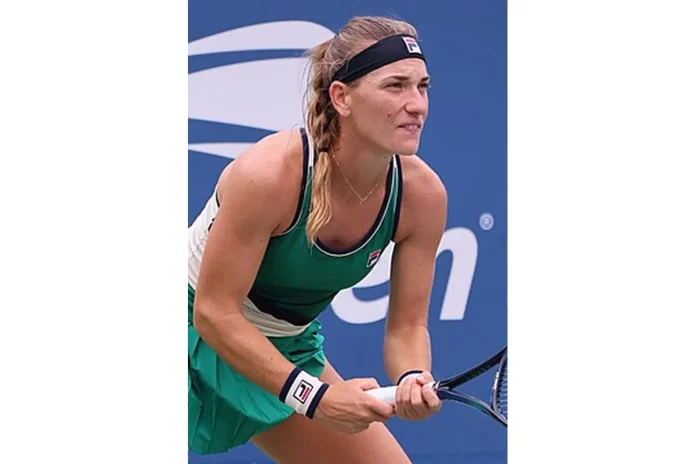
Tímea Babos Bio
Tímea Babos is a Hungarian professional tennis player who specializes in doubles. Born on 10 May 1993 in Sopron, Hungary, she is a former world No. 1 in doubles and one of the most successful Hungarian players in tennis history. Babos has won 28 WTA Tour doubles titles and three singles titles, and she is a four-time Grand Slam champion in women’s doubles, having claimed the Australian Open in 2018 and 2020 alongside Kristina Mladenovic, as well as the French Open in 2019 and 2020 with the same partner.
Standing 179 cm tall, Babos is widely regarded as the most successful Hungarian tennis player of her era, holding seven major doubles titles across women’s and girls’ competitions. She represented Hungary at the 2012 and 2016 Olympic Games and has been a member of the Hungarian Fed Cup and Billie Jean King Cup team since 2011. Her powerful serve and aggressive baseline game have made her a consistent threat on faster surfaces throughout her career.
Early Life and Background
Tímea Babos was born on 10 May 1993 in Sopron, Hungary, to mother Zsuzsanna and father Csaba. She has an older sister who was also a strong tennis player and later won NCAA titles while studying at the University of California, Berkeley. Coming from a sporty family, Babos was originally a swimmer and became a national champion in Hungary at a young age, but she eventually found the sport repetitive and decided to switch to tennis.
Babos began attending tennis practice with her sister at the age of eight and started playing at a local club in Sopron. Her father, who serves as a coach at the family-owned tennis club in their hometown, quickly recognized her talent and encouraged her to focus on the sport. By the age of nine, she had qualified for the Hungarian National Championships in the under-12 category and won her first national title shortly afterward. At 15, she relocated to the United Kingdom to train on hard courts, as Hungary’s clay-heavy facilities limited her development on faster surfaces. Two years later, a sponsorship deal allowed her to return to Hungary and train in Budapest.
Path to Professional Tennis
Babos began competing on the ITF Junior Circuit in September 2006 at the age of 13, winning the doubles title in her debut event at the Grade-5 Talentum Cup in Hungary. She quickly rose through the junior ranks, winning multiple Grade-3 and Grade-2 doubles titles by the end of 2007. In 2008, she made her junior Grand Slam debut at the French Open and reached the second round in both singles and doubles, later advancing to the quarterfinals in doubles at Wimbledon.
By 2009, Babos was producing strong results at Grade-A and Grade-1 junior events, winning both the singles and doubles titles at the Copa Gatorade and the Sarawak Chief Minister’s Cup. At the 2009 French Open, she reached her first junior Grand Slam doubles final, partnering with Heather Watson. The following year marked her major breakthrough, as she won the girls’ doubles titles at the French Open, Wimbledon, and the US Open, all alongside Sloane Stephens, without dropping a set at the French Open. That same year, she also began competing on the ITF Women’s Circuit at age 15, reaching the final in her debut event in Bournemouth and winning her first title the following week in the United Kingdom.
Tímea Babos Career
Early Career (2011–2013)
Babos made her WTA Tour singles debut at the 2011 Hungarian Open as a wildcard, recording her first WTA match-win before falling in the second round. That year, she also won her first $50,000 event in both singles and doubles at the Challenger de Saguenay. In 2012, she reached her first WTA Tour singles final at the Monterrey Open and won the title, helping her break into the top 100 for the first time. She also made her Grand Slam singles debut at the French Open and recorded her first major match-win at Wimbledon.
In doubles, Babos won her first WTA Tour title at the 2012 Birmingham Classic alongside Hsieh Su-wei, defeating Liezel Huber and Lisa Raymond in three sets. Throughout 2013, she made significant progress in doubles, winning four International-level titles, including the Copa Colsanitas, the Monterrey Open, the Morocco Open, and the Tashkent Open. These early successes laid the foundation for her transition into one of the elite doubles players on the WTA Tour.
WTA Tour Breakthrough (2014–2016)
In 2014, Babos continued her strong doubles form by winning the Premier-level Sydney International and reaching her first Grand Slam doubles final at Wimbledon alongside Kristina Mladenovic, where they lost to Sara Errani and Roberta Vinci. She also reached the doubles final at the Cincinnati Open that year. In 2015, she claimed her first Premier 5 doubles title at the Dubai Championships with Mladenovic and later won the Premier 5 Italian Open, establishing herself as a top-tier doubles player.
The 2016 season was a breakthrough year for Babos in singles, as she reached the round of 16 at the Miami Open, advanced to the third round at the US Open for the first time, and climbed to her career-high singles ranking of No. 25 in September. In doubles, she reached her second Grand Slam final at Wimbledon, this time partnering with Yaroslava Shvedova, losing to Serena and Venus Williams. She also qualified for the WTA Finals for the second consecutive year.
Grand Slam Titles and World No. 1 Era (2017–2020)
The 2017 season saw Babos win her second career singles title at the Hungarian Open and qualify for the WTA Finals in doubles, where she won the title alongside Andrea Sestini Hlaváčková. In 2018, she claimed her third singles title at the Taiwan Open and won her first Grand Slam doubles title at the Australian Open with Mladenovic, defeating Ekaterina Makarova and Elena Vesnina. On 16 July 2018, Babos became the world No. 1 in doubles, the first Hungarian player, male or female, to reach the top ranking in either singles or doubles. She held the No. 1 position for 13 weeks and won the WTA Finals title for the second time.
In 2019, Babos and Mladenovic won the French Open doubles title, defeating Duan Yingying and Zheng Saisai in the final. They also reached the final at the Australian Open and won the WTA Finals for the third time. In 2020, the pair successfully defended both their Australian Open and French Open titles, winning all four of their Grand Slam doubles crowns together. However, Babos withdrew from the 2020 Olympic Games in women’s doubles due to a hip injury.
Comeback and New Partnership Era (2021–2025)
After a difficult 2022 season in which she reached her lowest doubles ranking of No. 242 due to her refusal to comply with COVID-19 vaccination rules at the Australian Open, Babos gradually returned to form. In 2025, partnering with Brazilian Luisa Stefani for the first time, she won four doubles titles, including the WTA 500 Upper Austria Ladies Linz, the WTA 500 Internationaux de Strasbourg, the SP Open in São Paulo, and the Pan Pacific Open in Tokyo.
By reaching the final at the Ningbo International Open, Babos and Stefani qualified for the WTA Finals for the fourth time in Babos’s career. At the WTA Finals, they advanced past the round-robin stage and reached the semifinals before losing to Elise Mertens and Veronika Kudermetova in the final. Following the season, Babos announced she would not continue her partnership with Stefani in 2026 and planned to take a break before aiming to compete at the 2028 Summer Olympic Games in Los Angeles.
Playing Style and Strengths
Babos plays an aggressive style with a strong mix of shots, often using slices and drop shots to vary her game. Her height and power make her serve her biggest weapon, particularly effective on faster surfaces such as grass and indoor hard courts. Although she grew up playing on clay, she has adapted her game to thrive across all surfaces, frequently taking the net in doubles to finish points with winners. Her doubles expertise and tactical intelligence have been central to her success at the highest level.
Notable Events and Milestones
One of the defining moments of Babos’s career was becoming the first Hungarian player, male or female, to reach the world No. 1 ranking in either singles or doubles, achieving the milestone in July 2018. Her four Grand Slam doubles titles, all won alongside Kristina Mladenovic, cement her status as the most successful Hungarian tennis player in history. She has also won three WTA Finals doubles titles, a remarkable achievement in the year-end championship format.
Tímea Babos Career Wins
Tímea Babos has accumulated an impressive collection of titles across singles and doubles throughout her professional career. She has won three WTA Tour singles titles and 28 WTA Tour doubles titles, including four Grand Slam doubles crowns, three WTA Finals doubles titles, and two WTA 1000 trophies. Her partnership with Kristina Mladenovic has been the most successful of her career, producing the majority of her biggest titles.
Grand Slam Doubles Highlights
Babos is a four-time Grand Slam champion in women’s doubles, having won the Australian Open in 2018 and 2020, as well as the French Open in 2019 and 2020, all alongside Kristina Mladenovic. She has also reached the final at Wimbledon in 2014 (with Mladenovic) and 2016 (with Yaroslava Shvedova), the US Open final in 2018, and the Australian Open final in 2019. In mixed doubles, she reached the final at Wimbledon in 2015 with Alexander Peya and at the 2018 Australian Open with Rohan Bopanna.
Other Wins and Performances
Beyond her Grand Slam success, Babos has won three WTA Finals doubles titles in 2017, 2018, and 2019, partnering with Andrea Sestini Hlaváčková in 2017 and Mladenovic in 2018 and 2019. She has also won two WTA 1000 doubles titles and multiple Premier-level and International-level titles throughout her career. In singles, her three WTA Tour titles came at the 2012 Monterrey Open, the 2017 Hungarian Open, and the 2018 Taiwan Open.
Tímea Babos Family
Family Background and Tennis Lineage
Tímea Babos comes from a sporty family rooted in tennis. Her father, Csaba, is a coach at the family-owned tennis club in Sopron, Hungary, and was instrumental in developing both Tímea and her older sister’s games. Her mother, Zsuzsanna, is a housewife who supported the family’s athletic pursuits. Her older sister was also a talented tennis player and went on to win NCAA titles while studying at the University of California, Berkeley.
Personal Life
Babos resides in her birthplace of Sopron, Hungary, and continues to be closely connected to her hometown. Her doubles partner Kristina Mladenovic gave her the nickname ‘Babosdook’ on tour, a reference to the horror film The Babadook, owing to Babos’s well-known love of horror films. She is a supporter of Manchester United, a passion shared by her entire family. Growing up, she admired Russian player Elena Dementieva for her graceful playing style and sportsmanship.
2025 Season Performance
The 2025 season marked a strong resurgence for Tímea Babos in doubles, as she partnered with Brazilian Luisa Stefani for the first time. The pair quickly found success, winning the WTA 500 Upper Austria Ladies Linz in January and following it up with the WTA 500 Internationaux de Strasbourg in May. They added two more titles later in the season at the SP Open in São Paulo and the Pan Pacific Open in Tokyo, establishing themselves as one of the most consistent doubles teams on tour.
Throughout the Asian hard-court swing, Babos and Stefani reached the quarterfinals at the China Open, the round of 16 at the Wuhan Open, and the final at the Ningbo International Open. Their performance at Ningbo secured the remaining points needed to qualify for the WTA Finals, marking Babos’s fourth appearance at the year-end championship. They went on to reach the final at the WTA Finals in Riyadh before falling to Elise Mertens and Veronika Kudermetova.
Following the season, Babos confirmed that she would not continue her partnership with Stefani in 2026, opting instead to play only the Australian tournaments before taking a break to spend time with friends and family. She also expressed her intention to represent Hungary at the 2028 Summer Olympic Games in Los Angeles, signaling that her career is far from over.