
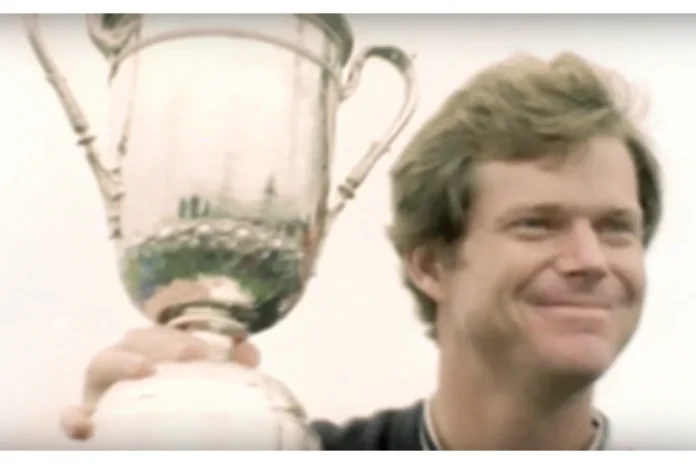
Tom Watson Bio
Thomas Sturges Watson, widely known as Tom Watson, is an American professional golfer born on September 4, 1949, in Kansas City, Missouri. In the 1970s and 1980s, Watson was one of the leading golfers in the world, winning eight major championships and heading the PGA Tour money list five times. He was the number one player in the world according to McCormack’s World Golf Rankings from 1978 until 1982, and he is regarded as one of the greatest links players in the history of the sport.
Watson’s career is also defined by remarkable longevity. At nearly sixty years of age, and more than two decades after his last major victory, he led after the second and third rounds of The Open Championship in 2009 before losing in a four-hole playoff to Stewart Cink. Beyond his playing career, Watson has been an international team captain, a golf course designer, and a member of the World Golf Hall of Fame.
Tom Watson Early Life and Background
Tom Watson was born in Kansas City, Missouri, and raised in the surrounding area. He was introduced to the game of golf by his father, Ray, who sparked a lifelong passion for the sport. His early coach was Stan Thirsk at the Kansas City Country Club, where Watson first developed the swing and temperament that would later define his professional career. He first gained local attention while playing on his high school team at The Pembroke-Country Day School in Kansas City.
Watson went on to attend Stanford University, where he played on the golf and table tennis teams and joined the fraternity Alpha Sigma Phi. He graduated from Stanford with a degree in psychology in 1971, the same year he turned professional. His college years in California helped sharpen his competitive game and prepared him for the rigors of the PGA Tour.
Path to Professional Golf
Before turning professional, Watson won four Missouri State Amateur championships in 1967, 1968, 1970, and 1971, establishing himself as one of the top amateur players in the region. His consistent amateur success drew the attention of professional scouts and laid the foundation for his smooth transition to the PGA Tour in 1971.
Watson joined the PGA Tour in 1971 and quickly began making his mark. He hired Bruce Edwards as his caddie for the first time at the 1973 St. Louis tournament held at Norwood Hills Country Club, and the two formed a partnership that lasted many years. Watson contended in a major championship for the first time at the 1974 U.S. Open at Winged Foot, where he held the 54-hole lead before fading in the final round. That disappointment was a turning point, as the legendary Byron Nelson reached out to mentor him, offering guidance on swing mechanics and course management that would shape Watson’s rise to the top of the game.
Tom Watson Career
Early Career (1971–1974)
Watson’s early years on the PGA Tour were a period of rapid learning. Just two weeks after his collapse at the 1974 U.S. Open, he won his first Tour title at the Western Open near Chicago, coming from six shots back in the final round at Butler National. That victory signaled his arrival as a player capable of competing at the highest level.
Working with Byron Nelson as a mentor, Watson refined his technique and course management. With that guidance and relentless practice, he built the foundation for a career that would soon include major championships and consistent contention on the toughest stages in golf.
The Open Championship Breakthrough (1975–1983)
Watson won his first major championship, the 1975 Open Championship, on his first appearance in the event in Britain. He holed a 20-foot birdie putt on the 72nd hole at Carnoustie to tie Jack Newton, then won an 18-hole playoff by a stroke the following day. He remains one of only four players since World War II to have won The Open Championship on their debut.
Watson won his second major and first Masters title in 1977 after a memorable duel with Jack Nicklaus. His 1977 Open Championship victory at Turnberry, where he and Nicklaus traded 65s for two consecutive rounds, is widely regarded as one of the finest tournaments of the twentieth century. Watson went on to win additional Open Championships in 1980 at Muirfield and in 1983 at Royal Birkdale, the last of his eight major titles.
Masters and U.S. Open Triumphs (1977–1982)
In 1981, Watson won his second Masters title at Augusta National by two strokes over Jack Nicklaus and Johnny Miller. The following year, in 1982, he captured the U.S. Open at Pebble Beach in one of the most dramatic finishes in major championship history. Trailing Nicklaus by one stroke on the 17th hole, Watson hit a miraculous chip that struck the flagstick and dropped for a birdie, then birdied the 18th to win by two shots.
Just a month later, Watson won the 1982 Open Championship at Royal Troon, becoming only the third golfer since World War II to win the U.S. Open and The Open Championship in the same year. Those two victories cemented his reputation as one of the most complete players of his generation.
Later PGA Tour Years (1984–1998)
After his runner-up finish at the 1984 Open Championship at St Andrews, where he narrowly missed a third consecutive Open title, Watson did not win a PGA Tour event for three years until the 1987 Nabisco Championship. He came close to a ninth major at the 1987 U.S. Open at the Olympic Club, where he led by one shot entering the final round but lost to Scott Simpson by a stroke.
Watson’s stellar play on the PGA Tour faded in the late 1980s as putting problems hampered his results. He mounted a revival in the late 1990s, winning the 1996 Memorial Tournament and recording the last of his 39 PGA Tour victories at the 1998 MasterCard Colonial at age 48.
Champions Tour Era (1999–Present)
Watson joined the Champions Tour in 1999 and built a remarkable senior career. He recorded 14 Champions Tour wins, including six senior majors, while playing a limited schedule. Watson won the Senior British Open Championship three times, in 2003, 2005, and 2007, with the 2003 victory coming at Turnberry, the site of his famous 1977 Open win.
Watson was named Champions Tour Player of the Year in 2003 and won the Champions Tour Charles Schwab Cup in both 2003 and 2005. He was inducted into the World Golf Hall of Fame in 1988, capping a distinguished career that includes recognition as PGA Player of the Year six times and Vardon Trophy winner three times.
Driving Style and Strengths
Watson has been one of the most complete players ever to play the game. Standing 5 feet 9 inches and weighing 160 pounds during his PGA Tour years, he achieved abundant length with accuracy and developed a superlative short game. He is renowned as an exceptional bad-weather golfer, having displayed his gritty talent best in the difficult and varied conditions of The Open Championship. At the height of his career, Watson was well known for his excellent recovery skills, especially around the greens, and a confident putting stroke.
Notable Events and Milestones
Watson’s career is filled with signature moments, including the 1977 Duel in the Sun at Turnberry, the chip-in birdie at the 1982 U.S. Open, and his unforgettable run at the 2009 Open Championship at age 59. He captained the United States Ryder Cup team to victory in 1993 at The Belfry in England and again in 2014 at Gleneagles in Scotland. Watson also won the 2018 Masters Tournament Par-3 Contest at age 68, the oldest player ever to win that event.
Tom Watson Career Wins
Tom Watson compiled 39 PGA Tour victories, 14 Champions Tour wins, and a total of 70 professional victories across multiple tours worldwide. His eight major championships rank sixth on the all-time list, behind only Jack Nicklaus, Tiger Woods, Walter Hagen, Ben Hogan, and Gary Player.
Major Championship Highlights
Watson won five Open Championships, including his debut win in 1975 at Carnoustie and his final major at Royal Birkdale in 1983. He captured two Masters titles, in 1977 and 1981, and one U.S. Open title in 1982 at Pebble Beach. He finished runner-up in multiple majors, including three Masters, the 1984 Open, and the famous 2009 Open at Turnberry.
Other Wins and Performances
Beyond his major victories, Watson was the leading money winner on the PGA Tour in 1977, 1978, 1979, 1980, and 1984. He recorded eight European Tour wins and four PGA of Japan Tour wins. His other senior titles include three Senior British Open Championships and additional Champions Tour victories that established him as one of the most successful Champions Tour players of his era.
Tom Watson Family
Family Background and Personal Life
Tom Watson married Linda Rubin in 1972, and they had two children before divorcing in 1997. He married Hilary Watson in 1999, and they were married for twenty years until her death in 2019. Three years later, in 2022, he married Leslie Anne Wade, though they separated later that year. Watson has resided in the Kansas City area for most of his life and designed the National Golf Club of Kansas City.
Personal Life
Watson was a long-standing member of the Kansas City Country Club from the start of his professional career, though he resigned in 1990 after learning that club leaders had rejected an applicant based on faith. His wife and two children at the time were Jewish, and Watson publicly stated his belief that people should not be judged on the basis of race or religion. He has also been involved in political and civic causes, donating to the National Rifle Association and participating in local political efforts in Overland Park, Kansas.
2025 Season Performance
Tom Watson’s competitive playing schedule has been significantly reduced in recent years. His last major appearance came at the 2016 Masters, where he missed the cut, and his final competitive event on British soil was the 2019 Senior British Open. At age 75 in 2025, Watson has transitioned away from active tournament play, focusing instead on golf course design through his Tom Watson Design company and on his legacy as one of the game’s greatest players.
Watson continues to be recognized at major championships and Champions Tour events as an ambassador of the game. His contributions to golf, both as a player and as a designer, remain influential, and he is widely consulted on matters relating to tradition, sportsmanship, and the spirit of competitive golf.