
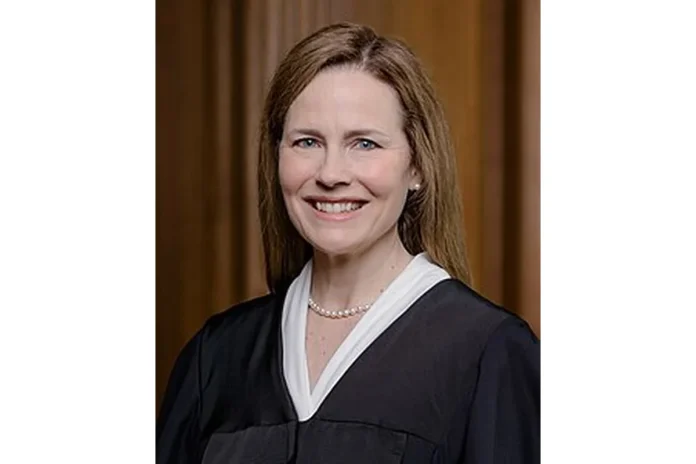
Amy Coney Barrett Bio
Amy Vivian Coney Barrett (born January 28, 1972) is an American lawyer, jurist, and academic who has served since 2020 as an Associate Justice of the Supreme Court of the United States. Nominated by President Donald Trump, she is the fifth woman to serve on the Court. Prior to joining the Supreme Court, she served as a judge on the U.S. Court of Appeals for the Seventh Circuit from 2017 to 2020, and she spent many years on the faculty of Notre Dame Law School, where she taught and published in constitutional law and statutory interpretation. A graduate of Rhodes College and Notre Dame Law School, Barrett clerked for Justice Antonin Scalia and is widely identified with a textualist and originalist approach to legal interpretation.
Beyond the courtroom, Barrett has been a prominent voice in debates over the proper role of judges, the meaning of precedent, and the interpretation of the Constitution. Her confirmation in 2020 was one of the most closely watched in modern history, occurring only days before a presidential election. She has since become a central figure in the Court’s conservative majority while occasionally crossing conventional lines in major cases.
Amy Coney Barrett
Early Life and Background
Amy Vivian Coney was born in 1972 in New Orleans, Louisiana, to Linda (née Vath) and Michael Coney. The eldest of seven children, she grew up with five sisters and one brother. Her father worked as an attorney for Shell Oil Company, and her mother was a high school French teacher and homemaker. Barrett has Irish and French ancestry, with maternal ancestors from Ballyconnell, County Cavan, Ireland, and French great-great-grandparents who emigrated to New Orleans. Her family is devoutly Catholic, and her father is an ordained deacon at St. Catherine of Siena Parish in Metairie, Louisiana, where she spent her formative years.
Barrett attended St. Mary’s Dominican High School, an all-girls Roman Catholic high school in New Orleans. She served as student body vice president and graduated in 1990. After high school, she enrolled at Rhodes College in Memphis, Tennessee, majoring in English literature and minoring in French. She has described herself as “somewhat fluent” in French, though with a Louisiana accent. Barrett graduated from Rhodes in 1994 with a Bachelor of Arts, magna cum laude, and was inducted into Omicron Delta Kappa and Phi Beta Kappa. In her graduating class, she was named the most outstanding English department graduate.
Path to Law
Following her undergraduate studies, Barrett attended Notre Dame Law School on a full-tuition scholarship. She served as an executive editor of the Notre Dame Law Review and graduated in 1997 with a Juris Doctor, summa cum laude, ranked first in her class. After law school, she clerked for Judge Laurence Silberman of the U.S. Court of Appeals for the D.C. Circuit and then for Supreme Court Justice Antonin Scalia, an experience that deeply shaped her legal philosophy. She has described Scalia as a mentor and has written that his judicial philosophy is also hers.
In 2001, Barrett was a visiting associate professor and John M. Olin Fellow in Law at George Washington University Law School. In 2002, she joined the faculty of her alma mater, Notre Dame Law School, where she taught federal courts, evidence, constitutional law, and statutory interpretation. In 2010, she was named a professor of law, and from 2014 to 2017 she held Notre Dame’s Diane and M.O. Miller II Research Chair of Law. Her scholarship focused on constitutional law, originalism, statutory interpretation, and stare decisis, and her work has appeared in the Columbia, Cornell, Virginia, Notre Dame, and Texas law reviews.
Amy Coney Barrett Career
Early Career (2002–2017)
Barrett spent more than a decade on the Notre Dame Law School faculty, earning a reputation as a leading conservative scholar of constitutional law. In 2010, Chief Justice John Roberts appointed her to serve on the Advisory Committee for the Federal Rules of Appellate Procedure, an early sign of her standing within the legal establishment. At Notre Dame, she received the “Distinguished Professor of the Year” award three times. From 2011 to 2016, she spoke on constitutional law at the Blackstone Legal Fellowship, a summer program for law students established by the Alliance Defending Freedom.
In 2017, Barrett was nominated by President Donald Trump to a seat on the U.S. Court of Appeals for the Seventh Circuit. She was confirmed by the U.S. Senate and joined the court, where she served until 2020. During her three years on the Seventh Circuit, she wrote 79 majority opinions, four concurring opinions, and six dissenting opinions, addressing issues ranging from Title IX and the Second Amendment to immigration law and the Fourth Amendment.
Supreme Court Confirmation (2020)
On September 26, 2020, shortly after the death of Justice Ruth Bader Ginsburg, President Donald Trump nominated Barrett to the Supreme Court of the United States. Her nomination was controversial because the 2020 presidential election was only 38 days away and Senate Republicans had refused to hold hearings for Merrick Garland during an election year in 2016. The following month, the U.S. Senate voted 52–48 to confirm her, with all Democrats and one Republican in opposition. Barrett was sworn in on October 26, 2020, becoming the fifth woman to serve on the Court.
Described as a protégée of Justice Antonin Scalia, Barrett supports textualism in statutory interpretation and originalism in constitutional interpretation. While generally considered part of the Court’s conservative bloc, she has shown a pattern of independence and moderation in some controversial cases, occasionally breaking with fellow conservatives to act as a swing vote.
Supreme Court Tenure (2020–Present)
Barrett delivered her first majority opinion on March 4, 2021, in United States Fish and Wildlife Service v. Sierra Club. Traditionally, a new justice’s first opinion reflects a unanimous court, but Barrett, like her predecessor Justice Ginsburg, wrote for a divided court. In November 2020, she was assigned to the Seventh Circuit for emergency duty, handling applications arising from that circuit’s jurisdiction. Her first concurring opinion came on February 5, 2021, in South Bay United Pentecostal Church v. Newsom.
Among her most significant votes, Barrett joined the 5–4 majority in September 2021 to reject an emergency petition blocking a Texas abortion law, and in June 2022 she joined the same majority in Dobbs v. Jackson Women’s Health Organization, which overturned Roe v. Wade and Planned Parenthood v. Casey. In January 2022, however, she dissented when the Court allowed an execution to proceed in Alabama, joining Justices Breyer, Sotomayor, and Kagan. In August 2021, she rejected a challenge to Indiana University’s COVID-19 vaccine mandate, the first legal test of such mandates before the Court. Barrett also wrote a concurring opinion in Does v. Mills, a 6–3 decision denying a stay of Maine’s vaccine requirement for health care workers.
Notable Events and Milestones
One of the most closely watched moments of Barrett’s tenure came in Roman Catholic Diocese of Brooklyn v. Cuomo, where she joined a 5–4 majority finding that New York’s COVID-19 restrictions on houses of worship likely violated the First Amendment. Commentators suggested she was the principal author of the unsigned opinion. Her confirmation hearings and her public statements about precedent, textualism, and the role of judges have made her a focal point in national debates about the future of the Supreme Court.
Amy Coney Barrett Family
Family Background and Personal Life
In 1999, Barrett married fellow Notre Dame Law School graduate Jesse M. Barrett, a former assistant U.S. attorney for the Northern District of Indiana who later became a partner at SouthBank Legal and a law professor at Notre Dame Law School. The couple lived in South Bend, Indiana, before moving to the Washington, D.C. area upon her confirmation to the Supreme Court. They have seven children, two of whom were adopted from Haiti, one in 2005 and one after the 2010 Haiti earthquake. Their youngest biological child has Down syndrome.
Barrett is a practicing Catholic and, since birth, a member of People of Praise, an ecumenical covenant community founded in South Bend that is associated with the Catholic charismatic renewal movement. Within the community, she has served as a lay pastoral women’s leader. According to public records reviewed by Politico, Barrett voted in the 2016 and 2018 general elections and in the 2016 Republican primary, though she pulled a Democratic ballot in the 2011 Indiana primary.