
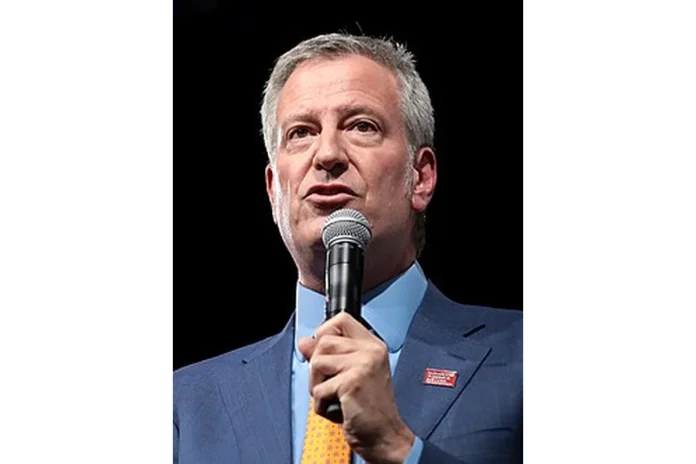
Bill de Blasio Bio
Bill de Blasio (born Warren Wilhelm Jr.; May 8, 1961) is an American politician who served as the 110th Mayor of New York City from 2014 to 2021. A member of the Democratic Party, he previously served as New York City Public Advocate from 2010 to 2013 and on the New York City Council representing Brooklyn’s 39th district from 2002 to 2009. As mayor, he made economic inequality his signature theme, often describing New York as a “tale of two cities,” and pursued universal pre-kindergarten, large-scale affordable housing, and policing reforms. He left office in January 2022 after being term-limited and was succeeded by Eric Adams.
After leaving City Hall, de Blasio briefly ran for the 2020 Democratic presidential nomination and later entered and then withdrew from a 2022 congressional campaign. He has remained active in public life and commentary, and has faced subsequent scrutiny over campaign-related security expenses that he was ordered to repay.
Early Life and Background
Bill de Blasio was born Warren Wilhelm Jr. on May 8, 1961, in Manhattan, New York. He was the son of Warren Wilhelm, his father, and Maria Angela de Blasio, his mother, whose surname he later adopted. After his parents separated, he was raised primarily in Cambridge, Massachusetts, where he attended Cambridge Rindge and Latin School.
He went on to earn a Bachelor of Arts from New York University and later completed a Master of International Affairs at Columbia University. In 1981, his academic and leadership potential was recognized when he was named a Harry S. Truman Scholar. He has described himself as “spiritual but not religious,” reflecting his mother’s break with her Catholic faith during his upbringing.
Path to US Politics
De Blasio’s introduction to political work came in 1984 through the Urban Fellows Program at the New York City Department of Juvenile Justice. After finishing graduate school, he joined the Quixote Center in Maryland in 1987 as a political organizer and traveled to Nicaragua in 1988 to distribute food and medicine during the final phase of the Nicaraguan Revolution. He openly supported the ruling Sandinista government, an alignment that placed him at odds with the Reagan administration. In 1990, he described himself as an advocate of democratic socialism.
His formal path to elected office began in 1989, when he served as a volunteer coordinator for David Dinkins’ successful mayoral campaign and then joined the Dinkins administration at City Hall. U.S. Representative Charles Rangel later recruited him to manage his 1994 reelection campaign, and in 1997, President Bill Clinton appointed de Blasio as regional director for the United States Department of Housing and Urban Development for New York and New Jersey. He managed Hillary Clinton’s successful 2000 U.S. Senate campaign and was elected to a Brooklyn school board in 1999, building the local network that supported his 2001 run for the New York City Council.
Bill de Blasio Career
Early Career (2001–2009)
In 2001, Bill de Blasio won the Democratic primary for the New York City Council’s 39th district in Brooklyn with 32 percent of the vote and went on to defeat his Republican opponent in the general election. He was reelected in 2003 with 72 percent and in 2005 with 83 percent, building a reputation as a vocal progressive voice on the Council.
During his Council tenure, de Blasio chaired the General Welfare Committee and passed legislation protecting tenants who held federal housing subsidy vouchers, expanding HIV/AIDS housing services, and creating domestic-partnership recognition for same-sex couples. He also helped pass the Gender-Based Discrimination Protection Law, which extended protections to transgender New Yorkers. He served on the education, environmental protection, finance, and technology committees while continuing to focus on poverty, housing, and civil rights issues.
Breakthrough (2010–2013)
De Blasio’s profile rose sharply when he ran for New York City Public Advocate in 2009. He finished first in a crowded Democratic primary with 33 percent of the vote, won the runoff against former Public Advocate Mark Green by 62 percent to 38 percent, and easily won the November 2009 general election. He was sworn in as the city’s third Public Advocate on January 1, 2010.
As Public Advocate, he launched the “NYC’s Worst Landlords Watchlist” in 2010 to shame negligent property owners, opposed proposed cuts to Section 8 vouchers, and challenged Mayor Michael Bloomberg’s education and budget policies. He also led a national campaign by elected officials to reverse the U.S. Supreme Court’s Citizens United decision. In 2013, he announced his candidacy for mayor of New York City, framing the race around economic inequality and the “tale of two cities” narrative. After a slow start in the polls, he surged following a campaign advertisement featuring his son Dante, and he won the Democratic primary decisively before capturing the general election in a landslide.
Democratic Era (2014–2021)
Bill de Blasio was sworn in as the 110th Mayor of New York City on January 1, 2014, by former President Bill Clinton. In his inaugural address, he pledged to confront “economic and social inequalities” in the city. His signature first-term policy was the rollout of universal pre-kindergarten, funded in part by a tax increase on residents earning $500,000 or more. He also pursued an aggressive affordable-housing plan that set a goal of 200,000 new units, signed the IDNYC municipal identification program in 2014, and launched the ThriveNYC mental-health initiative in 2015 under the leadership of his wife, Chirlane McCray.
On policing, de Blasio ended the Bloomberg administration’s appeal of the federal ruling that found the NYPD’s stop-and-frisk practices unconstitutional, and he introduced de-escalation training for officers. He faced sustained criticism from members of the NYPD, especially after officer Wenjian Liu and officer Rafael Ramos were killed in December 2014 and hundreds of officers turned their backs on him at their funeral. He was reelected in 2017, and in his second term he supported reforms to marijuana enforcement, a partial ban on glass-and-steel skyscrapers as part of his Green New Deal endorsement, and a 2021 executive order making ThriveNYC permanent as the Office of Community Mental Health.
His tenure was marked by major controversies, including a January 2014 photoshoot of him eating pizza with a knife and fork that drew national mockery, the accidental death of a groundhog named Charlotte during a 2014 Groundhog Day ceremony, and intense scrutiny of his early 2020 messaging about the coronavirus pandemic. He was term-limited in 2021 and left office on January 1, 2022.
Notable Events and Milestones
De Blasio’s most defining moments include his 2013 mayoral victory built around the “tale of two cities” message, the implementation of universal pre-kindergarten, the launch of the ThriveNYC mental-health program, and his 2017 reelection. He also entered the 2020 Democratic presidential primary in 2019 but suspended his campaign in September of that year after failing to qualify for the third primary debate. In 2022, he briefly entered the race for New York’s newly redrawn 10th congressional district before withdrawing prior to the Democratic primary.
Bill de Blasio Career Wins
Bill de Blasio’s electoral record includes three wins on the New York City Council, a successful run for Public Advocate, and two citywide victories for Mayor of New York City. The numbers below reflect only those returns that are clearly documented in his public record.
New York City Council Highlights
De Blasio first won the 39th district council seat in 2001 with 32 percent of the primary vote and 71 percent in the general election. He was reelected in 2003 with 72 percent and in 2005 with 83 percent, completing his three council terms with steadily expanding margins of victory in the Brooklyn district that included Park Slope, Borough Park, Carroll Gardens, and surrounding neighborhoods.
Other Wins & Achievements
De Blasio won the 2009 Democratic primary for Public Advocate with 33 percent and the runoff with 62 percent, then took the general election with 78 percent. In 2013, he won the Democratic mayoral primary in a landslide and captured the general election decisively, and he was reelected mayor in 2017. His 1981 designation as a Harry S. Truman Scholar remains a notable early-career honor.
| Position | Wins | Year |
|---|---|---|
| New York City Council, 39th District | 1 | 2001 |
| New York City Council, 39th District (reelection) | 1 | 2003 |
| New York City Council, 39th District (reelection) | 1 | 2005 |
| New York City Public Advocate | 1 | 2009 |
| Mayor of New York City | 1 | 2013 |
| Mayor of New York City (reelection) | 1 | 2017 |
Bill de Blasio Family
Family Background and Political Lineage
Bill de Blasio was born to Warren Wilhelm, his father, and Maria Angela de Blasio, his mother, and was raised primarily in Cambridge, Massachusetts, after his parents separated. He later adopted his mother’s surname, de Blasio, as his own. He began his political career in the orbit of Charles Rangel and Hillary Clinton, and he later built alliances with leading progressive figures in New York City, including former Mayor David Dinkins, whose 1989 campaign he helped organize.
Personal Life
Bill de Blasio married Chirlane McCray in 1994, and the couple have two children, a son named Dante and a daughter named Chiara. McCray became a central public figure during his mayoralty, leading the ThriveNYC mental-health initiative and the Mayor’s Fund to Advance New York City. According to Forbes, de Blasio and his wife had a combined net worth of $2.5 million as of August 2019, and the family has resided in New York City.