
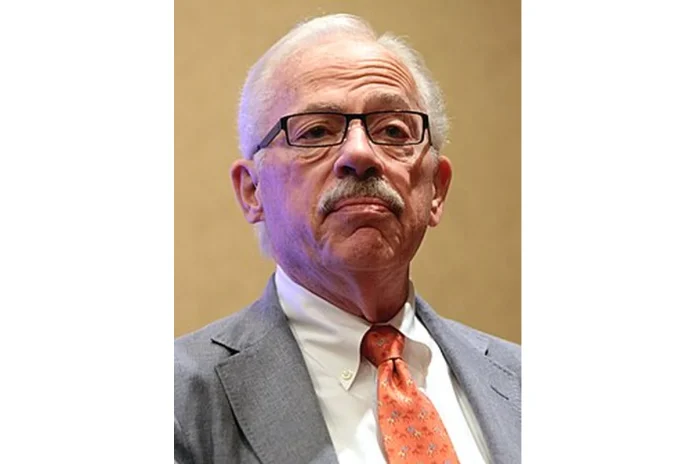
Bob Barr Bio
Robert Laurence Barr Jr. (born November 5, 1948) is an American attorney, lobbyist, and politician. A former Central Intelligence Agency (CIA) analyst and United States Attorney, he served as the U.S. Representative for Georgia’s 7th congressional district from 1995 to 2003 and is best known for authoring the Defense of Marriage Act and helping lead the impeachment of President Bill Clinton. After leaving Congress, Barr joined the Libertarian Party, ran as its 2008 presidential nominee, and later returned to the Republican Party. He was elected president of the National Rifle Association (NRA) in 2024 and served a one-year term.
Early Life and Background
Barr was born in Iowa City, Iowa, to Robert Laurence Barr and Beatrice Barr. His father was a career military officer and West Point graduate who was stationed in various locations around the world while pursuing a career in civil engineering. The second of six children, Bob Jr. lived abroad as a boy in Malaysia, Pakistan, Panama, Peru, Baghdad, and finally Tehran, Iran, where he graduated from Community High School in 1966.
He returned to the United States for college, attending the University of Southern California (USC), where he joined the Tau Kappa Epsilon fraternity in 1967 and completed a Bachelor of Arts degree, cum laude, in 1970. During his time at USC, his mother introduced him to the writings of Ayn Rand, which fostered his appreciation for conservatism and prompted him to join the Young Trojan Republican Club.
Path to US Politics
After college, Barr continued his education at the George Washington University Elliott School of International Affairs, where he earned a master’s degree in International Affairs in 1972, and later obtained his Juris Doctor from Georgetown University Law Center in 1977. From 1971 to 1978, he worked for the Central Intelligence Agency as an analyst of Latin American issues. Following his time at the CIA, Barr moved to northern Georgia, practiced law, and became active in the Republican Party, serving as a county chair.
He made an unsuccessful bid for the Georgia House of Representatives in 1984, but his political ascent continued the following year when he was appointed by President Ronald Reagan to serve as U.S. Attorney for the Northern District of Georgia, a position he held from 1986 to 1990. During that period, his office prosecuted state and local officials, members of the Medellin drug cartel, and secured a perjury indictment against Republican Congressman Pat Swindall, who ultimately served a year in prison.
Bob Barr Career
Early Career (1992–1994)
Barr sought the Republican nomination for the U.S. Senate in 1992 but lost the primary runoff to Paul Coverdell by fewer than 1,600 votes. He then set his sights on the U.S. House of Representatives, winning the Republican nomination in 1994 and upsetting six-term Democrat Buddy Darden to represent Georgia’s 7th congressional district in the 104th United States Congress. The 1994 election became known as the “Republican Revolution,” bringing 73 Republican freshmen into office and producing the first Republican House majority in 40 years.
Breakthrough (1995–2002)
During his time in Congress, Barr served as a senior member of the Judiciary Committee, vice-chairman of the Government Reform Committee, and a member of the Financial Services and Veterans’ Affairs Committees. In 1996, he authored and sponsored the Defense of Marriage Act (DOMA), which defined marriage as between a man and a woman for federal purposes and allowed states to refuse recognition of same-sex marriages performed elsewhere.
Barr gained national prominence as one of the leaders of the impeachment of President Bill Clinton, serving as one of the House managers during the 1999 Senate trial. He was the first lawmaker in either chamber to call for Clinton’s resignation after the Monica Lewinsky scandal broke, and he had earlier introduced a resolution in November 1997 calling for an impeachment inquiry focused on campaign finance matters.
He was re-elected three times and became known for his strongly conservative, “dour” image, telling constituents, “You don’t send me to Washington to smile.” He also gained attention for his work on the 1995 House Waco siege hearings, where he was described by the National Review as one of the few members able to ask effective questions of government witnesses.
Republican Era (2003–2004)
Following the 2000 redistricting by the Democratic-controlled Georgia legislature, Barr’s district was redrawn to favor Democrats. In the 2002 Republican primary, he was defeated by fellow Republican John Linder by a 2-to-1 margin, in a race shaped in part by Libertarian Party TV ads criticizing his opposition to medical marijuana. After his congressional defeat, Barr served from 1990 to 1991 as president of the Southeastern Legal Foundation in Atlanta.
Libertarian Era (2004–2011)
During the 2004 presidential election, Barr left the Republican Party and endorsed the Libertarian nominee Michael Badnarik. In 2006, he formally joined the Libertarian Party as a regional representative on its National Committee, and on May 25, 2008, he became the 2008 Libertarian presidential nominee after six rounds of voting at the Libertarian National Convention, running alongside Wayne Allyn Root. He appeared on the ballot in 45 states and received 523,686 votes, 0.4 percent of the national vote, distinguishing himself by opposing the financial bailout bill.
Return to Republican Era (2011–Present)
Barr announced his return to the Republican Party in 2011. In 2014, he launched a campaign for his old congressional seat, Georgia’s 11th, placing second in the six-way Republican primary with 26 percent of the vote and losing the runoff to State Senator Barry Loudermilk by a nearly 2-to-1 margin. On May 20, 2024, he was elected by the National Rifle Association Board of Directors as NRA President, a position he held for a one-year term. He also serves as chairman of the board of Liberty Guard and as president of the Law Enforcement Education Organization.
Notable Events and Milestones
Beyond authoring DOMA and his role in the Clinton impeachment, Barr is known for the “Barr Amendment,” which repeatedly blocked medical marijuana initiatives in Washington, D.C. He later reversed his position, joining the Marijuana Policy Project in 2007 and helping to repeal his own amendment. He also reversed his stance on the Defense of Marriage Act, apologizing for part of it at the 2008 Libertarian National Convention and later supporting its repeal.
Bob Barr Family
Family Background and Political Lineage
Barr was raised in a military family that moved frequently around the world, and he was the second of six children. His father, a West Point graduate and career Army officer, was stationed in countries across Asia, the Middle East, and Latin America. His mother’s introduction to the writings of Ayn Rand during his college years helped shape his political direction toward conservatism.
Personal Life
Barr married his first wife while still in college at USC; they divorced in 1976. He then married Gail Barr, with whom he had two children, and they divorced in 1986. In 1986, he married Jerilyn Dobbins, now known as Jeri Barr, with whom he had four children and, as of 2008, six grandchildren. Barr resides in Smyrna, Georgia.