
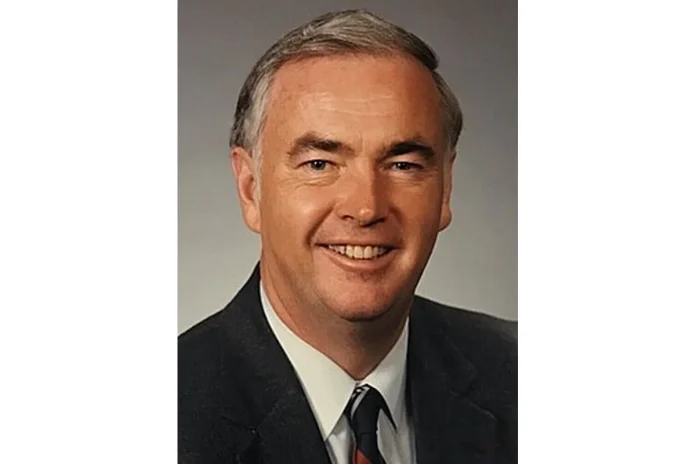
Frank Murkowski Bio
Frank Hughes Murkowski (born March 28, 1933) is an American politician and banker who served as a United States senator from Alaska from 1981 to 2002 and as the eighth governor of Alaska from 2002 to 2006. A member of the Republican Party, he chaired the Senate Energy and Natural Resources Committee from 1995 to 2001 and was a leading advocate for opening the Arctic National Wildlife Refuge to oil drilling. Before entering federal office, he built a career in Alaska banking and served as the state’s commissioner of economic development.
Early Life and Background
Frank Hughes Murkowski was born in Seattle, Washington, the son of Frank M. Murkowski and Helen (née Hughes). His paternal grandfather was of Polish descent. After his family relocated, he grew up in Alaska and attended Ketchikan High School, graduating in 1951. He then studied at Santa Clara University from 1951 to 1953 before transferring to Seattle University, where he earned a Bachelor of Science in economics in 1955.
Following his undergraduate studies, Murkowski joined the United States Coast Guard in the summer of 1955 and served until 1957, the same year his daughter Lisa was born. He was stationed in Sitka and Ketchikan, Alaska, and served aboard the cutters Sorrel and Thistle. His early years in Alaska helped him form the regional ties that would later shape his political career.
Path to US Politics
After a period at Pacific National Bank and additional study at the Pacific Coast Banking School, Murkowski became Alaska’s youngest commissioner at the time when Governor Keith Miller appointed him Commissioner of Economic Development at age 33. In 1971, he was elevated to the presidency of the Alaska National Bank of the North. He also led the Alaska Bankers Association and, in 1977, headed the Alaska State Chamber of Commerce, gaining wide influence over Alaska’s financial and business communities.
Murkowski made his first run for federal office in 1970, seeking Alaska’s sole U.S. House seat, but he was defeated in a landslide by Democratic state Senator Nick Begich. The loss did not end his political ambitions. A decade later, buoyed by the national popularity of Ronald Reagan, he set his sights on the United States Senate and built a campaign that combined his business record with a strong Republican message.
Frank Murkowski Career
Early Career (1970–1980)
Murkowski’s political career began in 1970 with his unsuccessful congressional bid against Nick Begich. Returning to the private sector, he continued to lead major Alaska banking institutions and statewide business groups throughout the 1970s, building a reputation as a capable economic manager. In 1980, he won election to the United States Senate by defeating Democratic candidate Clark Gruening, securing 54 percent of the vote with significant help from Ronald Reagan’s coattails.
U.S. Senate Breakthrough (1981–2002)
During his time in the Senate, Murkowski won reelection three times, in 1986, 1992, and 1998, making him one of Alaska’s longest-serving senators. He served as Chairman of the Energy and Natural Resources Committee from 1995 to 2001, a powerful position that allowed him to shape national policy on resource development. In that role, he argued for and attempted to pass legislation to open the Arctic National Wildlife Refuge to oil drilling, a defining issue of his Senate tenure.
Murkowski developed a record in the Senate that was anti-abortion, opposed to gun control, and opposed to affirmative action. He also took a conservative position on the military’s ban on homosexuals serving in the armed forces, stating that while individuals have a right to choose their lifestyle, there exists no right to serve and citing the cost effect of treating HIV-positive service members. His daughter and Senate successor, Lisa Murkowski, would later break with some of those positions, voting to repeal the ban and later becoming the third Republican senator to endorse the legalization of same-sex marriage while in office.
Governorship Era (2002–2006)
Murkowski ran for governor of Alaska in 2002 to replace Democratic incumbent Tony Knowles. He defeated Lieutenant Governor Fran Ulmer in the general election with nearly 56 percent of the vote, the highest percentage for any Republican gubernatorial nominee in Alaska history up to that point. He took office on December 2, 2002, becoming the eighth governor of Alaska.
Upon his inauguration, he resigned his Senate seat and appointed his daughter, Lisa Murkowski, then Majority Leader-designate of the Alaska House of Representatives, to fill it. The appointment was widely criticized as an act of nepotism. Toward the end of his administration, he brokered a deal for a gas pipeline that was never considered, in final form, by the legislature, and his threat to sign the deal without legislative approval led the legislature to file a successful lawsuit to block the action. He also purchased a Westwind II jet with state money for 2.7 million dollars in 2005 despite legislative opposition, a purchase that became a symbol of his unpopular legacy in state politics.
Notable Events and Milestones
Murkowski’s 2006 Republican primary defeat remains one of the most striking in modern Alaska history. He finished third behind former Wasilla Mayor Sarah Palin, who won with 51 percent, and businessman John Binkley, who took 30 percent, while Murkowski received just 19 percent. His margin of defeat was the largest in any Republican primary by an incumbent governor in United States history, and he left office with one of the nation’s worst approval ratings of 19 percent. In later years, he considered attempting a return to the governorship in the 2018 election but ultimately decided against it.
Frank Murkowski Career Wins
Frank Murkowski spent 27 years in public service, including two years in the armed services, 21 years as Alaska’s junior senator in Washington, and four years as governor. His electoral record included four U.S. Senate victories, a commanding gubernatorial win, and one of the most lopsided primary losses in the history of American gubernatorial politics.
U.S. Senate Highlights
Murkowski was first elected to the U.S. Senate in 1980, defeating Democratic candidate Clark Gruening with 54 percent of the vote with the help of Ronald Reagan’s popularity. He went on to win reelection in 1986, 1992, and 1998, securing more than two decades of continuous Senate service. His most notable Senate achievement was chairing the Energy and Natural Resources Committee from 1995 to 2001, where he led efforts to open the Arctic National Wildlife Refuge to oil drilling.
Other Wins and Achievements
Before his federal career, Murkowski became Alaska’s youngest commissioner at the time when he was appointed Commissioner of Economic Development at age 33. He also served as president of the Alaska National Bank of the North, led the Alaska Bankers Association, and headed the Alaska State Chamber of Commerce in 1977. His 2002 victory over Fran Ulmer earned him the governorship with the highest percentage ever recorded for a Republican gubernatorial nominee in Alaska up to that point.
Frank Murkowski Family
Family Background and Political Lineage
Frank Murkowski was born to Frank M. Murkowski and Helen (née Hughes), with his paternal grandfather tracing his roots to Poland. His family background combined Pacific Northwest origins with a Polish-American heritage, and his relocation to Alaska set the foundation for a career in state and national politics. He has continued a family tradition of public service through his daughter Lisa Murkowski, who replaced him in the U.S. Senate and has become a leading figure in American politics.
Personal Life
Frank Murkowski married Nancy Gore in 1954, and the couple has two daughters: Lisa Murkowski, born in 1957, and Carol Murkowski. Carol is married to the son of former Alaska State Senator and gubernatorial nominee Arliss Sturgulewski. The Murkowski family’s deep roots in Alaska politics have shaped the state’s public life for more than two decades.