
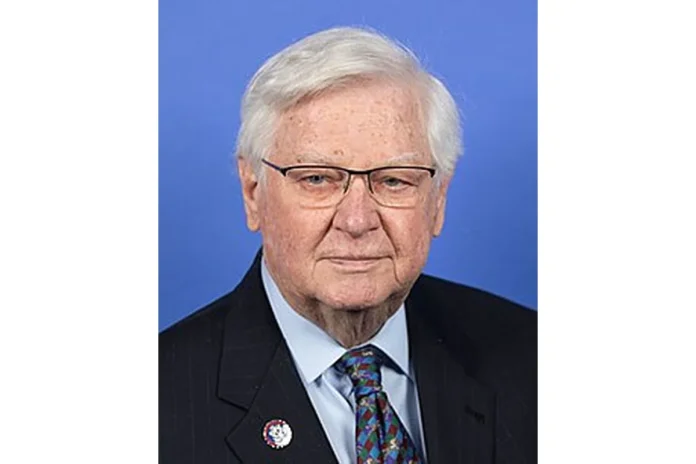
Hal Rogers Bio
Harold Dallas Rogers, known publicly as Hal Rogers, is an American lawyer and politician who has served as the U.S. Representative for Kentucky’s 5th congressional district since 1981. A Republican, he is one of the longest-serving members of Congress from Kentucky and became Dean of the House of Representatives in 2022 following the death of Representative Don Young. Best known for his work on the House Appropriations Committee, Rogers has shaped federal spending on homeland security and championed economic development in his largely rural Appalachian district.
Throughout his career, Rogers has balanced conservative voting patterns with a willingness to negotiate across the aisle on appropriations bills. His tenure has spanned more than two dozen terms, during which he has influenced national security funding, environmental cleanup efforts in Appalachia, and federal investment in southeastern Kentucky. He is recognized for steering substantial federal resources to one of the nation’s most economically challenged regions.
Early Life and Background
Harold Dallas Rogers was born on December 31, 1937, in Barrier, a small community in Kentucky. He grew up in the Appalachian region that he would later represent in Congress, an area shaped by coal mining traditions and persistent economic challenges. These early surroundings gave him a firsthand understanding of the issues facing rural Kentucky families.
Rogers pursued higher education at Western Kentucky University in Bowling Green before transferring to the University of Kentucky, where he earned a Bachelor of Arts and a Bachelor of Laws degree. His legal training laid the foundation for a career in public service, blending courtroom experience with civic leadership. During his college years and afterward, he also served in both the Kentucky Army National Guard and the North Carolina Army National Guard, gaining military discipline and a broader perspective on national affairs.
Path to US Politics
After completing his education, Rogers entered private legal practice and quickly became active in Kentucky politics. In 1969, he was elected commonwealth’s attorney for Pulaski and Rockcastle counties, a prosecutorial role he held for more than a decade. This position allowed him to build a reputation as a tough but fair legal mind while deepening his connections across south-central Kentucky.
Rogers stepped onto the statewide stage in 1979 when he served as the Republican nominee for lieutenant governor of Kentucky. Although he lost that race to Democrat John Y. Brown Jr., the campaign sharpened his political skills and expanded his network. When longtime Republican U.S. Representative Tim Lee Carter announced his retirement in 1980, Rogers launched a campaign for Kentucky’s 5th congressional district and won the Republican primary with a plurality of the vote, setting the stage for his long career in Washington.
Hal Rogers Career
Early Career (1969-1980)
Before reaching Congress, Rogers built his public profile as commonwealth’s attorney for Pulaski and Rockcastle counties from 1969 until 1980. In that role, he prosecuted criminal cases and worked closely with local law enforcement, gaining respect across party lines in a region with a strong Democratic tradition. His prosecutorial record demonstrated a commitment to law and order that would later define his political brand.
His 1979 run for lieutenant governor marked his first major statewide contest, paired on the ticket with former Governor Louie B. Nunn. Despite the loss, the experience positioned him for a successful congressional campaign the following year. The 1980 election, fueled by national conservative momentum, gave Rogers an opening to capture a seat that had long been held by Republicans in south-central Kentucky.
U.S. House of Representatives Breakthrough (1981-2000)
Rogers won his first congressional race in 1980 with 67 percent of the vote and quickly established himself as a steady conservative voice. He won reelection with at least 65 percent of the vote in nearly every cycle, with the sole exception of 1992, when he defeated Democratic challenger John Doug Hays with 55 percent of the vote. His district, anchored by ancestrally Republican voters south of the Ohio River, became one of the safest Republican seats in the nation.
Throughout the 1980s and 1990s, Rogers earned a reputation for delivering federal dollars back home. He supported the Economic Recovery Tax Act of 1981 and the Omnibus Budget Reconciliation Act of 1981, both signed by President Ronald Reagan. In 1993, he was one of only three House Republicans to vote for President Bill Clinton’s economic stimulus package, illustrating his pragmatic approach to economic development.
His most significant early achievement was the creation of The Center for Rural Development, a 501(c)(3) nonprofit established in Somerset, Kentucky, in March 1996. The center has since become a hub for workforce training, arts programming, and community development across southern and eastern Kentucky. Rogers also championed large-scale environmental cleanup programs throughout the Appalachian region, balancing his conservative fiscal instincts with targeted investments in his district’s well-being.
Appropriations Committee Leadership (2000-Present)
Rogers rose to become one of the most influential members of the House Appropriations Committee, eventually chairing the subcommittee that funds the Department of Homeland Security. In March 2003, his bipartisan negotiation skills earned him that powerful chairmanship during the early years of the war on terror. He used the position to push for stricter seaport, airport, and transportation security standards, even as critics questioned whether he was steering homeland security contracts back to Kentucky donors and companies.
He served as a delegate to nine Republican National Conventions from 1976 to 2008, reflecting his stature within the party. In 2013, Rogers chaired the United States House Committee on Appropriations, where he helped shape federal spending priorities. In 2011, he voted for the National Defense Authorization Act for Fiscal Year 2012, which included a controversial provision allowing indefinite detention of American citizens. He also voted for the Tax Cuts and Jobs Act of 2017 and against the American Rescue Plan Act of 2021.
In 2022, following the death of Representative Don Young, Rogers became Dean of the House of Representatives, the longest-serving member of the body. Following the retirement of Representative Grace Napolitano in 2024, he also became the oldest voting member of the House. In January 2024, Rogers was involved in a car crash in the Washington, D.C., area, but was reported in good condition and returned to Capitol Hill the following month to resume his duties.
Notable Events and Milestones
One of the defining moments of Rogers’s career came when President Bill Clinton publicly commended him for his bipartisan work on the House/Senate conference decision to bolster the Department of Commerce. Rogers also played a key role in introducing the STOP School Violence Act in 2018, which passed the House 407-10 and authorized federal grants to improve school safety. In 2001, the City of Williamsburg, Kentucky, named a water park and miniature-golf facility the Hal Rogers Family Entertainment Center in recognition of the federal funding he brought to the region.
Hal Rogers Family
Family Background and Personal Lineage
Public information about Rogers’s parents and extended family is limited, but he was raised in Barrier, Kentucky, a small community in the Appalachian foothills. His roots in rural south-central Kentucky shaped his lifelong focus on economic opportunity for the region’s residents.
Personal Life
Rogers married Shirley McDowell in 1958, and together they had three children. Shirley Rogers died of cancer in 1995. He later married Cynthia Doyle in 1999, and she remains his wife. The couple has largely kept their personal life out of the public eye, though Rogers’s family ties to the region remain central to his political identity.