
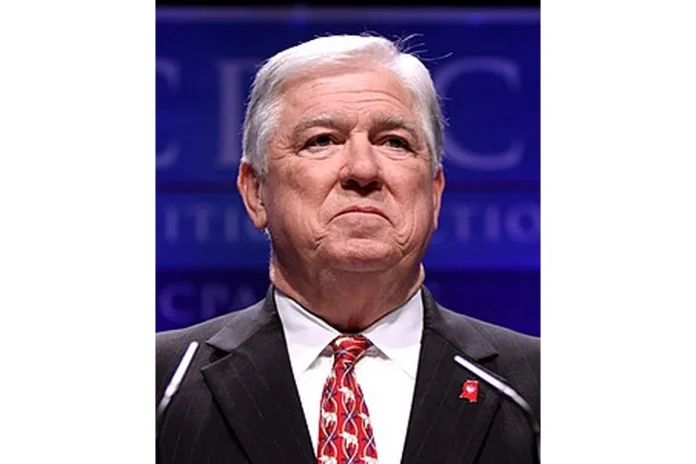
Haley Barbour Bio
Haley Reeves Barbour (born October 22, 1947) is an American attorney, lobbyist, and Republican politician who served as the 63rd Governor of Mississippi from 2004 to 2012. Before becoming governor, he chaired the Republican National Committee from 1993 to 1997 and worked on political campaigns and White House staffs during the Reagan and George H. W. Bush eras. A graduate of the University of Mississippi, Barbour co-founded the Washington lobbying firm now known as BGR Group and is widely regarded as one of the capital’s most influential operators. He led Mississippi through Hurricane Katrina in 2005 and the Deepwater Horizon oil spill in 2010, and he continues to participate in Republican politics and public policy debates.
Early Life and Background
Haley Reeves Barbour was born on October 22, 1947, in Yazoo City, Mississippi, where he was raised as the youngest of three sons. His mother was Grace LeFlore (née Johnson) Barbour, and his father was Jeptha Fowlkes Barbour Jr., a lawyer and circuit judge who died when Haley was two years old. After his father’s death, an inmate named Leon Turner, who had helped care for the judge in his final illness, became a surrogate presence in young Barbour’s life. Decades later, as governor, Barbour issued Leon Turner a posthumous pardon in the closing days of his administration.
Barbour grew up in Yazoo City during the era of the civil rights movement and has spoken about that period in interviews. His older brother, Jeptha Fowlkes Barbour III, was elected mayor of Yazoo City in 1968 as an independent and served until 1972. After finishing his early education in Yazoo City, Barbour enrolled at the University of Mississippi, where he earned his undergraduate degree and later a Juris Doctor from the University of Mississippi School of Law in 1972. Following law school, he joined his father’s old law firm in Yazoo City, where he briefly practiced with his cousin, William H. Barbour Jr., who later became a federal district judge.
Path to US Politics
Haley Barbour moved into Republican politics in the 1970s, working on Gerald Ford’s 1976 presidential campaign in the Southeast and on John Connally’s 1980 presidential bid. In 1982, he became the Republican nominee for the U.S. Senate in Mississippi, losing 64 percent to 36 percent to longtime conservative Democratic incumbent John C. Stennis, even with an endorsement from President Ronald Reagan. As of 2023, he remains the last Republican to lose a U.S. Senate race in Mississippi.
Barbour then served as a political aide in the Reagan administration and worked on George H. W. Bush’s 1988 presidential campaign. During this period he was credited with helping build the Republican Party’s organizational strength in a state long dominated by Southern Democrats. In 1991, while still active in national politics, Barbour co-founded the lobbying firm now called BGR Group with Ed Rogers, a former Bush administration lawyer; Lanny Griffith, another Bush veteran, joined the firm in 1994. Barbour’s national profile grew steadily through the early 1990s, leading to his selection as chairman of the Republican National Committee in 1993.
Haley Barbour Career
Early Career (1970s–1992)
Barbour’s first sustained involvement in politics came through campaign work, beginning with Republican efforts in the South during the 1970s. His early assignments included regional duties for Gerald Ford’s 1976 presidential campaign and a role in John Connally’s 1980 Republican primary bid. The 1982 U.S. Senate race in Mississippi gave Barbour his first statewide platform, even though he lost decisively to John C. Stennis. The experience established him as a leading Republican figure in a reliably Democratic state.
After the Senate defeat, Barbour served in the Reagan White House and assisted the 1988 presidential campaign of George H. W. Bush. In 1991, he and Ed Rogers established a Washington lobbying firm that would grow into one of the most powerful in the city, later joined by Lanny Griffith. By the end of 1992, Barbour had built a reputation as a strategist, fundraiser, and lobbyist with deep ties to both the Republican establishment and corporate America.
Republican National Committee Chairmanship (1993–1997)
In 1993, Haley Barbour became chairman of the Republican National Committee, taking over a party that had lost three of the last four presidential elections. Working with party strategists and donors, he rebuilt the committee’s fundraising and field operations heading into the 1994 midterm elections. The 1994 cycle produced one of the most consequential political results of the decade, as Republicans captured both chambers of the United States Congress, taking control of the House of Representatives for the first time in 40 years.
Barbour chaired the RNC through the 1996 presidential cycle, in which Bob Dole won the Republican nomination but lost the general election to Bill Clinton. After the 1996 election, Barbour stepped down as chairman in 1997. He returned to private lobbying and law practice, and by 1998 Fortune magazine ranked his firm as the second-most-powerful lobbying operation in America, a position it had reached by 2001, when Fortune named it the most powerful.
Governorship of Mississippi (2004–2012)
After two decades in Washington, Barbour returned to Mississippi and announced his candidacy for governor in 2003. He won the Republican primary on August 5, 2003, with campaign management by his nephew Henry Barbour, and on November 4, 2003, he defeated Democratic incumbent Ronnie Musgrove 53 percent to 46 percent. Barbour became only the second Republican governor of Mississippi since Reconstruction, following Kirk Fordice. He took office in January 2004.
Barbour won a second term in 2007, signing the Americans for Tax Reform Taxpayer Protection Pledge and easily dispatching Democrat John Arthur Eaves Jr. in the general election. As governor he confronted a $709 million budget shortfall in fiscal year 2004 and, working with the legislature, implemented a plan called Operation: Streamline that, without raising taxes, cut the deficit in half through spending reductions, particularly in Medicaid. He also pursued tort reform legislation that was described as among the strictest in the nation, and he worked with the legislature to fully fund the Mississippi Adequate Education Program in fiscal year 2008 for the first time since 1997.
Two natural disasters defined his time in office. Hurricane Katrina struck the Mississippi Gulf Coast on August 29, 2005, killing 231 people and devastating the state’s coastal economy. Barbour’s response drew widespread praise for rapid evacuation efforts, firm language on law and order, and steady coordination with local, state, and federal officials. In 2010 he led the state’s response to the Deepwater Horizon oil spill. He also helped secure $20 million in legislative funding for the Mississippi Civil Rights Museum in 2011 after personally testifying in favor of the project. In his final hours in office in January 2012, Barbour granted pardons or clemency to more than 200 individuals, a decision that was upheld by the Mississippi Supreme Court in March 2012.
Post-Governorship and Continued Influence (2012–Present)
After leaving the governorship in 2012, Barbour returned to the practice of law and lobbying, joining the Jackson, Mississippi firm Butler Snow and resuming his role as a senior partner at BGR Group. In 2014 he and his nephew Henry Barbour created a Super PAC, Mississippi Conservatives, which supported the successful reelection of Senator Thad Cochran. He has also been a frequent commentator on Republican strategy, immigration policy, and campaign finance, and he co-chairs the Immigration Task Force at the Bipartisan Policy Center.
Notable Events and Milestones
Barbour’s career includes several signature moments: leading the RNC to a 1994 congressional landslide that ended 40 years of Democratic control of the U.S. House, becoming only the second Republican governor of Mississippi since Reconstruction, guiding Mississippi through Hurricane Katrina in 2005, and helping break the logjam on funding for the Mississippi Civil Rights Museum. In 2009, his firm BGR Group was again ranked among the top lobbying operations in Washington, a standing it has held for many years. He is consistently described as one of the most powerful lobbyists in the history of Washington, D.C.
Haley Barbour Career Wins
Although Haley Barbour is best known as a strategist and officeholder rather than a candidate who racked up long lists of electoral victories, his political résumé includes several clear and well-documented wins. His most prominent electoral successes were his 2003 defeat of Governor Ronnie Musgrove and his 2007 reelection against John Arthur Eaves Jr., both of which secured him the Mississippi governorship for two full terms.
Governorship of Mississippi Highlights
Barbour won the 2003 Republican primary over Mitch Tyner on August 5, 2003, and then defeated incumbent Democrat Ronnie Musgrove 53 percent to 46 percent in the November 4, 2003, general election. He won a second term in 2007, defeating Frederick Jones in the Republican primary on August 7, 2007, and Democrat John Arthur Eaves Jr. in the November general election. These two gubernatorial victories, in a state with a long Democratic tradition, are the centerpiece of Barbour’s record of competitive electoral success.
Other Achievements
Beyond his own races, Barbour played a central role in the 1994 Republican takeover of Congress as RNC chairman, and in 2014 he helped guide the successful reelection of U.S. Senator Thad Cochran through the Mississippi Conservatives Super PAC. His lobbying firm, BGR Group, has been repeatedly ranked among the most powerful in Washington, reaching the top position on Fortune’s list in 2001.
Haley Barbour Family
Family Background and Political Lineage
Barbour was born into a legal family in Yazoo City, Mississippi. His father, Jeptha Fowlkes Barbour Jr., was a lawyer and circuit judge who died in 1949, when Haley was two years old. His mother, Grace LeFlore (née Johnson) Barbour, raised Haley and his two older brothers, including Jeptha Fowlkes Barbour III, who later served as mayor of Yazoo City from 1968 to 1972. Barbour’s cousin, William H. Barbour Jr., practiced law with him in Yazoo City and went on to become a federal district judge. His nephew, Henry Barbour, managed Haley’s 2003 gubernatorial campaign and later co-founded the Mississippi Conservatives Super PAC with him.
Personal Life
Haley Barbour married Marsha Dickson in 1971, and the couple has remained married. Barbour and his wife participated in public events during his time in office, including joint appearances with First Lady Michelle Obama in 2010 promoting the Let’s Move! anti-obesity campaign. Public information about his personal life is limited primarily to his long marriage and his well-known family ties in Yazoo City and Mississippi legal and political circles.
Haley Barbour Awards and Honors
Haley Barbour has received a range of honors recognizing his public service, his connections to international academic institutions, and his contributions to his home state. These awards reflect both his national political influence and his lasting impact in Mississippi.
Notable Recognitions
In 2009, Barbour received the Honorary Patronage of the University Philosophical Society at Trinity College, Dublin. On January 5, 2012, the Mississippi Emergency Management Agency headquarters building in Pearl, Mississippi, was named in his honor in recognition of his leadership during disasters including Hurricane Katrina. Later that year, on October 18, 2012, the Center for Manufacturing Excellence at the University of Mississippi in Oxford was also named in his honor.