
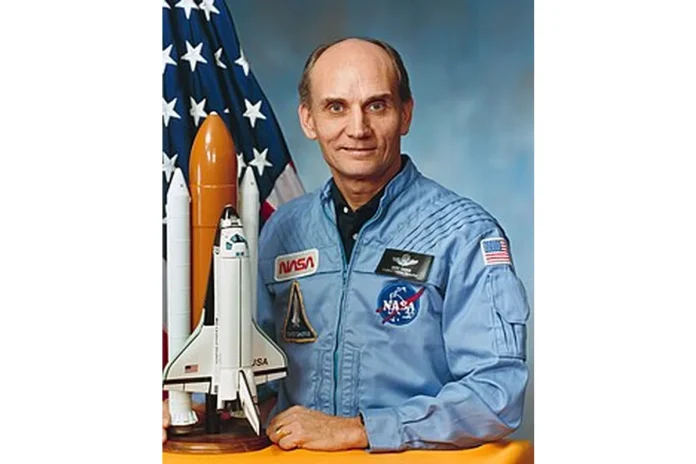
Jake Garn Bio
Edwin Jacob “Jake” Garn (born October 12, 1932) is an American politician, retired military officer, and former insurance executive from the U.S. state of Utah. A Republican, he served as the mayor of Salt Lake City from 1972 to 1974 and represented Utah in the United States Senate from 1974 to 1993. In April 1985 he became the first sitting member of Congress to fly in space as a payload specialist aboard Space Shuttle Discovery during mission STS-51-D. Garn chaired the Senate Banking Committee and co-authored the Garn–St. Germain Depository Institutions Act of 1982, a major financial deregulation law.
Beyond politics, Garn built a long career as a pilot in the United States Navy and the Utah Air National Guard, retiring as a colonel in 1979. He later earned the rank of brigadier general following his spaceflight. After leaving the Senate in 1992, he remained active on federal financial and urban policy issues and co-wrote the 1989 novel Night Launch, a thriller set aboard the Space Shuttle Discovery.
Early Life and Background
Edwin Jacob Garn was born on October 12, 1932, in Richfield, Utah. He is the son of Ed Garn, a World War I pilot, and Agnes Fern Christensen. Through his family heritage, Garn is of Danish, English, German, and Norwegian descent. His father’s service as a military aviator helped shape a household that valued discipline, citizenship, and aviation, influences that would guide his later career in the Navy, the Air National Guard, and ultimately the United States Senate.
Garn grew up in Salt Lake City, where he attended Uintah Elementary School, Roosevelt Junior High School, and East High School. He went on to study at the University of Utah, joining the Sigma Chi fraternity and earning a Bachelor of Science degree in business and finance in 1955. His college training in finance laid the foundation for his pre-political work in the insurance industry and shaped his later command of complex banking and budget issues in Washington.
Path to U.S. Politics
Before entering public life, Garn worked as an insurance executive in Utah while also serving his country in uniform. He flew as a Martin P5M Marlin pilot in the United States Navy and later joined the 151st Air Refueling Group of the Utah Air National Guard, where he flew the Boeing KC-97L and KC-135A. His dual track in business and military aviation gave him practical experience in logistics, risk, and leadership.
Garn took his first major step into elected office in 1971, when he won the race for mayor of Salt Lake City and entered office in 1972. He served a single term as mayor until 1974, the last Republican to hold that office to date. While leading the city, he also became active in the Utah League of Cities and Towns, serving as its president in 1972, and in 1974 he was elected first vice president of the National League of Cities. Those statewide and national roles quickly made him a leading Republican figure in Utah politics.
Jake Garn Career
Early Career (1972–1974)
Garn’s first notable public role came as mayor of Salt Lake City, a position he won in 1971 and held from 1972 to 1974. As mayor, he focused on urban management and municipal services, while continuing to fly with the Utah Air National Guard. His office also served as a launchpad for his involvement in national civic organizations, where he built relationships that would later help him win a Senate seat.
His standing in the Republican Party grew quickly during these years. Service as president of the Utah League of Cities and Towns in 1972 and as first vice president of the National League of Cities in 1974 elevated his profile beyond Utah. By the time he launched his Senate campaign, Garn had already established himself as a capable executive, a respected military officer, and a proven vote-getter in the state.
U.S. Senate Career (1974–1993)
Garn was first elected to the United States Senate in 1974, succeeding retiring Republican Wallace F. Bennett, father of his eventual successor Bob Bennett. His election continued a line of Republican Senate representation from Utah and put him in a powerful position on federal financial policy. He was re-elected to a second term in November 1980 with 74 percent of the vote, the largest victory margin in a statewide race in Utah history at the time. In 1986 he won re-election again, cementing his standing as one of the state’s most durable politicians.
As a senior member of the Senate, Garn chaired the United States Senate Committee on Banking, Housing, and Urban Affairs. In that role he co-authored, with House member Fernand St. Germain of Rhode Island, the Garn–St. Germain Depository Institutions Act of 1982, a law that partially deregulated the savings and loan industry and attempted to head off a looming crisis. He also served on the Senate Appropriations Committee, chairing the HUD-Independent Agencies Subcommittee, which oversees NASA, and sat on Energy and Water Resources, Defense, Military Construction, and Interior subcommittees. From 1979 to 1984 he served as secretary of the Republican Conference, a post in the Senate’s elected GOP leadership.
Space Shuttle Era (1985)
Garn’s most unusual distinction came in April 1985, when he became the first sitting member of the United States Congress to fly in space. He joined the crew of Space Shuttle Discovery on mission STS-51-D as a payload specialist, serving as a congressional observer and a subject for medical experiments on space adaptation syndrome. The mission launched from and returned to the Kennedy Space Center in Florida, deploying two communications satellites and running electrophoresis and echocardiograph experiments. By the end of the flight, Garn had logged more than 167 hours in space, traveling over 2.5 million miles across 108 Earth orbits.
He earned the flight because he chaired the Senate appropriations subcommittee that funds NASA and had logged more than 17,000 hours in military aircraft, including a Northrop Grumman B-2 Spirit prototype. Astronaut Charles Bolden later described him as “the ideal candidate to do it, because he was a veteran Navy combat pilot who had more flight hours than anyone in the Astronaut Office.” The space sickness he experienced on the mission was so severe that NASA colleagues jokingly created a “Garn” scale for space sickness, with one Garn as the highest possible level. After his return, he was promoted to brigadier general, and NASA later named its Jake Garn Mission Simulator and Training Facility in his honor.
Notable Events and Milestones
Garn’s signature achievements include chairing the Senate Banking Committee, co-authoring the Garn–St. Germain Depository Institutions Act of 1982, and making history as the first sitting member of Congress to fly in space. His 1980 Senate re-election, with 74 percent of the vote, set a Utah statewide record that stood for years. In 1986 he donated a kidney to his daughter Susan, who was suffering progressive kidney failure, an act that drew national attention to organ donation.
Jake Garn Career Wins
Across more than two decades in public service, Jake Garn compiled a record that combined electoral success with major legislative and symbolic victories. His wins include a Salt Lake City mayoral election, three Senate elections, and the passage of one of the most consequential banking laws of the 1980s.
Electoral Highlights
Garn was elected mayor of Salt Lake City in 1971 and entered office in 1972, serving until 1974. He won his first United States Senate race in 1974 to succeed Wallace F. Bennett, won a dominant re-election in 1980 with 74 percent of the vote, and secured a third term in 1986. Garn retired from the Senate in 1992, leaving behind a record of consistent electoral success in Utah politics.
Other Achievements
Beyond elections, Garn’s major achievements include co-authoring the Garn–St. Germain Depository Institutions Act of 1982, which reshaped American banking regulation, and his groundbreaking 1985 Space Shuttle Discovery flight as a congressional payload specialist. He also helped lead the National League of Cities in 1974 and was honored by the organization as its president for the first two months of 1975. The Jake Garn Mission Simulator and Training Facility at NASA stands as a lasting tribute to his role in American spaceflight.
Jake Garn Family
Family Background and Aviation Lineage
Garn was raised in a family with deep military and pioneer roots. His father, Ed Garn, was a World War I pilot, and his mother was Agnes Fern Christensen. That aviation heritage shaped Jake Garn’s own decades-long flying career in the Navy and the Utah Air National Guard, where he retired as a colonel in 1979 before being promoted to brigadier general after his spaceflight. He is of Danish, English, German, and Norwegian descent and remains a member of the Church of Jesus Christ of Latter-day Saints.
Personal Life
Garn married Hazel Rhae Thompson on February 2, 1957, in Biloxi, Mississippi, and together they had four children: Jacob, Susan, Ellen, and Jeffrey. Hazel was killed in a car crash in Cheyenne County, Nebraska, on August 17, 1976. On April 8, 1977, he married Kathleen Brewerton at Salt Lake Temple, and they had two more children, Matthew and Jennifer. Kathleen, who had a son, Brook, from a previous marriage, died on May 31, 2018. In 1986, Garn donated a kidney to his daughter Susan, who was facing progressive kidney failure caused by diabetes.