
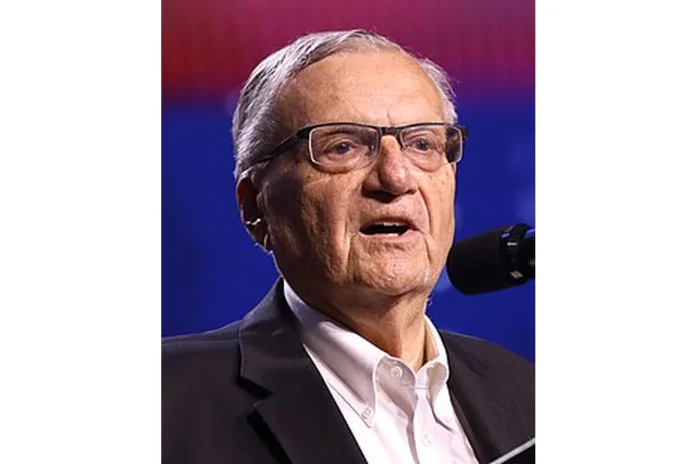
Joe Arpaio Bio
Joseph Michael Arpaio (born June 14, 1932) is an American former law enforcement officer and politician best known for serving as the elected Sheriff of Maricopa County, Arizona, for 24 years, from 1993 to 2017. A Republican, Arpaio built a national profile through a hardline approach to illegal immigration and by styling himself as “America’s Toughest Sheriff.” He gained attention for creating the Tent City jail complex, reinstating chain gangs, and clashing repeatedly with federal courts over accusations of racial profiling and unconstitutional jail conditions. In 2017, Arpaio was convicted of criminal contempt of court and was pardoned by President Donald Trump later that year.
After losing his 2016 reelection bid, Arpaio pursued several other political offices without success, including the 2018 Republican primary for U.S. Senate, the 2020 race for Maricopa County Sheriff, and two attempts to unseat the incumbent mayor of Fountain Hills, Arizona. He lives in Fountain Hills and is regarded as one of the most controversial sheriffs in modern American history.
Early Life and Background
Joseph Michael Arpaio was born in Springfield, Massachusetts, on June 14, 1932. His parents were Italian immigrants, both originally from Lacedonia, in the Campania region of Italy. His mother died during childbirth, and he was raised by his father, who ran an Italian grocery store. Arpaio completed high school and worked in the family business until he turned 18.
At 18, Arpaio enlisted in the United States Army and served from 1950 to 1954 in the Medical Department, with part of his service as a military policeman in France. Following his army discharge in 1954, he moved to Washington, D.C., and became a police officer, later transferring to Las Vegas, Nevada, in 1957. After about six months with the Las Vegas force, he was appointed as a special agent with the Federal Bureau of Narcotics, an agency that later became part of the Drug Enforcement Administration (DEA).
Path to US Politics
During a 25-year career with the DEA, Arpaio was stationed in Argentina, Turkey, and Mexico and rose to head the agency’s Arizona branch. After retiring from federal service, he became involved in a travel venture through his wife’s Starworld Travel Agency in Scottsdale, including an effort to sell seats on a planned space flight called the Phoenix E, which never launched.
His entry into elected office came in 1992, when he ran for Maricopa County Sheriff, an elected position in Arizona’s most populous county. He won that race and would go on to be reelected five more times, transforming the role of county sheriff into a national political platform. His early tenure established a reputation for cost-cutting, aggressive media tactics, and tough-on-crime policies that set the stage for his later national prominence.
Joe Arpaio Career
Early Career (1950–1992)
Arpaio’s early professional life was spent in uniformed federal service. After his time in the U.S. Army Medical Department, he served as a police officer in Washington, D.C., and then in Las Vegas. His appointment as a special agent with the Federal Bureau of Narcotics launched a long career in drug enforcement. Over more than two decades with the DEA and its predecessor agency, he conducted operations in several countries and eventually led the agency’s Arizona office, gaining the kind of executive law enforcement experience that he would later promote in his political campaigns.
His decision to enter politics came after a brief stint in the private travel industry in the late 1980s. In 1992, he won his first election as Maricopa County Sheriff, a position that combined law enforcement leadership with significant administrative and political power in one of America’s fastest-growing counties.
Sheriff of Maricopa County (1993–2017)
Arpaio was first elected Maricopa County Sheriff in 1992 and was reelected in 1996, 2000, 2004, 2008, and 2012. In 1993, he established a “Tent City” jail compound next to a permanent detention facility to house convicted and sentenced inmates, a program that drew national headlines and intense criticism. In 1995, he reinstituted chain gangs, and in 1996 expanded the concept with female volunteer chain gangs, followed later by an all-juvenile volunteer chain gang in which participants could earn high school credit.
Arpaio also built a media-centric public image, famously requiring inmates to wear pink underwear to reduce theft and to make them easily identifiable after release. He introduced pink handcuffs, launched an in-house radio station called KJOE, and ordered undocumented immigrants in his jails to register with the Selective Service System. He also appeared in a 2008–2009 Fox Reality Channel series titled Smile…You’re Under Arrest! and regularly courted press coverage throughout his tenure.
Immigration Crackdown (2005–2017)
Beginning in 2005, Arpaio shifted his focus toward enforcing immigration laws, conducting saturation patrols, immigration sweeps, and business raids that critics said disproportionately targeted Latino neighborhoods and day laborers. In November 2010, he created an armed illegal immigration operations posse that at one point included actors Steven Seagal, Lou Ferrigno, and Peter Lupus. His hardline tactics made him a leading national voice against illegal immigration and a flashpoint in the debate over Arizona’s SB 1070 anti-illegal immigration law, which was largely struck down by the U.S. Supreme Court.
His immigration enforcement work triggered a cascade of legal challenges. The U.S. Department of Justice and the American Civil Liberties Union (ACLU) filed suits alleging racial profiling, and a federal court monitor was eventually appointed to oversee his office. In the Melendres v. Arpaio class-action case, U.S. District Judge G. Murray Snow ruled that Arpaio and his office had unfairly targeted Latinos in traffic stops. A separate DOJ suit, United States v. Maricopa County, accused the sheriff’s office of the worst pattern of racial profiling in U.S. history and of unconstitutional jail conditions, costing taxpayers more than $140 million in litigation during his tenure.
Contempt of Court and Presidential Pardon (2017)
Arpaio’s defiance of federal court orders became the defining legal battle of his final years in office. After Judge Snow found that Arpaio’s office had continued to detain people without reasonable suspicion in violation of an earlier injunction, Arpaio was held in civil and then criminal contempt of court. On July 31, 2017, U.S. District Judge Susan Bolton found him guilty of criminal contempt, ruling that he had willfully violated the court’s order.
On August 25, 2017, President Donald Trump pardoned Arpaio for the contempt conviction, calling him an “American patriot” who had “kept Arizona safe.” The pardon was praised by Arizona Governor Doug Ducey but sharply criticized by U.S. Senators John McCain and Jeff Flake, House Speaker Paul Ryan, and numerous legal scholars. Although the pardon spared him from punishment, Judge Bolton later denied his motion to vacate the conviction, ruling that the pardon did not “revise the historical facts” of the case. In 2020, the U.S. Court of Appeals for the Ninth Circuit rejected his attempt to vacate the verdict.
Notable Events and Milestones
Arpaio was a defining figure in the modern debate over immigration enforcement, helping to popularize the term “sanctuary city” as a political flashpoint and shaping Arizona’s reputation as a testing ground for restrictive immigration laws. His Tent City jail and chain gang programs were widely emulated in popular culture, while his sustained legal defeats set important precedents on racial profiling and judicial oversight of local police. His 2017 pardon by President Trump remains one of the most debated exercises of presidential clemency in recent memory.
Joe Arpaio Career Wins
Joe Arpaio’s electoral career is defined by his six consecutive victories as Maricopa County Sheriff, which made him one of the longest-serving sheriffs in Arizona history. Beyond law enforcement, however, his later attempts to win other offices ended in defeat.
Maricopa County Sheriff Elections
Arpaio was first elected Maricopa County Sheriff in 1992 and was reelected in 1996, 2000, 2004, 2008, and 2012, winning six consecutive terms. In 2016, seeking a seventh term amid his ongoing contempt case, he was defeated by Democrat Paul Penzone. In 2020, Arpaio attempted to reclaim his old office but again lost to Penzone.
Other Wins & Achievements
Outside the sheriff’s race, Arpaio’s later political efforts were unsuccessful. He lost the 2018 Republican primary for the U.S. Senate in Arizona, finishing with about 19 percent of the vote against Martha McSally and Kelli Ward. In 2022 and 2024, he ran for mayor of Fountain Hills, Arizona, but was defeated both times by the incumbent. His only other notable post-sheriff electoral venture was a 2010 advertising campaign supporting Bill Montgomery for Maricopa County Attorney, which resulted in a civil penalty of $153,978 against his political committee for violating Arizona election law.
Joe Arpaio Family
Family Background and Personal Life
Arpaio was born into an Italian-American family in Springfield, Massachusetts, and was raised by his father after his mother’s death during childbirth. His family background, rooted in the immigrant experience in New England, shaped his early working-class life before he entered military and federal law enforcement service.
In 1958, Arpaio married Ava Lamb, his wife of more than 60 years. The couple had two children and remained together until her death in 2021 from cancer complications. As of the late 2000s, Arpaio has made his home in Fountain Hills, Arizona, where he has also been active in local politics.