
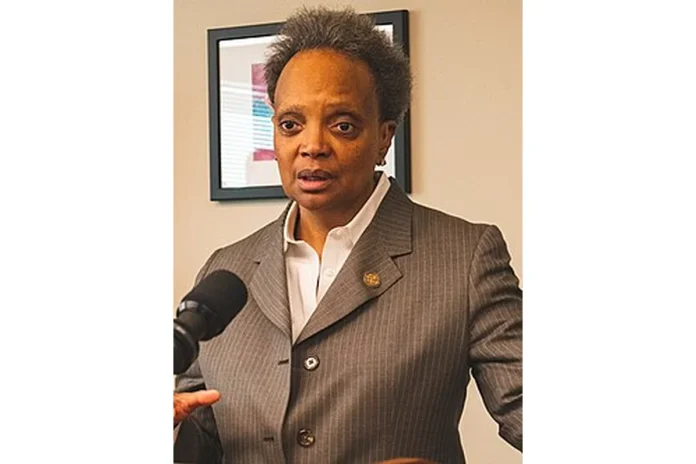
Lori Lightfoot Bio
Lori Elaine Lightfoot (born August 4, 1962) is an American politician and attorney who served as the 56th mayor of Chicago from 2019 to 2023. A member of the Democratic Party, she was the first Black woman and the first openly LGBTQ person to hold the office of Chicago mayor. She was also the second woman, after Jane Byrne, and the third Black person overall to lead the city.
Trained as an attorney, Lightfoot built her career in both private practice and public service, including a stint as an Assistant United States Attorney and a partnership at the law firm Mayer Brown. She later led the Chicago Police Board and chaired the Police Accountability Task Force before running for mayor.
Early Life and Background
Lori Elaine Lightfoot was born on August 4, 1962, in Massillon, Ohio, the youngest of four children. Her mother, Ann Lightfoot, worked as a nighttime healthcare aide and served on the local school board, while her father, Elijah Lightfoot, was a local factory worker and janitor. She grew up in a primarily white neighborhood on the west side of the city, an experience that shaped her awareness of race and inequality from a young age.
Lightfoot graduated from Washington High School in Massillon, where she was active in school life. She played trumpet in the school band, sang alto in the choir, competed in basketball, volleyball, and softball, and edited the yearbook. She was elected class president three times and once ran under the slogan “Get on the right foot with Lightfoot.” She has often pointed to a high school boycott she organized over the quality of school lunches as the start of her interest in political organizing.
She went on to earn a Bachelor of Arts in political science from the University of Michigan in 1984, graduating with honors. To pay for her education, she held seven different jobs, including work as a resident assistant and as a cook for the school’s football team, and she also worked factory jobs at home during summers.
Path to US Politics
Before attending law school, Lightfoot held positions working for members of Congress, including Ralph Regula and Barbara Mikulski. She has said that she chose law school not because of her older brother Brian’s legal troubles but because she wanted a career that offered financial independence. She earned her Juris Doctor from the University of Chicago Law School in 1989 on a full scholarship, where she served as president of the student body and clerked for Justice Charles Levin of the Michigan Supreme Court.
After law school, Lightfoot became a practicing attorney at the Mayer Brown law firm, where she eventually became a partner and earned approximately one million dollars annually in some years. Her clients included Republicans in two cases contesting supposed Democratic gerrymandering, and she also defended a Chicago police officer in a physical assault case. In addition to her private practice work, she served on the boards of the Illinois chapters of NARAL and the ACLU, and served as external counsel for Bank of America.
Lightfoot first entered the public sector as an Assistant United States Attorney for the Northern District of Illinois, a role she held from 1996 to 2002. She helped prosecute federal crimes, including drug cases, and assisted with Operation Silver Shovel, an FBI investigation into Chicago corruption, helping to convict Alderman Virgil Jones. In 2013, she was a finalist for the position of U.S. Attorney for the Northern District of Illinois, but the job went to Zachary T. Fardon.
Lori Lightfoot Career
Early Career (1996–2018)
After years in private practice, Lightfoot returned to public service in 2015 when Mayor Rahm Emanuel appointed her to replace a 19-year incumbent as president of the Chicago Police Board. The board recommends disciplinary action in disputed cases of police misconduct, and under her leadership it became more punitive, firing officers in 72 percent of its cases. In the wake of the controversy over the murder of Laquan McDonald by a Chicago police officer, Emanuel also appointed Lightfoot as chair of a special Police Accountability Task Force, which in 2016 issued a report sharply critical of the Chicago Police Department’s practices.
She specifically criticized the police union’s “code of silence” and clashed publicly with Emanuel over his attempts to reach a police reform deal. Emanuel reappointed her to a second term as Police Board president in 2017. Her work on police accountability established her public profile and laid the groundwork for her later run for mayor.
2019 Mayoral Breakthrough
On May 10, 2018, Lightfoot announced her candidacy for mayor of Chicago in the 2019 elections, her first run for public office. She was the first openly lesbian candidate in the history of Chicago mayoral elections. By summer 2018, she had the highest-funded campaign of any individual challenging the two-term incumbent mayor, Rahm Emanuel, who ultimately dropped out of the race.
A January 2019 corruption scandal involving Chicago Alderman Ed Burke upended the race, and Lightfoot ran a television advertisement criticizing four of her opponents as the “Burke Four” for their connections to the disgraced alderman. In February 2019, in what was considered an upset, Lightfoot finished first in a crowded field of fourteen candidates, and she and Toni Preckwinkle advanced to a runoff election.
On April 2, 2019, Lightfoot won the runoff election, becoming mayor-elect of Chicago. She won more than 73 percent of the overall vote, taking all 50 of the city’s wards and all but 20 of its 2,069 voting precincts. Her victory made her the first Black woman and the first openly LGBTQ person to serve as mayor of Chicago.
Mayoral Era (2019–2023)
Lightfoot was sworn in as mayor on May 20, 2019, at Wintrust Arena by Magistrate Judge Susan E. Cox, accompanied by her wife and daughter. Her first executive order limited “aldermanic prerogative,” a long-standing practice under which Chicago aldermen were granted an effective veto over local matters. She unveiled ethics reform proposals, called for the resignation of indicted Alderman Edward M. Burke, and proposed revisions to Chicago City Council operating rules, including live-streamed committee meetings and tighter conflict-of-interest rules.
On November 23, 2019, the Chicago City Council approved her plan to raise the city’s minimum wage to $15 an hour by 2021, though the increase did not include restaurant servers and tipped workers. She also announced a graduated transfer tax for commercial real estate sales and, on October 14, 2019, created a 20-member affordable housing task force. On March 6, 2020, she named Tracey Scott as CEO of the Chicago Housing Authority.
During the COVID-19 pandemic, Lightfoot took a series of actions aimed at slowing the spread of the virus. She postponed Saint Patrick’s Day festivities with Governor J. B. Pritzker, banned events of more than 1,000 people, extended Chicago Public School closures beyond the state mandate, closed parks, beaches, and trails, and personally patrolled the city to enforce stay-at-home orders. Her administration secured 300 hotel rooms for first responders and worked with the United States Army Corps of Engineers to establish a makeshift hospital at McCormick Place. Her strict approach inspired a series of internet memes, while also drawing criticism for perceived hypocrisy when she was found to have had her hair cut in violation of state rules and for invoking the Passover story in defending the suspension of Freedom of Information Act response deadlines.
On public safety, Lightfoot launched the Our City, Our Safety initiative and proposed the creation of a new Office of Public Safety Administration. She named Charlie Beck to serve as interim superintendent of the Chicago Police Department, fired Eddie T. Johnson for what she called “intolerable” actions, and nominated David Brown to be permanent superintendent. She also announced that the city’s police department would not assist U.S. Immigration and Customs Enforcement (ICE) raids. In July 2020, she directed the removal of a Christopher Columbus statue from Grant Park. In February 2022, she launched a $500-per-month universal basic income pilot program for 5,000 Chicago residents, which was described as the largest such program in the United States at that time.
2023 Reelection and Departure
In the 2023 Chicago mayoral election, Lightfoot faced a wide field of nine challengers. She drew controversy for emailing public school teachers offering school credit for students who interned on her campaign and for telling South Side residents to vote for her or not at all. On February 28, 2023, she finished third with 16.81 percent of the vote and failed to qualify for the runoff, becoming the first Chicago mayor to lose reelection in 40 years. Brandon Johnson prevailed in the April 4, 2023 runoff, and Lightfoot left office in 2023.
After leaving office, Lightfoot began teaching a course titled “Health Policy and Leadership” as a Menschel Senior Leadership Fellow at Harvard University’s T.H. Chan School of Public Health.
Notable Events and Milestones
Among the defining moments of Lightfoot’s career were her April 2, 2019 landslide runoff victory over Toni Preckwinkle, her May 20, 2019 inauguration as Chicago’s first Black woman and first openly LGBTQ mayor, her $15 minimum wage ordinance, the launch of the nation’s largest $500-per-month universal basic income pilot, and her unprecedented loss in the 2023 reelection.
Lori Lightfoot Career Wins
Lightfoot’s most prominent political victory was her landslide win in the 2019 Chicago mayoral runoff, in which she captured more than 73 percent of the vote and prevailed in all 50 wards. She also finished first in the February 2019 first-round mayoral contest, placing ahead of a crowded field of fourteen candidates.
2019 Mayoral Highlights
Lightfoot entered the 2019 race as a relative unknown, with early polls showing her support between 2 and 5 percent. She surged in the final weeks of the campaign to finish first in the primary and then won the runoff in historic fashion, taking all but 20 of the city’s 2,069 voting precincts and setting the stage for her becoming the first Black woman to lead Chicago.
Other Wins and Achievements
Beyond the mayoral election, Lightfoot’s policy wins included securing City Council approval of a $15-per-hour minimum wage and launching a 5,000-participant $500-per-month universal basic income pilot. She was also named a 2019 grand marshal of the Chicago Pride Parade, named a 2020 Queerty 50 hero, and received the 2020 NMQF Honorable John Lewis Lifetime Achievement Award.
Lori Lightfoot Family
Family Background and Public Service Lineage
Lightfoot was raised in Massillon, Ohio, by her mother, Ann Lightfoot, a healthcare aide and school board member, and her father, Elijah Lightfoot, a factory worker and janitor. She was the youngest of four children, and her older brother, Brian Lightfoot, was arrested in connection with a bank robbery and the shooting of a security guard while she was an undergraduate at the University of Michigan. Her family background shaped her interest in racial justice and public service, themes that ran through her career.
Personal Life
Lightfoot married Amy Eshleman on May 31, 2014. Eshleman, a former Chicago Public Library employee, became a full-time mother to the couple’s adopted daughter. The family resides in the Logan Square neighborhood on Chicago’s Northwest Side. Lightfoot has held Chicago Bears season tickets for 20 years and is also a season ticket holder for the Chicago White Sox and the WNBA’s Chicago Sky. She is a Founding Trustee at Christ the King Jesuit High School in Chicago and a member of St. James AME Zion Church.