
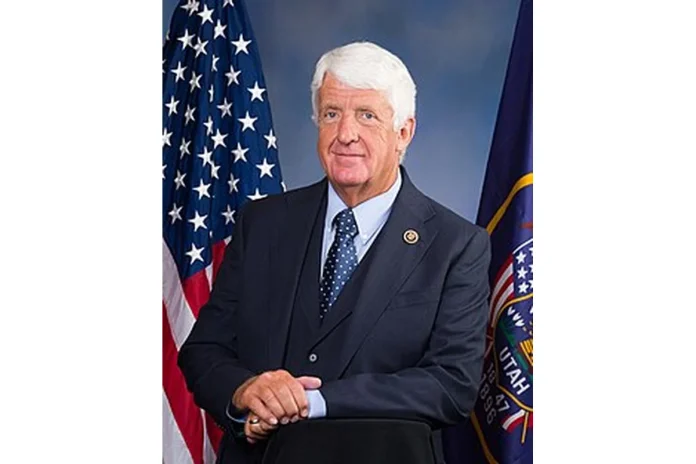
Rob Bishop Bio
Robert William Bishop (born July 13, 1951) is an American politician and former educator who represented Utah’s 1st congressional district in the United States House of Representatives from 2003 to 2021. A Republican, he previously served in the Utah House of Representatives from 1978 to 1994, including two years as Speaker, and chaired the Utah Republican Party from 1997 to 2001. Before his time in Congress, Robert William Bishop taught civics, government, and German at Utah high schools and served as a missionary for the Church of Jesus Christ of Latter-day Saints in Germany.
Early Life and Background
Robert William Bishop was born in Kaysville, Utah, on July 13, 1951, and grew up in the Beehive State during a period of steady post-war growth. He graduated from Davis High School, a public school in Kaysville, and went on to serve as a missionary for the Church of Jesus Christ of Latter-day Saints in Germany from 1970 until 1972. The assignment overseas gave him early exposure to a culture and language very different from his hometown and helped shape his interest in civic life.
After returning from his mission, Rob Bishop enrolled at the University of Utah in Salt Lake City, where he studied political science and earned a bachelor’s degree in 1974. His college years coincided with a turbulent political era in the United States, including the Watergate scandal, which sharpened his interest in government and the way institutions function. That focus on civics would soon become a defining feature of his career.
Path to US Politics
Following his graduation from the University of Utah, Rob Bishop took a job teaching civics classes at Brigham City’s Box Elder High School in 1974, where he remained until 1980. He then moved to Ben Lomond High School in Ogden, Utah, to teach German, before returning to Box Elder High School to teach government and history until his retirement from teaching in 2002. While a teacher at Box Elder, Rob Bishop partnered with the Close Up Foundation to help students participate in civic education programs based in Washington, D.C.
Bishop’s entry into elective office came in 1978, when he won a seat in the Utah House of Representatives. Over the next sixteen years he rose through the chamber, serving as House Majority Leader and then as Speaker of the House from 1992 to 1994. In 1997, he was elected chairman of the Utah Republican Party and held that post for two terms, also working at one point as a legislative lobbyist in Washington.
Rob Bishop Career
Early Career (1978–2002)
Rob Bishop’s political career began in the Utah House of Representatives in 1978, where he served continuously for sixteen years. He built a reputation as a steady conservative voice and rose to become House Majority Leader before being chosen as Speaker of the House, a position he held from 1992 until 1994.
After leaving the speakership, Rob Bishop spent the next several years in party leadership and lobbying. In 1997, he was elected chairman of the Utah Republican Party and served in that role for two terms, helping to shape the state’s Republican brand during the late 1990s. He also worked as a legislative lobbyist in Washington, D.C., giving him direct experience with federal policy before he ever ran for federal office.
U.S. House of Representatives Breakthrough (2003–2021)
In 2002, Rob Bishop returned to elected politics when he ran for the Republican nomination in Utah’s 1st congressional district after twenty-two-year incumbent Jim Hansen announced his retirement. At the state Republican convention, he finished first in a seven-candidate field and went on to defeat State Representative Kevin Garn in the primary with 59.8 percent of the vote. He then won the general election with 61 percent of the vote, beginning what would become nearly two decades in Congress.
Bishop was reelected in 2004, 2006, 2008, 2010, and 2012 with even larger margins, and in 2014 he was reelected with 64 percent of the vote. In the 2016 election cycle, 92.6 percent of contributions to Rob Bishop’s political campaign came from outside Utah, the highest out-of-state percentage of any member of the House, with much of the funding coming from the energy and agribusiness sectors.
During his time in the House, Rob Bishop chaired the House Natural Resources Committee, becoming a leading voice on public-lands and natural-resource policy. He advocated for transferring federal public lands to the states, supported reforms to the national monument designation process, and pushed for changes to environmental-review laws. In 2010, he introduced the so-called “repeal amendment,” which would have allowed a two-thirds majority of state legislatures to overturn acts of the United States Congress. He also sponsored a successful amendment to the 2006 National Defense Authorization Act that created the Cedar Mountain Wilderness.
Post-Congress Era (2021–Present)
Rob Bishop announced in July 2019 that he would not seek reelection to the House in 2020, and he left Congress in January 2021 after nine terms. The same year, he joined the Thomas Wright gubernatorial ticket as a candidate for lieutenant governor of Utah in the 2020 election, although the ticket later lost the Republican primary. After exiting the House, he became the dean of Utah’s congressional delegation following the retirement of Senator Orrin Hatch in 2019.
His post-Congress activities have not been formally detailed in available sources, and any future political plans have not been confirmed.
Notable Events and Milestones
One of the most memorable moments of Rob Bishop’s career came in 2013, when he introduced the Ensuring Public Involvement in the Creation of National Monuments Act, a bill designed to require environmental review and public input before a president could designate new national monuments. The proposal placed him at the center of a long-running debate over the use of the Antiquities Act of 1906, and he argued that the American people deserved a direct voice in land-use decisions. He also gained national attention in March 2019 when he publicly criticized the Green New Deal in unusually sharp terms.
Rob Bishop Career Wins
Rob Bishop won election to the U.S. House of Representatives nine times, beginning with his initial victory in 2002 and continuing through his final reelection in 2018, each time representing Utah’s 1st congressional district. He also served continuously in the Utah House of Representatives from 1978 to 1994 and rose to become Speaker of the House.
U.S. House of Representatives Highlights
Rob Bishop first won Utah’s 1st congressional district seat in 2002 with 61 percent of the general-election vote, then steadily increased his margins in subsequent cycles. He was reelected in 2004, 2006, 2008, 2010, and 2012, and in 2014 he was reelected with 64 percent of the vote. His longevity in the seat made him a senior figure within the Utah Republican delegation and a respected voice on natural-resource and public-lands policy.
Other Wins and Achievements
Before his time in Congress, Rob Bishop served in the Utah House of Representatives for sixteen years and was elected Speaker of the House in 1992, a position he held until 1994. He was also elected chairman of the Utah Republican Party in 1997 and served two terms in that role. In 2012, he was named the third-best-dressed member of Congress by the Washingtonian magazine, a small but widely noted distinction.
Rob Bishop Family
Family Background and Personal Life
Rob Bishop was raised in Kaysville, Utah, and comes from a long-standing Utah family rooted in the state’s Latter-day Saint community. His formative years, including a two-year mission in Germany for the Church of Jesus Christ of Latter-day Saints, helped shape his conservative values and interest in public service.
Rob Bishop is married to Jeralynn Hansen, a former Miss Peach Queen for Brigham City, Utah. He and his family reside in Brigham City, and the couple has four sons and one daughter. Bishop became well known in political circles for his signature three-piece suits, a personal style that drew national attention when he was named the third-best-dressed congressman in 2012 by the Washingtonian.