
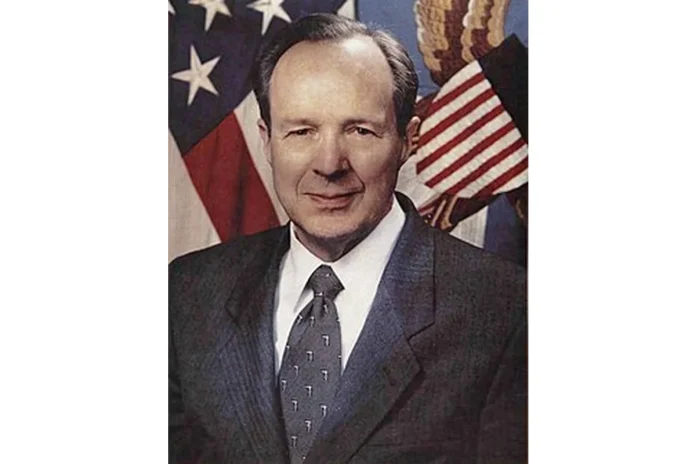
William Perry Bio
William James Perry (born October 11, 1927) is an American mathematician, engineer, businessman, academic, and former civil servant whose career has spanned higher education, private industry, and the highest levels of the United States government. A longtime Stanford University professor and technology executive, Perry is best known for serving as the 19th United States Secretary of Defense from February 3, 1994, to January 23, 1997, under President Bill Clinton. He also held the positions of Deputy Secretary of Defense and Under Secretary of Defense for Research and Engineering in earlier administrations. In his later years, Perry has become a leading public advocate for nuclear risk reduction, founding the William J. Perry Project to educate citizens about the dangers posed by modern nuclear weapons.
A member of the Democratic Party in his political affiliations, Perry has combined technical expertise with policy leadership across more than six decades. His work has shaped post-Cold War defense planning, arms control negotiations, and the structure of the American defense industry. He continues to be recognized as one of the most influential defense policymakers of the late twentieth century.
Early Life and Background
William James Perry was born on October 11, 1927, in Vandergrift, Pennsylvania, a small industrial town along the Kiskiminetas River. Growing up in a working-class community during the Great Depression shaped his early awareness of national priorities and public service. As a young man, Perry attended Culver Military Academy in Indiana, although he did not complete his studies there. He later graduated from Butler Senior High School in 1945, completing his secondary education just as World War II came to a close.
After high school, Perry served in the United States Army as an enlisted soldier from 1946 to 1947, including a tour of duty in the occupation of Japan. This early exposure to military life and to Asia influenced his later interest in international affairs and security policy. He later received a commission in the United States Army Reserve through the Reserve Officers’ Training Corps program, serving as an officer from 1950 to 1955. These formative years helped Perry decide on a career that would unite mathematics, engineering, and public service.
Perry pursued his higher education at Stanford University, where he earned a Bachelor of Science degree in 1949 and a Master of Arts degree in 1950. He continued his studies in mathematics at Pennsylvania State University, completing a Ph.D. in 1957. His training in advanced mathematics gave him the analytical foundation that would later prove valuable in defense research and technology policy.
Path to US Politics
Perry’s entry into public service began in 1967, when he was hired as a technical consultant to the United States Department of Defense. His work combined academic research with hands-on engineering, allowing him to influence national security policy from outside the government at first. In 1977, President Jimmy Carter nominated Perry to serve as Under Secretary of Defense for Research and Engineering, a position he held until 1981. In that role, he oversaw the research and procurement programs of the United States military, helping modernize weapons systems and technology during the final years of the Cold War.
After leaving the Pentagon in 1981, Perry moved into the private sector, becoming managing director of the San Francisco investment bank Hambrecht and Quist, a firm specializing in high-technology and defense companies. During the 1980s, he also served on several federal advisory bodies, including the President’s Commission on Strategic Forces, appointed by President Ronald Reagan in 1983, and the Packard Commission. He continued teaching at Stanford University, where he held a professorship in the School of Engineering, and co-directed the Preventive Defense Project at the university’s Center for International Security and Cooperation.
In the early 1990s, Perry returned to Washington, D.C., when President-elect Bill Clinton nominated him to serve as Deputy Secretary of Defense in 1993. Within a year, he was nominated to succeed Les Aspin as Secretary of Defense. The United States Senate confirmed him by a unanimous vote of 97-0, and he was sworn in on February 3, 1994, becoming the nineteenth person to lead the Department of Defense.
William Perry Career
Early Career (1954–1981)
From 1954 to 1964, Perry served as director of the Electronic Defense Laboratories of Sylvania and GTE in California, where he led research on communications theory, radio propagation, and computer-based systems for advanced military applications. In 1964, he founded Electromagnetic Systems Laboratory (ESL), Incorporated, an electronics research firm, and served as its president until 1977. Under his leadership, ESL demonstrated the technical feasibility of extracting Soviet signals intelligence from the broader radio frequency background, contributing to the development of the Rhyolite and Aquacade surveillance programs.
In 1977, Perry was nominated by President Jimmy Carter to serve as Under Secretary of Defense for Research and Engineering. In this role, he oversaw the research, development, and procurement portfolios of the United States armed services, guiding investments in emerging technologies. He left the Pentagon in 1981 at the end of the Carter administration, having established a strong reputation as a hands-on manager and technical innovator.
Department of Defense Leadership (1993–1994)
Perry returned to government service in 1993, when President Bill Clinton nominated him to serve as Deputy Secretary of Defense. Working alongside Secretary Les Aspin, Perry helped shape the administration’s defense policy during a period of post-Cold War budget reductions. In the autumn of 1993, Perry and Aspin hosted a dinner with two dozen defense industry executives, urging consolidation in the face of shrinking Pentagon budgets. The meeting became known as the Last Supper and is widely credited with spurring the wave of defense industry mergers that reshaped the sector in the following years.
When Aspin resigned in late 1993, Perry was nominated to succeed him. The Senate confirmed Perry as Secretary of Defense by a unanimous vote of 97-0, reflecting broad bipartisan support for his experience in defense management and technology. He took office on February 3, 1994, becoming the nineteenth United States Secretary of Defense.
Secretary of Defense (1994–1997)
As Secretary of Defense, Perry adopted preventive defense as the guiding principle of his national security strategy, aiming to keep threats from emerging, deter those that did, and defeat them with military force if necessary. He traveled abroad more than any previous defense secretary, meeting with European allies, hosting the first Conference of Defense Ministers of the Americas in Williamsburg, Virginia, in 1995, and engaging with partners across the Pacific.
Perry guided the defense budget through Congress during a period of sharp post-Cold War reductions. He requested $252.2 billion for fiscal year 1995, $246 billion for fiscal year 1996, and $242.6 billion for fiscal year 1997, while pressing for acquisition reform and base closings. He managed major international crises, including the Bosnian War, the Haiti intervention, and rising tensions with North Korea over its nuclear program. The Agreed Framework of October 1994, signed with North Korea after negotiations assisted by former President Jimmy Carter, was a signature diplomatic achievement of his tenure.
Perry also worked to reduce the nuclear threat from the former Soviet Union, using the Cooperative Threat Reduction Act of 1992, also known as the Nunn-Lugar program, to dismantle weapons in Russia, Ukraine, Belarus, and Kazakhstan. In June 1996, he traveled to Ukraine to observe the transfer of nuclear warheads to Russia under the Budapest Memorandum on Security Assurances. He testified in favor of ratifying the START II treaty and addressed the Russian State Duma in October 1996 to urge its passage. He stepped down as Secretary of Defense on January 23, 1997, after President Clinton’s reelection in November 1996.
Post-Government and Advocacy (1997–Present)
After leaving the Pentagon, Perry returned to California and rejoined the faculty at Stanford University, where he became the Michael and Barbara Berberian Professor emeritus at the School of Engineering, with a joint appointment at the Freeman Spogli Institute for International Studies. He also became a senior fellow at the Hoover Institution and continued to co-direct the Preventive Defense Project. In 2013, he founded the William J. Perry Project, a nonprofit effort to educate the public on the dangers of nuclear weapons in the modern era.
Perry has served on the boards of several technology companies, including Hambrecht and Quist, Xyleco, and Fabrinet, the last of which he joined in 2008. He was also a board member of Theranos, a Silicon Valley biotech company that later collapsed in fraud. In January 2021, Perry joined nine other living former Secretaries of Defense in publishing a Washington Post op-ed urging President Donald Trump not to involve the military in determining the outcome of the 2020 elections.
William Perry Awards and Honors
Awards and Decorations
Perry has received numerous honors for his service to the United States and contributions to international security. In 1997, he was awarded the Presidential Medal of Freedom, the highest civilian award in the United States, in recognition of his leadership of the Department of Defense. In 1999, he received the James A. Van Fleet Award from The Korea Society for his contributions to United States-Republic of Korea relations. In 2002, he was awarded the Grand Cordon of the Order of the Rising Sun by the government of Japan. In 2008, the United States Military Academy presented him with the Sylvanus Thayer Award for outstanding service to the nation.
Academic Recognition
In 1970, Perry was elected a member of the National Academy of Engineering for his contributions to communications theory, radio propagation theory, and computer technology in the design of advanced systems. He is also a fellow of the American Academy of Arts and Sciences. In 2006, he delivered the featured commencement address to engineering and science graduates at the University of California, Santa Barbara.
William Perry Family
Personal Life
William James Perry is married to Leonilla Green. Details of his family life have generally been kept private, and limited verified information is available about his children or other relatives. Perry has long resided in the San Francisco Bay Area, where he has been affiliated with Stanford University for most of his academic and professional life.