
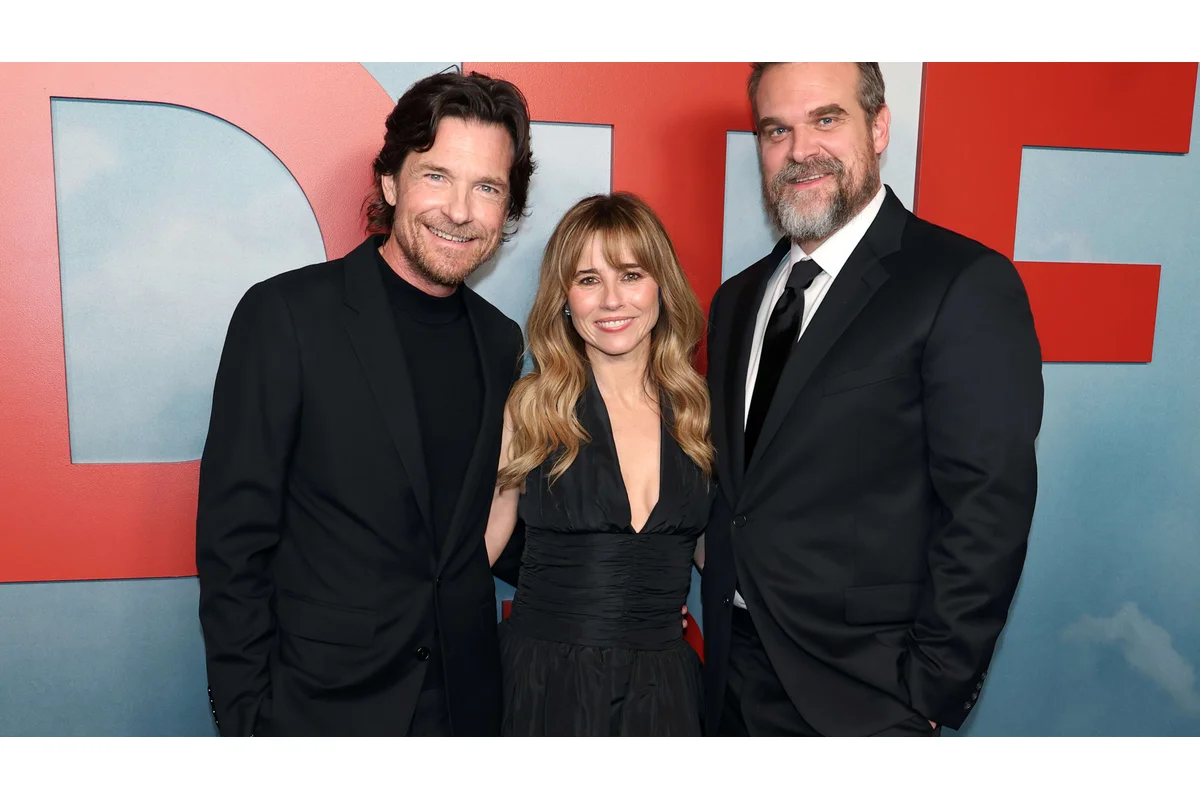
David Harbour is the primary entity for this article, supported by Entertainment topic context.
Related WII context: related keeper article. External authority context: industry context.
David Harbour spoke about his choice to wear a prosthetic stomach for his role in the dark comedy series DTF St. Louis, which debuted on HBO on March 1. Harbour, 50, portrays Floyd, a man tangled in a love triangle with his wife Carol, played by Linda Cardellini, and his coworker Clark, portrayed by Jason Bateman. The character Floyd is introduced as self-conscious, partly due to recent weight gain, which led to Harbour donning a false stomach for the role.
Harbour explained the reasoning behind the prosthetic, stating,
“It is used a bit for comedic effect, but also I wanted it to play as he uses food in a certain way, and to play as the reality of a guy who’s not getting hits on these sites, and various things,”
reflecting the character’s struggles.
“We wanted to highlight some of the struggles that he has,”
he added.
The Experience and Practicality of Wearing the Prosthetic
Describing the prosthetic, Harbour praised its effectiveness and shared that while it offered some enhancement, he might have been able to bulk up sufficiently on his own.
“It’s so funny. I keep thinking back to the prosthetic because … I don’t know that I really needed it. I mean, it only added [a little bit],”
he remarked.
He reflected on the freedom the prosthetic provided, emphasizing,
“I could have really just bulked up a little bit more, and I think I would have been fine, but it was nice to have, because there’s something about having a mask that allows you a freedom.”
The process of applying the prosthetic was extensive. Harbour detailed,
“When it was just under my clothes, it was just a suit that I could zip up myself, and it’d be easy, take it off during lunch. But then, when we had to see it, even just the belly part, they had to put on the whole thing, and it took about an hour.”
The prosthetic was made from latex and weighed approximately 30 pounds. Harbour explained,
“They’re printed out of latex. It was about 30 pounds, so it’s like a vest [that came down and] wrapped around the love handles a little bit.”
Attaching the prosthetic involved spirit gum, which required careful daily application. He added,
“put it down [the vest] then I’d wear it for a nice 14-hour day of shooting. Then at the end, you’d have to peel it off, and it would be all sweaty.”
Recent Trends: Actors and Prosthetic Usage for On-Screen Scenes
David Harbour is among several actors recently choosing prosthetics for challenging scenes. Paramount+’s Landman surprised audiences with Billy Bob Thornton performing a full-frontal scene, though the reality was less explicit than viewers assumed. Christian Wallace, cocreator of Landman, clarified the details in January when speaking with The Hollywood Reporter.

Wallace revealed,
“We had an on-set intimacy coordinator, and the original prosthetic she brought in made everyone laugh. We were like, ‘No.’”
Due to this, the crew decided on a subtler prosthetic option for Thornton’s scene.
He further explained,
“It is surprising to me that people think that was actually Billy doing full-frontal nudity,”
adding praise for the efforts behind the scene:
“So I should say props to our intimacy coordinator for making it extremely realistic, and to the props team. They had a whole rig, as Billy called it: ‘Got my rig on.’”
The Impact of Prosthetic Use in Character Portrayal and Production
Harbour’s decision to wear a prosthetic highlights how physical alterations support character development on screen, particularly in roles requiring vulnerability or comedic undertones. The lengthy process and physical demands of wearing such prosthetics emphasize the dedication actors invest to bring authenticity to their performances.
Moreover, the industry’s increasing reliance on prosthetics serves practical needs, such as preserving actors’ bodies while enabling challenging scenes to appear convincing. Insights from productions like Landman illustrate a trend of balancing authenticity with on-set safety and actor comfort, especially with intimacy coordinators involved.
As streaming platforms continue to deliver diverse content, the inclusion of prosthetics in storytelling is likely to remain a valuable tool for creators and performers alike, enhancing realism while respecting personal boundaries.
