
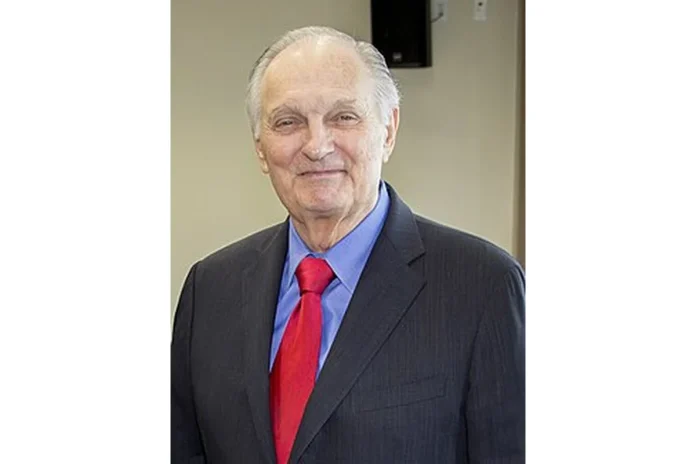
Alan Alda Bio
Alphonso Joseph D’Abruzzo, known professionally as Alan Alda, is an American actor, comedian, director, and screenwriter born on January 28, 1936, in New York City. He is best known for portraying Captain Benjamin Franklin “Hawkeye” Pierce on the CBS wartime sitcom M*A*S*H from 1972 to 1983, a role he also wrote and directed throughout the show’s eleven seasons. Over the course of seven decades on stage and screen, Alda has built a remarkable career that blends acting, writing, directing, and a deep commitment to science communication.
Alda has received six Primetime Emmy Awards and six Golden Globe Awards, along with nominations for an Academy Award, a Grammy Award, three Tony Awards, and two BAFTA Awards. He was inducted into the Television Hall of Fame in 1994 and received the Screen Actors Guild Life Achievement Award in 2018. Beyond entertainment, Alda founded the Alan Alda Center for Communicating Science at Stony Brook University and continues to advocate for clearer public engagement with research.
Early Life and Background
Alan Alda was born Alphonso Joseph D’Abruzzo on January 28, 1936, in Manhattan, New York City. His father, Robert Alda, was an actor and singer of Italian descent who created the stage name Alda by combining the first two letters of his first and last names. His mother, Joan Browne, was a homemaker and former beauty-pageant winner of Irish descent. Alda spent much of his childhood traveling around the United States with his parents in support of his father’s acting career, and he occasionally performed alongside his father in the less-risqué sketches of burlesque shows.
When Alda was seven years old, he contracted polio. His parents treated him with a painful regimen developed by Elizabeth Kenny, which involved applying hot woolen blankets to his limbs and stretching his muscles. This early health challenge helped shape his resilience. Alda later attended Archbishop Stepinac High School in White Plains, New York, where he began to develop his interest in performance. He went on to study English at Fordham University in the Bronx, where he also worked as a staff member at the campus FM radio station, WFUV. During his junior year, he studied in Paris, acted in a play in Rome, and performed with his father on television in Amsterdam.
Alda received his Bachelor of Arts degree from Fordham University in 1956. As a member of the Reserve Officers’ Training Corps, he entered the United States Army Reserve and served for six months at Fort Benning, followed by additional reserve duty in New York City. He has often joked about being placed in charge of a mess tent during his military service. Alda also has a half-brother, Antony Alda, born in 1956, who followed their father into acting.
Path to Acting
Alan Alda began his professional career in the 1950s as a member of the Compass Players, an improvisational comedy revue directed by Paul Sills. He later joined the Second City improvisational group in Chicago and participated in the Cleveland Play House during their 1958 to 1959 season through a Ford Foundation grant. These early experiences helped him develop the quick thinking and emotional honesty that would define his later work. In 1958, he appeared as Carlyle Thompson III in an episode of The Phil Silvers Show titled “Bilko the Art Lover.”
Alda made his Broadway debut portraying Charlie Cotchipee in the Ossie Davis play Purlie Victorious in 1961. He continued on Broadway with the 1964 stage version of The Owl and The Pussycat alongside actress Diana Sands, a pairing that drew both critical attention and hate mail for its interracial kiss. In 1966, he starred in the musical The Apple Tree on Broadway with Barbara Harris, earning a Tony Award nomination for Best Actor in a Musical. He also appeared on television as part of the cast of the American version of That Was the Week That Was, which aired from 1964 to 1965.
Alda made his Hollywood film debut in Gone Are the Days!, a screen adaptation of Purlie Victorious. He went on to portray author and humorist George Plimpton in Paper Lion (1968) and appeared in films such as The Extraordinary Seaman (1969) and The Mephisto Waltz (1971). During this period, he frequently appeared as a game show panelist on What’s My Line? and contributed several stories and poems to Marlo Thomas’ television program Free to Be… You and Me. These varied projects established him as a versatile performer ready for a defining role.
Alan Alda Career
Early Career (1958-1971)
During the late 1950s and 1960s, Alan Alda built a steady reputation through theater, television, and film work. His Broadway performances in Purlie Victorious (1961) and The Apple Tree (1967) earned him critical attention and his first Tony Award nomination. He also wrote material for Free to Be… You and Me, a children’s television project that highlighted his commitment to social causes and would become one of the earliest expressions of his support for women’s rights.
By the end of the 1960s, Alda had developed a reliable presence on both stage and screen. His early film roles in Paper Lion, The Extraordinary Seaman, and The Mephisto Waltz showcased his range as a character actor. These formative years laid the groundwork for the role that would soon transform him into one of the most recognizable faces on American television.
Breakthrough (1972-1983)
In early 1972, Alan Alda was selected to play Hawkeye Pierce in the television adaptation of the 1970 film M*A*S*H. He became the only series regular to appear in all 256 episodes and earned twenty-one Primetime Emmy Award nominations during the show’s run, winning five. Alda wrote nineteen episodes, including the 1983 series finale “Goodbye, Farewell and Amen,” which he also directed as his thirty-second episode behind the camera.
Throughout M*A*S*H, Alda gradually took on greater creative control as original writers departed. By the later seasons, he had become a producer and creative consultant, helping guide the show toward a more dramatic tone that openly addressed the political and social issues of the 1970s. By 1981, he was the highest-paid person on a television show, earning $225,000 per episode. His commitment to the role required him to commute weekly from Los Angeles to his family home in New Jersey for eleven years.
During the M*A*S*H years, Alda also starred in the 1978 films Same Time, Next Year and California Suite, and wrote and starred in the 1979 political drama The Seduction of Joe Tynan. He made his directorial debut with the ensemble comedy The Four Seasons in 1981. In 1996, TV Guide ranked him 41st on its list of the 50 Greatest TV Stars of All Time.
Established Actor (1984-1999)
After M*A*S*H, Alan Alda continued to expand his creative range. He appeared in Woody Allen’s Crimes and Misdemeanors (1989), Manhattan Murder Mystery (1993), and Everyone Says I Love You (1996). He directed Betsy’s Wedding (1990), his last directing credit to date, and played Dr. Robert Gallo in the television film And the Band Played On (1993). From 1990 to 2005, he hosted the PBS series Scientific American Frontiers, exploring advances in science and technology.
Alda returned to Broadway in 1998, starring in the original production of the play Art, which won the Tony Award for Best Play. He also appeared in the films Canadian Bacon (1995), Flirting with Disaster (1996), and Murder at 1600 (1997). His recurring role as Dr. Gabriel Lawrence on ER (1999) earned him an Emmy nomination for Outstanding Guest Actor in a Drama Series. He also played physicist Richard Feynman in the play QED during this period.
Continued Success (2000-Present)
In 2004, Alan Alda joined the cast of the NBC drama The West Wing as Republican Senator and presidential candidate Arnold Vinick. He appeared in twenty-eight episodes across the show’s sixth and seventh seasons and won the Primetime Emmy Award for Outstanding Supporting Actor in a Drama Series in 2006. That same year, he received his first Academy Award nomination for his portrayal of Senator Owen Brewster in Martin Scorsese’s The Aviator (2004), co-starring with Leonardo DiCaprio.
Alda continued to work across film, television, and stage in the following years. He starred in the Broadway revival of Glengarry Glen Ross (2005), earning a Tony nomination, and appeared in films such as Tower Heist (2011) and Steven Spielberg’s Bridge of Spies (2015). He received critical praise for his performance in Louis C.K.’s Horace and Pete (2016) and portrayed Dr. Arthur Amiot in Ray Donovan from 2018 to 2020. His role in Noah Baumbach’s Marriage Story (2019) earned widespread acclaim.
In 2025, Alda appeared in a cameo role in the Netflix miniseries The Four Seasons, a remake of the 1981 film he had directed and starred in. Throughout these years, he also remained active in science communication, founding the Alan Alda Center for Communicating Science at Stony Brook University in 2009 and receiving the Kavli Foundation’s first Distinguished Kavli Science Communicator award in 2021.
Notable Works and Milestones
Alan Alda’s signature work remains M*A*S*H, where his portrayal of Hawkeye Pierce earned him five Emmy Awards and lasting cultural influence. He won an additional Emmy for The West Wing, received an Academy Award nomination for The Aviator, and earned Tony nominations for The Apple Tree, Jake’s Women, and Glengarry Glen Ross. He was inducted into the Television Hall of Fame in 1994 and received the Screen Actors Guild Life Achievement Award in 2018.
Alan Alda Award Nominations
Throughout his career, Alan Alda has earned recognition across film, television, and stage. He received an Academy Award nomination for Best Supporting Actor for his role in The Aviator (2005), a BAFTA Award nomination for Best Actor in a Leading Role for Born on the Fourth of July (1991), and three Tony Award nominations for his performances in The Apple Tree (1967), Jake’s Women (1992), and Glengarry Glen Ross (2005). He also earned a Grammy Award nomination for Best Audio Book, Narration and Storytelling Recording for Things I Overheard While Talking to Himself and received multiple Primetime Emmy Award nominations for guest and supporting roles across series such as ER, 30 Rock, and The Blacklist.
Alan Alda Awards Won
Alan Alda has won six Primetime Emmy Awards and six Golden Globe Awards across his seven-decade career. He earned an Emmy for Outstanding Supporting Actor in a Drama Series for his role as Senator Arnold Vinick in The West Wing in 2006, adding to five earlier Emmy wins earned during his time on M*A*S*H. In 2018, he was honored with the Screen Actors Guild Life Achievement Award, and in 1994, he was inducted into the Television Hall of Fame. Alda has also received honorary degrees and numerous recognitions for his work in science communication.
| Award | Wins | Year |
|---|---|---|
| Primetime Emmy Award (Outstanding Supporting Actor in a Drama Series, The West Wing) | 1 | 2006 |
| Screen Actors Guild Life Achievement Award | 1 | 2018 |
| Television Hall of Fame Induction | 1 | 1994 |
Alan Alda Family
Alan Alda was born to Robert Alda, an actor and singer of Italian descent, and Joan Browne, a homemaker and former beauty-pageant winner of Irish descent. His father created the family stage name by combining the first two letters of his first and last names, a name Alan would later adopt professionally. Alda’s mother was diagnosed with schizophrenia during his childhood, an experience he has spoken about openly as shaping his ability to improvise and adapt in unpredictable situations. He also has a half-brother, Antony Alda, born in 1956, who followed their father into acting.
Personal Life
Alan Alda met Arlene Weiss in 1956 while attending Fordham University, and they were married on March 15, 1957. The couple has three daughters, including the actress Beatrice Alda. The Aldas were long-time residents of Leonia, New Jersey, where they raised their family while Alan commuted weekly to Los Angeles during his years on M*A*S*H. In his memoir Things I Overheard While Talking to Himself, Alda described how he gradually moved away from his Roman Catholic upbringing toward a more agnostic outlook. On July 31, 2018, Alda publicly announced that he had been diagnosed with Parkinson’s disease three years earlier.