
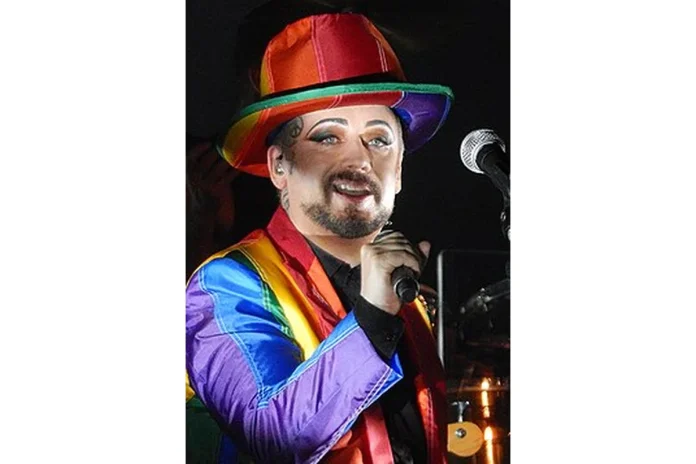
Boy George Bio
George Alan O’Dowd, known professionally as Boy George (born 14 June 1961), is a British musician, singer, songwriter, DJ and mixed-media artist who rose to international fame as the lead singer of the pop band Culture Club. Renowned for his androgynous style and distinctive voice, he has also maintained a long solo career and worked as a DJ, record label founder and mixed-media artist. Boy George’s music spans pop, new wave, soul, disco and reggae, and he has been active as a performer since 1979.
Over the course of his career, Boy George has sold millions of records as a member of Culture Club and as a solo artist, and has branched out into writing, photography, fashion design and theatre. He was voted 46th in the BBC poll of the 100 Greatest Britons in 2001, and continues to perform, record and appear on television.
Early Life and Background
Boy George was born George Alan O’Dowd at Barnehurst Hospital in Kent, England, on 14 June 1961. He was raised in Eltham, in south-east London, and grew up in a working-class Irish Catholic family as the second of five children of builder Jerry O’Dowd (1934–2004) and Dinah O’Dowd (1939–2023). His father was born in England of Irish descent and his mother was originally from Dublin, and Boy George has described his family history as resembling a “sad Irish song,” with branches that extended back to the Irish War of Independence.
He attended Middle Park Infant School and later Eltham Green Secondary School, where he struggled academically and left without qualifications. Before finding his footing in music, he worked at a series of jobs including fruit picker, printer, makeup artist and model. He has spoken openly about a difficult childhood shaped by his father’s temper, and about his younger brother Gerald, who has schizophrenia and was convicted of killing his wife in 1995.
As a teenager, Boy George became a follower of the New Romantic movement and began visiting the Blitz nightclub in London, run by Steve Strange and Rusty Egan. He has cited Siouxsie and the Banshees, Roxy Music, Patti Smith, David Bowie and Marc Bolan as formative influences, with Bowie and Bolan in particular shaping his androgynous image and sense of artistic identity.
Path to Music
Boy George’s first break came when music entrepreneur Malcolm McLaren arranged for him to perform with the group Bow Wow Wow under the stage name Lieutenant Lush. That stint ended after tensions with lead singer Annabella Lwin, and Boy George moved on to form his own band with bassist Mikey Craig, drummer Jon Moss and guitarist Roy Hay. Originally called Sex Gang Children, the group renamed itself Culture Club in 1981.
Culture Club recorded demos paid for by EMI Records, but the label declined to sign them. Virgin Records signed the band for European releases, while Epic Records handled North American distribution. The group’s debut album, Kissing to Be Clever, was released in 1982 and produced the international hit “Do You Really Want to Hurt Me,” which topped charts in multiple countries.
Between recording and touring, Boy George held odd jobs and became a fixture on the London club scene, drawing attention for his bold makeup and fashion. His visibility at the Blitz and other venues helped turn him into one of the most recognizable faces of the New Romantic era.
Boy George Career
Early Career (1979–1981)
Boy George began his professional music career in the late 1970s as part of the New Romantic scene, performing at clubs and fronting short-lived groups. He fronted Bow Wow Wow briefly under the name Lieutenant Lush before leaving to start his own project with Mikey Craig.
That project became Culture Club in 1981, with Jon Moss and Roy Hay completing the lineup. The band soon attracted major-label interest and recorded their debut album, Kissing to Be Clever, which would launch Boy George into the international spotlight in 1982.
Breakthrough (1982–1986)
Culture Club’s debut album Kissing to Be Clever (1982) was an immediate commercial success, reaching No. 5 in the UK and No. 14 in the US. The single “Do You Really Want to Hurt Me” became a global hit, reaching No. 1 in multiple countries, while follow-ups “Time (Clock of the Heart)” and “I’ll Tumble 4 Ya” also reached the US Top 10, making Culture Club the first group since the Beatles to have three Top 10 US hits from a debut album.
The band’s second album, Colour by Numbers (1983), was even bigger, topping the UK chart and reaching No. 2 in the US. Its lead single “Karma Chameleon” hit No. 1 in 16 countries, spent three weeks at No. 1 in the US, and was the best-selling single of 1983 in the UK. Further singles such as “Church of the Poison Mind,” “Victims” and “It’s a Miracle” kept the band at the top of the charts.
A third album, Waking Up with the House on Fire (1984), reached No. 2 in the UK, and its single “The War Song” became a UK No. 2 hit. On 25 November 1984, Boy George was a featured vocalist on the Band Aid charity single “Do They Know It’s Christmas?,” which became the Christmas No. 1 and best-selling single of 1984 in the UK. Internal pressures and the disappointing performance of the 1986 album From Luxury to Heartache led to Culture Club disbanding that year.
Notable Works and Milestones
Boy George’s signature recordings include “Do You Really Want to Hurt Me,” “Karma Chameleon,” “Time (Clock of the Heart),” “Church of the Poison Mind,” “The War Song” and his solo cover of “Everything I Own,” which reached No. 1 in the UK in 1987. He has released 11 solo studio albums, seven DJ albums and numerous singles across labels including EMI, Virgin, Epic, Sire, More Protein and BMG.
Boy George Award Nominations
Boy George has received multiple award nominations across his career with Culture Club and as a solo artist. He was nominated for a Tony Award for Best Musical Score for the London musical Taboo, and Taboo itself received four Laurence Olivier Award nominations during its West End run. His 1995 dance track “When Will You Learn” was nominated for the Grammy Award for Best Dance Recording.
Boy George Awards Won
In 2015, Boy George received the Ivor Novello Award from the British Academy of Songwriters, Composers and Authors for Outstanding Services to British Music. Earlier, in 2001, he was voted 46th in the BBC poll of the 100 Greatest Britons.
| Award | Wins | Year |
|---|---|---|
| Ivor Novello Award (Outstanding Services to British Music) | 1 | 2015 |
Boy George Family
Boy George was raised in a large Irish Catholic family in Eltham, south-east London, as the second of five children of Jerry O’Dowd and Dinah O’Dowd. He has one older brother, two younger brothers and a younger sister, as well as an older half-brother born in Dublin before the family moved to England.
His younger brother Gerald has schizophrenia and was convicted in 1995 of killing his wife during an episode of paranoia. Another younger brother, David, publicly discussed Boy George’s heroin addiction on UK television in the mid-1980s in an effort to encourage him to seek treatment.
Personal Life
Boy George has spoken publicly about his sexuality, telling interviewer Barbara Walters in 1985 that he was bisexual and had had both girlfriends and boyfriends. In his 1995 autobiography Take It Like a Man, he later stated that he was gay and discussed past relationships with punk singer Kirk Brandon and Culture Club drummer Jon Moss. He has credited his practice of Nichiren Buddhism with helping him stay sober.
From 1979 to the present, Boy George has remained an active performer, DJ and recording artist. He appeared as a contestant on the 22nd UK series of I’m a Celebrity…Get Me Out of Here! in November 2022, finishing in eighth place, and has continued to tour with Culture Club. He is due to represent San Marino at the Eurovision Song Contest 2026 alongside Italian singer Senhit.