
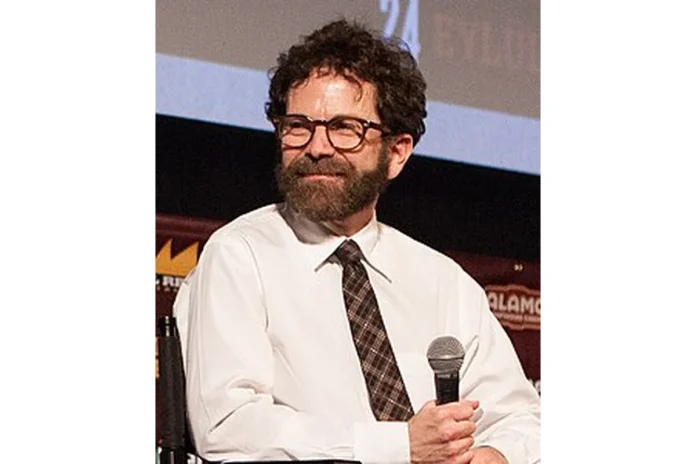
Charlie Kaufman Bio
Charles Stuart Kaufman (born November 19, 1958) is an American screenwriter, producer, director, and novelist whose work is widely associated with postmodernist and surrealist storytelling. Many film critics consider him an auteur of contemporary American cinema, and three of his screenplays appear on the Writers Guild of America list of the 101 greatest movie screenplays ever written. He first gained mainstream attention through his collaborations with directors Spike Jonze and Michel Gondry, and later expanded his career to include directing, animation, and long-form fiction.
Early Life and Background
Charles Stuart Kaufman was born on November 19, 1958, in New York City to a Jewish family, the son of Helen Kaufman and Myron Kaufman. He grew up in Massapequa, New York, on Long Island, before his family later moved to West Hartford, Connecticut. During high school, Kaufman joined the drama club and appeared in numerous school productions, eventually landing the lead role in a staging of Woody Allen’s play Play It Again, Sam during his senior year, an experience that pointed him toward a future in storytelling and performance.
After graduating from high school, Kaufman enrolled at Boston University before transferring to New York University, where he studied film and earned a Bachelor of Fine Arts degree. While attending NYU, he met fellow writer Paul Proch, and the two began collaborating on screenplays and stage plays, many of which would never be produced. Their early partnership, formed in a college environment, gave Kaufman his first sustained creative relationship and helped shape his offbeat comic sensibility.
Path to Screenwriter
Kaufman’s professional path began in print comedy. Between 1983 and 1984, he and Proch wrote satirical articles and parodies for National Lampoon, including spoofs of novelist Kurt Vonnegut and the X-Men comic series. The pair also wrote several original screenplays and sent them across the film industry, receiving only a single encouraging response: a supportive letter from actor Alan Arkin about their script Purely Coincidental. To attract representation, Kaufman assembled a portfolio of spec scripts based on popular television series such as Married… with Children, Newhart, It’s Garry Shandling’s Show, and The Simpsons.
While pursuing his writing career, Kaufman worked a series of customer service jobs to support himself and his wife, Denise. During the late 1980s, he lived in Minneapolis, where he spent four and a half years in the circulation department of the Star Tribune and also worked at the Minneapolis Institute of Art. In 1991, one of his spec scripts drew the attention of a talent agent, who encouraged him to move to Los Angeles to look for television work. After a brief period of job hunting, Kaufman found a foothold writing for the Chris Elliott sitcom Get a Life, contributing two episodes before the show’s cancellation in 1992.
Following the end of Get a Life, Kaufman continued to work in television comedy, contributing to series such as The Edge, The Trouble with Larry, Ned and Stacey, and The Dana Carvey Show, the last of which featured a young writing staff that included Louis C.K., Stephen Colbert, Steve Carell, and Greg Daniels. He also drafted several unproduced pilot scripts of his own, including surrealist and time-travel concepts for Disney and HBO, experiences that sharpened his voice and clarified the kind of material he most wanted to write.
Charlie Kaufman Career
Early Career (1983–1997)
Kaufman’s earliest professional work consisted of comedic articles and parodies written for National Lampoon between 1983 and 1984, often in collaboration with Paul Proch. Throughout the late 1980s, he balanced odd jobs in Minneapolis with an active but unproduced screenwriting habit, writing spec scripts based on established television series. His transition to professional writing came through small television jobs in the early 1990s, beginning with the short-lived series Get a Life and continuing with a string of sketch and sitcom projects.
On shows such as Ned and Stacey, The Dana Carvey Show, and The Edge, Kaufman built a reputation as a thoughtful, unconventional voice in the writers’ room. Several of his pilot scripts, including the surrealist buddy comedy Depressed Roomies and an adaptation concept titled Rambling Pants, went unproduced but kept him in contact with producers and agents. By the late 1990s, he was ready to bring his distinctive sensibility to feature films.
Breakthrough (1999–2004)
Kaufman first reached a wide audience as the writer of Being John Malkovich (1999), directed by Spike Jonze. He had originally written the script on spec in 1994, and after many rejections it eventually reached producer Francis Ford Coppola, who passed it to Jonze. The film earned Kaufman an Academy Award nomination for Best Original Screenplay and a BAFTA Award. He then reunited with Jonze to co-produce Human Nature (2001), directed by Michel Gondry, before writing Adaptation (2002), another Jonze-directed film that brought him a second Academy Award nomination and a second BAFTA Award.
In 2002, Kaufman also wrote Confessions of a Dangerous Mind, the directorial debut of actor George Clooney, based on the claimed CIA double life of television host Chuck Barris. His most acclaimed work of the period came with Eternal Sunshine of the Spotless Mind (2004), directed by Michel Gondry and co-credited to Kaufman, Gondry, and French artist Pierre Bismuth. The film won the Academy Award for Best Original Screenplay, a third BAFTA Award, and the PEN American Center 2005 screenplay prize, and was widely regarded as one of the finest films of the decade.
Notable Works and Milestones
Three screenplays by Kaufman, Being John Malkovich, Adaptation, and Eternal Sunshine of the Spotless Mind, were named to the Writers Guild of America list of the 101 greatest movie screenplays ever written. His work during this period also brought him two Academy Award nominations, three BAFTA Awards, and recognition from leading critics as one of the most distinctive screenwriters of his generation.
Charlie Kaufman Award Nominations
Charlie Kaufman has received numerous major award nominations across his career, including multiple Academy Award nominations for screenwriting, an Academy Award nomination in connection with Anomalisa’s run for Best Animated Feature, and additional nominations from the British Academy of Film and Television Arts, the Independent Spirit Awards, and the Writers Guild of America. He has also been recognized for his stop-motion work, television writing, and contributions to the craft of adaptation.
Charlie Kaufman Awards Won
Kaufman has won an Academy Award for Best Original Screenplay for Eternal Sunshine of the Spotless Mind, three BAFTA Awards for his screenplays, two Independent Spirit Awards, an Emmy Award, and a Writers Guild of America Award. His stop-motion feature Anomalisa won the Grand Jury Prize at the Venice Film Festival, and his directorial debut Synecdoche, New York was later named by film critic Roger Ebert as the best movie of the decade in 2009.
Charlie Kaufman Family
Kaufman is the son of Helen Kaufman and Myron Kaufman. He has been married to Denise Monaghan, and together they have a daughter named Anna. Kaufman has frequently kept his family life out of the public eye, and his daughter has been mentioned in interviews rather than featured in his professional work.
Personal Life
Charlie Kaufman lives in Manhattan, New York, having previously lived in Pasadena, California, since 1998 before relocating. He is married to Denise Monaghan, his wife since the early years of his writing career, and the couple share a daughter, Anna. Outside of his screenwriting and directing, Kaufman is also a published novelist, and his interests have long included literature, philosophy, and the work of influential writers such as Franz Kafka, Samuel Beckett, and Philip K. Dick.