
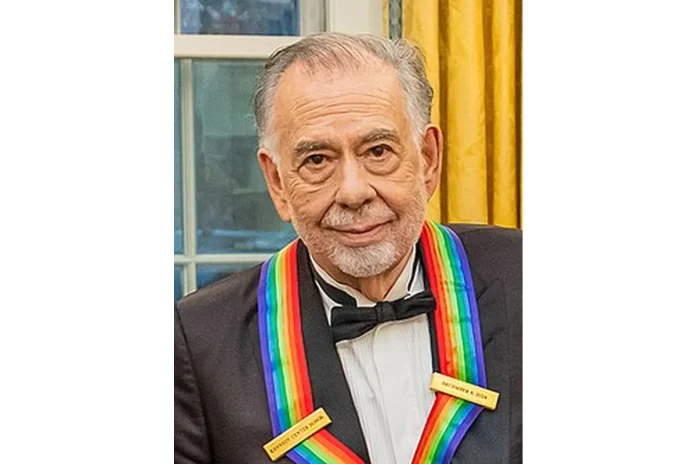
Francis Ford Coppola Bio
Francis Ford Coppola (born April 7, 1939) is an American filmmaker widely regarded as one of the leading figures of the New Hollywood era. He is the founder of American Zoetrope and is best known for directing The Godfather (1972), The Godfather Part II (1974), and Apocalypse Now (1979). Over the course of his career, Coppola has earned multiple Academy Awards, BAFTA Awards, Golden Globe Awards, and the Palme d’Or, and he continues to influence generations of filmmakers. In addition to directing, he has produced and written across a wide range of films, and he has pursued independent, experimental projects and winery ventures in Napa Valley.
Early Life and Background
Francis Ford Coppola was born on April 7, 1939, in Detroit, Michigan, and was delivered at Henry Ford Hospital. His father, Carmine Coppola, was a flautist with the Detroit Symphony Orchestra and an arranger for The Ford Sunday Evening Hour, while his mother, Italia Pennino, came from a family of second-generation Italian immigrants. His paternal grandparents had come to the United States from Bernalda, in the Basilicata region of Italy, and his maternal grandfather, Italian composer Francesco Pennino, emigrated from Naples, Italy. Two years after his birth, the family moved to New York when Carmine was named principal flutist for the NBC Symphony Orchestra under Arturo Toscanini, and they settled in Woodside, Queens, where Coppola spent the remainder of his childhood.
Coppola contracted polio as a boy and was bedridden for long stretches of his childhood, during which he staged homemade puppet theater productions. He developed an interest in theater after reading A Streetcar Named Desire at age 15 and began making 8 mm feature films edited from home movies with titles such as The Rich Millionaire and The Lost Wallet. Although he was a mediocre student, his interest in technology and engineering earned him the childhood nickname “Science.” He trained initially for a career in music, became proficient in the tuba, and eventually earned a music scholarship to the New York Military Academy. In all, Coppola attended 23 schools before graduating from Great Neck North High School.
He matriculated at Hofstra University in 1955 as a theater arts major, where he was awarded a scholarship in playwriting that furthered his interest in directing theater. His father disapproved and wanted him to study engineering, but Coppola was profoundly impressed by Sergei Eisenstein’s October: Ten Days That Shook the World and decided to pursue cinema rather than theater. While at Hofstra, he won three D. H. Lawrence Awards for theatrical production and direction and received a Beckerman Award for his outstanding contributions to the school’s theater arts division. His classmates at Hofstra included James Caan, Lainie Kazan, and radio artist Joe Frank, and he later cast Kazan and Caan in his films.
Path to Director
After earning his theater arts degree from Hofstra in 1960, Coppola enrolled at the UCLA Film School, where he directed short horror films inspired by Edgar Allan Poe and other sources. In the early 1960s, he made $10 per week and supplemented his income by writing, re-editing, and assisting on low-budget productions, including nudie-cuties and Roger Corman quickies. Corman first hired Coppola to dub and re-edit the Soviet science fiction film Nebo Zovyot, which Coppola turned into the monster movie Battle Beyond the Sun, and later worked with him on Tower of London, The Young Racers, and The Terror. These early assignments gave Coppola invaluable experience in production, editing, and managing difficult shoots.
Coppola’s first feature film was Dementia 13 (1963), a low-budget horror movie made on location in Ireland with leftover funds from Corman’s The Young Racers. He wrote a brief draft in one night, incorporating elements from Hitchcock’s Psycho, and directed the picture over the course of nine days. The film recouped its expenses and later became a cult favorite among horror enthusiasts. It was on the set of Dementia 13 that Coppola met Eleanor Jessie Neil, the woman he would marry. He later bought the rights to David Benedictus’s novel You’re a Big Boy Now and merged it with a story idea of his own, resulting in his UCLA thesis project You’re a Big Boy Now (1966), which earned him his Master of Fine Arts degree from UCLA and received a theatrical release via Warner Bros.
Francis Ford Coppola Career
Early Career (1962–1969)
Following You’re a Big Boy Now, Coppola directed the musical Finian’s Rainbow (1968), starring Fred Astaire and Petula Clark, which proved a critical and commercial success despite a disjointed visual style. He then wrote, directed, and initially produced The Rain People (1969), a road film that won the Golden Shell at the 1969 San Sebastián International Film Festival. While touring Europe during this period, Coppola was introduced to alternative filmmaking equipment and, inspired by the bohemian spirit of Copenhagen’s Lanterna Film, decided to build a deviant studio that would conceive and implement unconventional approaches to filmmaking. He named the studio Zoetrope after receiving a gift of zoetropes from Mogens Scot-Hansen, and in 1969 the first home for Zoetrope Studio was a warehouse in San Francisco on Folsom Street.
In 1965, Coppola won the annual Samuel Goldwyn Award for best screenplay written by a UCLA student, and the honor secured him a job as a scriptwriter with Seven Arts. He co-wrote the scripts for This Property Is Condemned (1966) and Is Paris Burning? (1966), and he co-wrote the script for Patton starting in 1963 along with Edmund H. North, an effort that would earn him his first Academy Award. After touring Europe, Coppola returned home and, with George Lucas, searched for a mansion in Marin County to house the studio, eventually settling on a San Francisco warehouse. The Rain People introduced Coppola to George Lucas, who became a lifelong friend and later served as a production assistant on his next film.
Breakthrough (1970–1979)
Coppola co-wrote the script for Patton (1970) along with Edmund H. North, and the film earned him the Academy Award for Best Original Screenplay. The movie opens with George C. Scott’s rendering of Patton’s famous military pep talk set against a huge American flag, an opening monologue that has become an iconic scene and has spawned parodies in numerous films, political cartoons, and television shows. Coppola later revealed that George C. Scott, who remembered reading the screenplay years earlier, was the one who insisted on using Coppola’s version of the script. The success of Patton helped cement Coppola’s reputation as a major American filmmaker.
The Godfather (1972) was a turning point in Coppola’s career, even though he faced enormous difficulties during production. Paramount had owned the rights to Mario Puzo’s novel for several years, and the studio was not initially enthusiastic about Coppola as director; he agreed to receive $125,000 and six percent of the gross rentals. Coppola found a deeper theme in the material and decided the film should be a family saga and a metaphor for capitalism in America, casting Marlon Brando as Vito Corleone, Al Pacino as Michael, and James Caan, John Cazale, Robert Duvall, Diane Keaton, and his sister Talia Shire in supporting roles. The film was a critical and commercial success, setting box-office records, and Brando won the Academy Award for Best Actor, which he refused. The film won Best Picture and Best Adapted Screenplay, and Coppola was nominated for Best Director but lost to Bob Fosse for Cabaret.
The Conversation (1974) further cemented Coppola’s reputation and was influenced by Michelangelo Antonioni’s Blowup (1966). It stars Gene Hackman as Harry Caul, a surveillance expert hired to spy on a young couple, with John Cazale as his partner, and the movie won Coppola his first Palme d’Or at the 1974 Cannes Film Festival. The film received three Oscar nominations: Best Picture, Best Original Screenplay, and Best Sound, and Coppola’s brother-in-law David Shire wrote the score while Walter Murch edited the picture.
The Godfather Part II is both prequel and sequel to the first film, telling parallel stories of the rise of young Vito Corleone and the fall of his son Michael. Coppola claims it was the first major motion picture to use “Part II” in its title, a decision inspired by Sergei Eisenstein’s two-part Ivan the Terrible. The film received tremendous critical acclaim and was nominated for 11 Academy Awards, winning six, including Best Picture, Best Adapted Screenplay, and Best Director. Robert De Niro won Best Supporting Actor for his portrayal of Vito, making him and Brando the first actors to win Oscars for playing the same character.
Apocalypse Now (1979) was an adaptation of Joseph Conrad’s Heart of Darkness set in Cambodia during the Vietnam War, following Willard (Martin Sheen) on a mission upriver to find and assassinate the rogue Kurtz (Brando). The production in the Philippines was plagued by typhoons, nervous breakdowns, the firing of Harvey Keitel, Sheen’s heart attack, Brando arriving overweight and unprepared, and extras and helicopters leaving in the middle of scenes to fight real rebels. The film premiered at the 1979 Cannes Film Festival, where Coppola famously declared, “My film is not about Vietnam, it is Vietnam,” and it shared the Palme d’Or with Volker Schlöndorff’s The Tin Drum. Apocalypse Now won Oscars for Best Cinematography (Vittorio Storaro) and Best Sound, and the documentary Hearts of Darkness: A Filmmaker’s Apocalypse chronicles the difficulties the crew went through during production.
Notable Works and Milestones
Coppola’s signature works include The Godfather, The Godfather Part II, The Conversation, and Apocalypse Now, four films that redefined American cinema and helped launch the New Hollywood movement. His films have earned five Academy Awards, two Palmes d’Or, a BAFTA Award, three Golden Globe Awards, and the Irving G. Thalberg Memorial Award, and four of his films have been inducted into the National Film Registry by the Library of Congress. He is one of ten filmmakers to have won the Palme d’Or twice, and in 2024 he received the Kennedy Center Honors and, in 2025, the AFI Life Achievement Award.
Francis Ford Coppola Award Nominations
Across his career, Francis Ford Coppola has received multiple Academy Award nominations, including Best Director for The Godfather (lost to Bob Fosse for Cabaret), Best Picture, Best Director, and Best Adapted Screenplay for The Godfather Part II, and Best Picture, Best Director, and additional nominations for The Godfather Part III. He has also received Golden Globe nominations, including for Best Director and Best Picture for The Cotton Club, and his films have earned a long list of nominations across directing, writing, producing, and picture categories from major industry organizations.
Francis Ford Coppola Awards Won
Francis Ford Coppola has won five Academy Awards, two Palmes d’Or, a BAFTA Award, three Golden Globe Awards, and the Irving G. Thalberg Memorial Award. His Academy Award wins include Best Original Screenplay for Patton (1969), Best Picture for The Godfather (1972), and Best Director and Best Picture for The Godfather Part II (1974), along with additional wins for his producing and writing work. The Conversation (1974) and Apocalypse Now (1979) each won the Palme d’Or at the Cannes Film Festival, and in 2024 he received the Kennedy Center Honors, followed by the AFI Life Achievement Award in 2025.
| Award | Wins | Year |
|---|---|---|
| Academy Award for Best Original Screenplay (Patton) | Won | 1969 |
| Academy Award for Best Picture (The Godfather) | Won | 1973 |
| Academy Award for Best Director (The Godfather Part II) | Won | 1975 |
| Palme d’Or (The Conversation) | Won | 1974 |
| Palme d’Or (Apocalypse Now) | Won | 1979 |
| Irving G. Thalberg Memorial Award | Won | 2010 |
Francis Ford Coppola Family
Coppola was born into a family of Italian heritage: his father, Carmine Coppola, was a flautist and composer whose music featured in his son’s films, and his mother, Italia Pennino, came from a family of second-generation Italian immigrants. His older brother was August Coppola, and his younger sister is actress Talia Shire. Many of his relatives have found success in film: his daughter Sofia is a director, his son Roman is a screenwriter, and his nephews Jason Schwartzman and Nicolas Cage are actors. His father, Carmine, won Academy Awards for his musical work and appeared in several of his son’s films.
Personal Life
In 1963, Coppola married writer and documentary filmmaker Eleanor Jessie Neil, whom he met on the set of Dementia 13, and they remained married until her death on April 12, 2024, at the age of 87. Together they had three children: Gian-Carlo, Roman, and Sofia, all of whom became filmmakers. Gian-Carlo died in 1986 at the age of 22 in a speedboating accident, and he had one daughter, Gia Coppola, also a filmmaker. Coppola resides in Napa, California, and since the 1970s has been a vintner, owning a family-branded winery.