
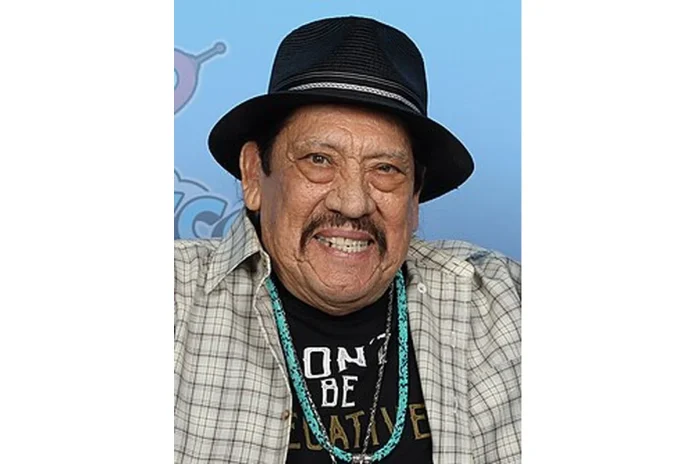
Danny Trejo Bio
Danny Trejo (born May 16, 1944, in Maywood, California) is an American actor who has built one of Hollywood’s most recognizable careers through a steady stream of character roles. Films in which he has appeared have grossed over $3.7 billion at the global box office, a figure that reflects both the volume and reach of his filmography. Over the course of more than three decades, Trejo has worked across action, crime, and family films, in addition to voice acting, television, and video games. His distinctive look, marked by a lined face, a mustache, long hair, and a prominent chest tattoo, has made him a familiar figure on screen and on pop-culture merchandise alike.
Early Life and Background
Danny Trejo was born on May 16, 1944, in Maywood, California, and was raised on Temple Street in the Echo Park neighborhood of Los Angeles. He is the son of Mexican-American parents, Delores Rivera King and Dionisio “Dan” Trejo (1922–1981), a construction worker. Trejo was the result of an extramarital affair, with his mother’s husband away fighting in World War II; his parents met at a dance hall in Highland Park, Los Angeles, in 1943. After his birth, the family briefly moved to San Antonio, Texas, fleeing Los Angeles because his father was wanted by police for stabbing another man; they returned about a year later, when Dionisio turned himself in.
Trejo’s childhood was difficult. He was often abused by his father, and his stepmother, Alice Mendias, became his primary source of comfort during those years. He had a maternal half-sister, Dyhan, but saw neither her nor his mother from 1949 until 1965, after his father banned Delores from seeing him following an arm injury. Trejo began using marijuana, heroin, and cocaine by the ages of 8, 12, and 18, respectively, with an uncle, Gilbert, introducing him to all three substances. By 1949, he shared a room with his cousins at his grandmother’s house, and at 13 he moved to the majority Hispanic neighborhood of Pacoima, Los Angeles, where he has said he did not experience racism growing up. Years later, he purchased his childhood home there.
Path to Actor
Trejo’s path to acting ran through years of incarceration, sobriety, and community service. He participated in his first drug deal at age seven, was first arrested at 10, and experienced his first incarceration at Eastlake Juvenile Hall in 1956. Throughout the 1960s, his life consisted largely of intermittent jail stints in the California prison system, including time at San Quentin, Folsom, Soledad, Vacaville, Susanville, and Sierra. At San Quentin, he focused on boxing and became a champion in the prison’s lightweight and welterweight divisions. He arrived at San Quentin State Prison in 1966, and his heroin use worsened during that period.
A turning point came during a 1968 prison riot on Cinco de Mayo at Soledad. After hitting a guard with a rock, Trejo faced capital charges and possible execution in solitary confinement. While in solitary, he found faith and became a member of a 12-step program, having first attended one by accident at age 15. Trejo successfully overcame his drug addictions and was released from prison in 1969, remaining sober from that point on. He earned his high-school diploma while incarcerated and, by 1973, had become a substance abuse counselor, working with the Western Pacific Med Corp in the 1980s to establish and operate sober-living houses within the San Fernando Valley. That counseling work would eventually lead him onto a film set.
Danny Trejo Career
Early Career (1985-1990)
Trejo’s film career began in 1985, when he was offered a job as an extra in the prison scenes of Runaway Train. Edward Bunker, a former convict turned published crime author who was writing the screenplay, recognized Trejo from their time together at San Quentin. Remembering Trejo’s boxing skills, Bunker helped secure him as Eric Roberts’ personal trainer and boxing advisor. Bunker also convinced director Andrei Konchalovsky to offer Trejo a small acting role, arguing that his real incarceration experience would provide authenticity. Trejo’s first credited role came as Art Sanella in Death Wish 4: The Crackdown (1987), and Penitentiary III became his first billed role.
By 1990, Trejo had made a dozen films, including Death Wish 4: The Crackdown and Marked for Death, often in small parts as inmates, gangsters, or other criminals. On a good month, he was earning as much as $700 by 1989 from extra work alone. Even at this early stage, his appearances on television helped his work as a drug counselor, because clients would recognize him and appreciate the humility behind his recovery story.
Breakthrough (1991-2009)
In 1991, Edward James Olmos originally offered Trejo the role of Pedro Santana in American Me, though Trejo ultimately chose Blood In, Blood Out after pressure from figures within the Mexican Mafia. Of that experience, Trejo has said it brought him legitimate, worldwide fame, even though filming at San Quentin triggered flashbacks from his time there. He went on to take supporting roles in Heat (1995), reuniting with director Michael Mann; From Dusk till Dawn (1996); Con Air (1997); The Replacement Killers (1998); Reindeer Games (2000); and Once Upon a Time in Mexico (2003), building a reputation for dependable, character-driven work in crime and action films.
A major breakthrough arrived with the Spy Kids franchise (2001-2003), directed by Robert Rodriguez, in which Trejo originated the role of Isador “Machete” Cortez. Spy Kids gave him worldwide recognition, and for the first time he was instantly recognizable to children around the globe. Throughout the 2000s, he also appeared in XXX; Anchorman: The Legend of Ron Burgundy; The Devil’s Rejects; Rob Zombie’s Halloween; and Grindhouse, and made television appearances on Monk, Desperate Housewives, Stargate: Atlantis, and Breaking Bad. He also voiced Enrique and several other characters on King of the Hill.
Notable Works and Milestones
Trejo’s most iconic work came with the exploitation action film Machete (2010), a spin-off based on the character from the Grindhouse trailer, in which he starred as the protagonist. He reprised the role of Machete in the direct sequel Machete Kills (2013). His other major screen presence has included the Bad Ass films, the Sons of Anarchy arc as Romero ‘Romeo’ Parada, a guest role on Rick and Morty’s “Pickle Rick” as Mr. Jaguar, and appearances as himself in the animated series Big City Greens. He has also produced films, beginning with Ambition (2014) and Bad Asses (2014).
Danny Trejo Award Nominations
Danny Trejo has earned recognition across his career for both his film work and his ongoing community outreach, with nominations tied to his genre performances and his off-screen advocacy for sobriety.
Danny Trejo Awards Won
Trejo has received honors reflecting his cultural impact, including recognition for his memoir and his humanitarian work with at-risk youth and people in recovery.
Danny Trejo Family
Danny Trejo’s parents were Delores Rivera King and Dionisio “Dan” Trejo (1922–1981), a construction worker of Mexican-American heritage. His second cousin is filmmaker Robert Rodriguez, a connection the two did not discover until the filming of Desperado. Trejo also has a second cousin, Patricia Vonne, who is part of the same extended family.
Personal Life
Danny Trejo has been married and divorced four times and has three children: Danny (b. 1981), actor and director Gilbert (b. 1988), and actress Danielle (b. 1990). His eldest child, nicknamed “Danny Boy,” is from a relationship with Diana Walton, who was with him from 1978 to 1983, while his latter two children are from a relationship with Maeve Crommie (1986-1997); he has also helped raise her two sons from a subsequent relationship. He married Laura in 1962, Debbie Schipek from 1971 to 1975, Joanne Discuillo from 1975 to 1978, and Debbie Shreve from 1997 until their separation in 2005 and his filing for divorce in 2009.
Trejo is a Christian and a Democrat who has battled liver cancer, overcoming it in 2010. He is a passionate fan of the Los Angeles Lakers, Los Angeles Dodgers, Los Angeles Kings, Los Angeles FC, and Los Angeles Rams, frequently attending games and team training camps. In August 2019, he witnessed a car collide with an SUV at an intersection and helped extract a five-year-old trapped in a child safety seat inside the overturned SUV, an experience he has described as consistent with a lifetime spent helping others. He is also the owner of a series of Los Angeles restaurants, including Trejo’s Tacos, Trejo’s Cantina, and Trejo’s Coffee and Donuts, and has built brands of beer, coffee, and merchandise under his name.