
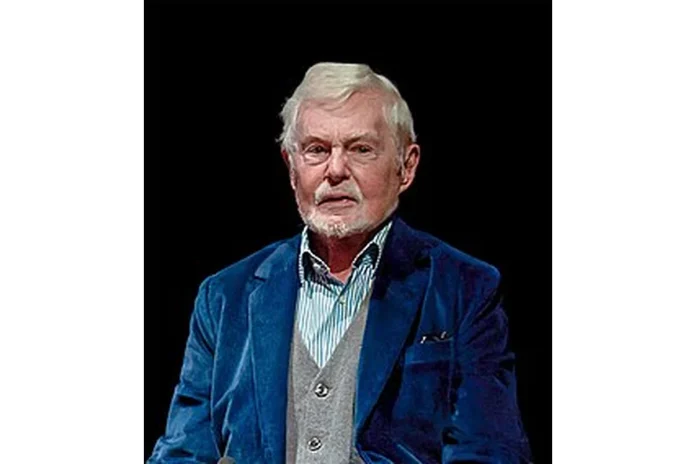
Derek Jacobi Bio
Sir Derek George Jacobi is an English actor known for his distinguished work on stage and screen. Born in Leytonstone, Essex, England in 1938, he established a career spanning theatre, television, and film. Jacobi has received numerous accolades including a Tony Award, two Laurence Olivier Awards, two Primetime Emmy Awards, and was knighted in 1994 for services to theatre.
His versatility and distinctive voice have made him one of Britain’s most respected performers. From Shakespearean roles to contemporary television dramas, Jacobi has maintained a prominent presence in entertainment for over six decades. His notable works include I, Claudius, The King’s Speech, Gladiator, and television series such as Vicious and Last Tango in Halifax.
Early Life and Background
Derek George Jacobi was born on 22 October 1938 in Leytonstone, Essex, England. He is the only child of Alfred George Jacobi, who ran a tobacconist and sweet shop in Chingford, and Daisy Gertrude Masters, who worked as a secretary. His patrilineal great-grandfather emigrated from Germany to England during the 19th century.
At age nine, Jacobi contracted rheumatic fever and spent 18 months confined to bed. His parents moved his bed to the living room, where he spent time listening to the radio and watching television. This exposure to broadcast performances influenced his accent and sparked his desire to become an actor. He describes his childhood in a working-class family as happy.
Jacobi attended Leyton County High School for Boys, now known as Leyton Sixth Form College. He became an integral part of the school’s drama club, The Players of Leyton. While in the sixth form, he starred in a production of Hamlet that was taken to the Edinburgh Festival Fringe and received positive recognition.
Path to Acting
At age 18, Jacobi won a scholarship to the University of Cambridge, where he studied history at St John’s College. His university contemporaries included Ian McKellen and Trevor Nunn. During his Cambridge years, Jacobi performed many roles, including Hamlet, which toured to Switzerland where he met Richard Burton. His performance as Edward II at Cambridge earned him an invitation to join the Birmingham Repertory Theatre upon his graduation in 1960.
Laurence Olivier recognized Jacobi’s talent and invited the young actor to become one of the founding members of the new National Theatre in 1963. Jacobi made his debut as Laertes in the National Theatre’s inaugural production of Hamlet, opposite Peter O’Toole. This opportunity marked the beginning of his association with Britain’s most prestigious theatre companies.
Following eight years at the National Theatre, Jacobi left in 1971 to pursue diverse roles. Throughout the 1970s, he performed extensively with the Prospect Theatre Company, undertaking many classical roles including Ivanov, Pericles, Prince of Tyre, and A Month in the Country opposite Dorothy Tutin.
Derek Jacobi Career
Early Career (1959-1979)
Jacobi began his professional acting career in 1959. His early stage work included playing Cassio in the National Theatre’s production of Othello, a role he reprised in the 1965 film version. He also appeared as Andrei in both the stage production and film adaptation of Three Sisters in 1970. In 1965, he originated the role of Brindsley Miller in the first production of Peter Shaffer’s Black Comedy.
His television work during this period included the BBC serial Man of Straw in 1972 and the role of Lord Fawn in the 1974 mini-series The Pallisers. However, his breakthrough came in 1976 when he portrayed the title role in the BBC series I, Claudius. His performance as the stammering Emperor Claudius earned critical acclaim and a British Academy Television Award for Best Actor.
Breakthrough (1980-1999)
Jacobi joined the Royal Shakespeare Company in 1980 and embarked on a period of intense theatrical activity. From 1982 to 1985, he performed four demanding roles simultaneously: Benedick in Much Ado About Nothing, Prospero in The Tempest, Peer Gynt, and Cyrano de Bergerac. His portrayal of Benedick earned him a Tony Award for Best Actor in a Play in 1985.
In 1986, Jacobi made his West End debut in Breaking the Code by Hugh Whitemore, starring as Alan Turing in a role specifically written for him. The play transferred to Broadway. In 1988, he alternated the title roles of Richard II and Richard III in West End repertoire. His television work during this decade included playing Hitler in Inside the Third Reich and winning a Primetime Emmy Award for Outstanding Supporting Actor in a Miniseries or Movie for The Tenth Man.
The 1990s saw Jacobi continuing his repertoire stage work with productions of Kean, Becket, and Macbeth. He served as joint artistic director of the Chichester Festival Theatre from 1995 to 1998. His television work included starring as the medieval monk in Cadfael from 1994 to 1998. Film appearances included Kenneth Branagh’s Dead Again, Branagh’s Hamlet as King Claudius, and his role as Senator Gracchus in Gladiator.
Breakthrough (2000-Present)
Jacobi’s career continued with diverse projects across mediums. In 2001, he won a Primetime Emmy Award for Outstanding Guest Actor in a Comedy Series for his appearance on Frasier, where he humorously parodied his Shakespearean background. He appeared in films including Nanny McPhee, Underworld: Evolution, and My Week with Marilyn.
From 2012 to 2020, Jacobi starred as Alan Buttershaw in the BBC series Last Tango in Halifax. In 2013, he began starring alongside Ian McKellen in the ITV sitcom Vicious as Stuart Bixby, with the show concluding in 2016. His film appearances during this period included The King’s Speech, for which he received a Screen Actors Guild Award as part of the ensemble cast, and Cinderella as the King.
Jacobi has continued working consistently into his later years. In 2018, he played the Bishop of Digne in the BBC miniseries Les Misérables. He appeared in the 2022 film Allelujah and the 2023 drama The Martini Shot. His voice work includes narrating the BBC children’s series In the Night Garden… and various audiobooks.
Notable Works and Milestones
Jacobi’s signature performances include his title role in I, Claudius, which established him as a leading television actor, and his Shakespearean work on stage and screen. He has portrayed numerous Shakespearean characters including Hamlet, Benedick, Cyrano de Bergerac, Malvolio, and King Lear. His film roles in The King’s Speech and Gosford Park demonstrated his ability in ensemble pieces, earning him Screen Actors Guild Awards. His late-career television success in Last Tango in Halifax and Vicious introduced him to new audiences while showcasing his comedic talents alongside his dramatic abilities.
Derek Jacobi Award Nominations
Sir Derek Jacobi has received numerous award nominations throughout his distinguished career. His work across stage, television, and film has been recognized by prestigious institutions including the Tony Awards, Laurence Olivier Awards, Primetime Emmy Awards, and British Academy Television Awards. These nominations reflect his versatility as a performer and his contributions to classical theatre alongside contemporary work.
Derek Jacobi Awards Won
Sir Derek Jacobi has accumulated an impressive collection of awards spanning his career. He won the Tony Award for Best Actor in a Play in 1985 for his performance as Benedick in Much Ado About Nothing. His work in Shakespearean theatre earned him Laurence Olivier Awards for Best Actor in 1983 for Cyrano de Bergerac and in 2009 for Twelfth Night. His television performances garnered Primetime Emmy Awards for Outstanding Supporting Actor in a Miniseries or Movie in 1988 for The Tenth Man and Outstanding Guest Actor in a Comedy Series in 2001 for Frasier. In 1994, Queen Elizabeth II conferred upon him the honor of Knight Bachelor for his services to theatre.
| Award | Wins | Year |
|---|---|---|
| Tony Award for Best Actor in a Play | 1 | 1985 |
| Laurence Olivier Award for Best Actor | 2 | 1983, 2009 |
| Primetime Emmy Award for Outstanding Supporting Actor in a Miniseries or Movie | 1 | 1988 |
| Primetime Emmy Award for Outstanding Guest Actor in a Comedy Series | 1 | 2001 |
| Knight Bachelor | 1 | 1994 |
Derek Jacobi Family
Derek Jacobi was born to Alfred George Jacobi and Daisy Gertrude Masters. His father owned a tobacconist and sweet shop in Chingford, while his mother worked as a secretary. Jacobi was their only child. His family background includes German ancestry through his patrilineal great-grandfather, who emigrated to England during the 19th century. He also has distant Huguenot ancestry.
Personal Life
Derek Jacobi has been in a relationship with theatre director Richard Clifford since the late 1970s. The couple registered their civil partnership in March 2006, shortly after civil partnerships were introduced in the United Kingdom. They later married on Jacobi’s 80th birthday. The couple resides in West Hampstead, northwest London. Jacobi publicly discussed his sexuality when he was 21, telling his mother he was gay. Jacobi is also known for his interest in the Shakespeare authorship question, supporting the Oxfordian theory that Edward de Vere, 17th Earl of Oxford, wrote the works attributed to William Shakespeare.