
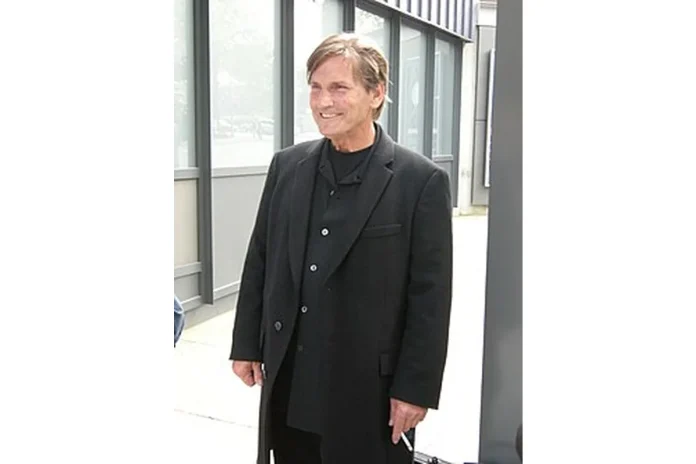
Joe Dallesandro Bio
Joseph Angelo D’Allesandro III, known professionally as Joe Dallesandro, is an American actor and model born on December 31, 1948, in Pensacola, Florida. He became a defining figure of the Andy Warhol era and was widely regarded as a sex symbol of gay subculture during the 1960s and 1970s. Dallesandro first gained attention posing for homoerotic photographs before joining Warhol’s Factory and appearing in Lonesome Cowboys (1968). His performance in Flesh (1968) and his lead role in Trash (1970) established him as a celebrity of youth culture and the sexual revolution.
Over the following decades, Dallesandro moved between underground cinema and mainstream Hollywood, appearing in films such as The Cotton Club (1984) and Cry-Baby (1990). He has continued to act occasionally, maintaining his status as a lasting icon of counterculture cinema. In 2009, he received a special Teddy Award at the Berlin International Film Festival in recognition of his contributions to LGBT artistic vision.
Early Life and Background
Joseph Angelo D’Allesandro III was born on December 31, 1948, in Pensacola, Florida. His father, Joseph Sr., was an 18-year-old Italian-American sailor in the U.S. Navy, and his mother, Thelma Testman, was 14 years old at the time of their marriage. She was 16 when she gave birth to him. His surname was spelled “D’Allesandro” on his birth certificate, a recurrence of an error from his father’s military documents. Following his rise to fame, his father’s name was legally changed back to D’Alessandro.
His parents separated soon after the family moved to New Jersey when he was two years old. His father maintained custody of him and his younger brother, Robert “Bobby” Dallesandro, and the boys eventually ended up at Angel Guardian Home awaiting foster care. They were placed in the foster care of Mr. and Mrs. Gary Silano, with Dallesandro attending Catholic school in Brooklyn until the family relocated to North Babylon, New York. By the time he was five years old, his mother was serving a five-year sentence in a U.S. federal penitentiary for interstate auto theft.
As a teenager, Dallesandro grew increasingly rebellious. He moved to Queens, New York, at age 13 to live with his paternal grandparents and his father. He was expelled from school for punching the principal and began running with gangs and stealing cars. At age 15, he drove a stolen car through the Holland Tunnel without paying the toll, was shot once in the leg by police, and was later arrested. In 1964, he was sentenced to Camp Cass Rehabilitation Center for Boys in the Catskills. He escaped in 1965 and fled to Florida to live with his father.
Path to Celebrity
In 1965, Dallesandro made his way to the West Coast with a friend and briefly worked at a pizza shop. When he was looking for another job, someone recommended modeling, though he was unaware that they meant nude modeling. By the age of 16, he was supporting himself by posing for Bob Mizer’s Athletic Model Guild and Bruce Bellas. His photographs were published in Physique Pictorial and The Male Figure, laying the foundation for his later image as a counterculture figure.
By 1967, Dallesandro had returned to New York. He married at the age of eighteen and was hustling around Times Square to support his drug habit, while also working as a bookbinder. He met Pop artist Andy Warhol and director Paul Morrissey while they were shooting Four Stars (1967) in Manhattan’s Greenwich Village. After accompanying a friend to observe the filming, he was cast in the project on the spot, marking the beginning of his association with the Factory.
Joe Dallesandro Career
Early Career (1967–1969)
Dallesandro began doing odd jobs at the Factory as Warhol’s bodyguard and sometime actor. He starred in Lonesome Cowboys (1968), which was filmed in Arizona, and while Warhol was recuperating from an assassination attempt in the summer of 1968, Dallesandro filmed Flesh (1968), a story of a male hustler based loosely on his own experiences. Directed by Paul Morrissey, Flesh featured several nude scenes and became a crossover hit, making Dallesandro the most popular of the Warhol stars. In 1969, he was cast in the MGM film The Magic Garden of Stanley Sweetheart, but was dismissed on the first day of filming.
By 1970, Dallesandro was earning a salary of $124 a week, and his work in Lonesome Cowboys and Flesh had begun to attract mainstream attention. The Factory’s films rarely used scripts, so actors improvised while the cameras rolled. Dallesandro later reflected that his best performances came when he was not wearing clothes, an approach that shaped his on-screen presence during these early underground productions.
Breakthrough (1970–1974)
After starring in Trash (1970), Dallesandro’s underground fame crossed over into popular culture and he was widely viewed as a sex symbol. New York Times critic Vincent Canby wrote that “his physique is so magnificently shaped that men as well as women become disconnected at the sight of him.” Newsday critic Jerry Parker compared him to Clark Gable, calling him “to Andy Warhol what Clark Gable once was to Louis B. Mayer.” Dallesandro appeared on the cover of Rolling Stone in April 1971 and was photographed by Francesco Scavullo, Annie Leibovitz, and Richard Avedon.
According to Dallesandro, Francis Ford Coppola wanted him to screen test for the role of Michael Corleone in The Godfather (1972), though the offer fell through. Dallesandro went on to star in Heat (1972), Andy Warhol’s Frankenstein (1973), and Andy Warhol’s Dracula (1974), all directed by Morrissey. The latter two were filmed in Rome, and Morrissey encouraged Dallesandro to seek an agent to find more work in Europe.
Notable Works and Milestones
His signature works include Flesh (1968), Trash (1970), Heat (1972), Andy Warhol’s Frankenstein (1973), and Andy Warhol’s Dracula (1974). His role as mobster Lucky Luciano in The Cotton Club (1984) marked his most prominent mainstream appearance. He has also appeared in a 1995 Calvin Klein ad campaign alongside model Kate Moss and in the 2016 Dandy Warhols music video “You Are Killing Me.”
Joe Dallesandro Award Nominations
Joe Dallesandro’s career has been recognized primarily through honorary distinctions rather than competitive nominations. His contributions to underground and independent cinema, along with his status as a counterculture icon, have been celebrated by international film communities. The Teddy Award jury in particular acknowledged his lasting influence on LGBT artistic vision.
Joe Dallesandro Awards Won
In February 2009, Dallesandro received a special Teddy Award at the 59th Berlin International Film Festival. The honor recognizes filmmakers and artists who have contributed to the further acceptance of LGBT people, culture, and artistic vision.
| Award | Wins | Year |
|---|---|---|
| Special Teddy Award | 1 | 2009 |
Joe Dallesandro Family
Joe Dallesandro’s younger brother, Robert “Bobby” Dallesandro, died in 1977. Bobby had worked for Warhol as a chauffeur and appeared in Flesh (1968) and Trash (1970). Dallesandro was raised in foster care after his parents separated, and at age 21 he was reunited with his mother, Sandy Hoyt, in 1970. His mother located him through the local chamber of commerce in Pensacola, and that October he and his brother visited her in Sacramento.
Personal Life
Dallesandro has been married three times and has two sons. In 1967, at age 18, he married his first wife, Leslie, the daughter of his father’s girlfriend; their son, Michael, was born on December 19, 1968, and the marriage ended in 1969. He met his second wife, Theresa (“Terry”), in the East Village, and they married in 1970; their son, Joseph A. Dallesandro, Jr., was born on November 14, 1970, and they divorced in 1978. While in Europe, he was romantically involved with Italian actress Stefania Casini in the mid-1970s, and she appeared as his love interest in Blood for Dracula (1974). In 1987, he married his third wife, Kimberly (“Kim”). Dallesandro has a grandson and a granddaughter by his son Michael, and a grandson by his son Joseph. Although he primarily had romantic relationships with women, he identifies as bisexual and has spoken openly about his sexuality and his early experiences within gay culture.