
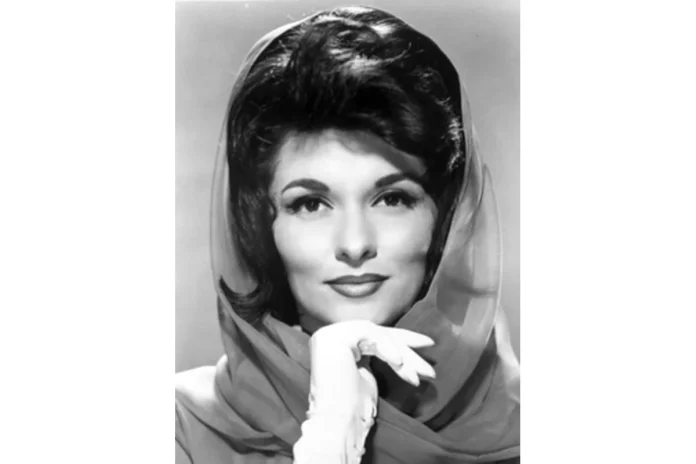
Nancy Kovack Bio
Nancy Kovack (born March 11, 1936) is a retired American film and television actress whose career spanned stage, cinema, and television from the late 1950s through the mid-1970s. Recognized for her striking screen presence and poise, she built an early reputation on Broadway before moving into Hollywood features and guest roles on major television series. Kovack is perhaps best remembered for her role as the high priestess Medea in the fantasy classic Jason and the Argonauts (1963) and for playing a memorable femme fatale in the Star Trek episode A Private Little War (1968). She earned an Emmy nomination for her supporting work on Mannix in 1969 before stepping away from the screen to focus on her family.
Beyond her professional life, Kovack is known for her long marriage to the celebrated Indian conductor Zubin Mehta, with whom she shared more than five decades of partnership. Highly intelligent and strategically minded, she approached acting as a serious business, planning her rise with the same discipline that defined her personal life.
Early Life and Background
Nancy Kovack was born on March 11, 1936, in Flint, Michigan. Her father, Michael A. Kovack, worked as the manager of a General Motors plant, grounding the family in the industrial heart of mid-century America. Raised in this hardworking Midwestern environment, she displayed exceptional intellectual ability from an early age, reportedly scoring an IQ of 152. That gift for focus and discipline shaped much of what she would later accomplish in entertainment.
Determined to move forward quickly, Kovack graduated high school early and entered the University of Michigan at the age of 15. She completed her studies in 1955, earning her degree when she was just 19. Even at this young age, she had already begun mapping out a path into show business, treating her future in acting not as a daydream but as a calculated profession.
Path to Celebrity
Kovack began raising her public profile through modeling work and beauty contests, a practical strategy that helped her transition into the entertainment industry. She became one of the Glee Girls for Jackie Gleason and worked as a hostess on the popular game show Beat the Clock. These early appearances gave her valuable on-camera experience and connected her with the television world just as it was booming in postwar America.
In 1958, Kovack made her Broadway debut in the original production of The Disenchanted, signaling her arrival as a serious dramatic talent. The stage work sharpened her craft and opened the door to Hollywood, where she soon began landing supporting roles in feature films and guest spots on television series. Her combination of intelligence, ambition, and screen appeal made her a natural fit for the growing medium of television and the new wave of fantasy and adventure films emerging in the early 1960s.
Nancy Kovack Career
Early Career (1958–1962)
Kovack’s professional screen work began on Broadway in 1958 with The Disenchanted, followed soon after by her entry into Hollywood features. She earned early film credits in productions including Strangers When We Meet (1960), where she appeared alongside Kirk Douglas and Kim Novak. These initial projects allowed her to develop her acting style and gain notice from casting directors across the studio system.
Throughout this formative period, Kovack balanced stage training with television appearances and modeling commitments. Her reputation as a poised and photogenic performer steadily grew, laying the foundation for the bigger roles that would soon follow in fantasy films and prestige television.
Breakthrough (1963–1969)
Kovack’s most notable early film role came in 1963, when she played the high priestess Medea in the stop-motion fantasy adventure Jason and the Argonauts. The role placed her at the center of one of the most memorable films of the era and remains her most widely recognized cinematic credit. She followed this success with a string of varied film appearances, including Diary of a Madman (1963) with Vincent Price, The Outlaws Is Coming (1965) with The Three Stooges, Sylvia (1965) with Carroll Baker, The Great Sioux Massacre (1965), The Silencers (1966) with Dean Martin, Tarzan and the Valley of Gold (1966), Frankie and Johnny (1966) with Elvis Presley, and Carl Reiner’s directorial debut Enter Laughing (1967).
During this period, Kovack also became a familiar face on American television. She appeared in multiple episodes of Bewitched, playing both Darrin Stephens’s ex-girlfriend and an Italian client, as well as roles in Batman, I Dream of Jeannie, Get Smart, Perry Mason, 12 O’Clock High, The Man from U.N.C.L.E., The Invaders, Burke’s Law, Family Affair, The Name of the Game, and Hawaii Five-O. She also spent more than two years in Iran, where she starred in three locally produced films before returning to the United States in 1968.
In 1968, Kovack delivered one of her most iconic television performances as a native medicine woman and femme fatale in the Star Trek episode A Private Little War. The role cemented her status among science-fiction fans and remains a defining moment of her career.
Notable Works and Milestones
Kovack’s signature work includes her portrayal of Medea in Jason and the Argonauts (1963) and her Star Trek performance in A Private Little War (1968). Her dramatic range was formally recognized in 1969 when she earned an Emmy nomination for Outstanding Single Performance by an Actress in a Supporting Role for the Mannix episode Sing a Song of Murder. Her final theatrical film role came in the science-fiction drama Marooned (1969), after which she largely stepped away from Hollywood.
Nancy Kovack Award Nominations
Throughout her career, Nancy Kovack received recognition from the television industry for her dramatic guest work. She earned one Primetime Emmy Award nomination, reflecting the respect she commanded as a supporting performer during television’s golden age.
Nancy Kovack Awards Won
No major competitive acting award wins for Nancy Kovack are confirmed from verified sources.
Nancy Kovack Family
Nancy Kovack was born to Michael A. Kovack, who served as the manager of a General Motors plant in Flint, Michigan. Her father’s steady industrial career shaped her Midwestern upbringing and her disciplined approach to pursuing opportunities in entertainment. Public information about additional family members remains limited.
Personal Life
In 1969, Nancy Kovack married Zubin Mehta, the celebrated Indian conductor who served as music director of the Los Angeles Philharmonic and later the New York Philharmonic. The couple also spent several months each year in Munich, Germany, where Mehta led the Bavarian State Opera until 2006. Kovack largely stepped away from Hollywood after her marriage, choosing to prioritize her life with Mehta over continued acting work, and the two have shared a long and private partnership for more than five decades.