
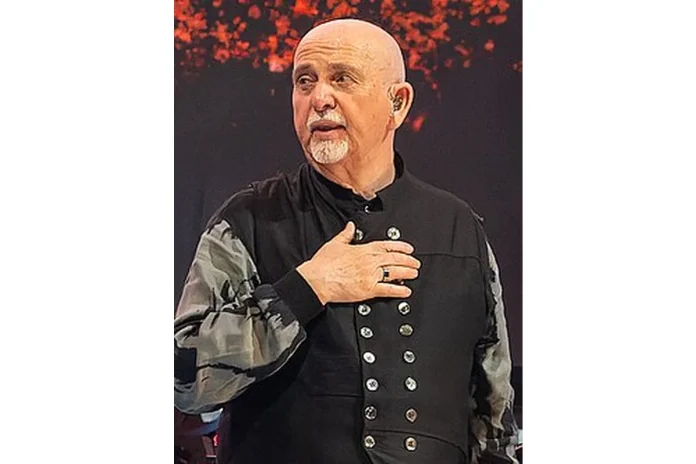
Peter Gabriel Bio
Peter Brian Gabriel (born 13 February 1950) is an English singer, songwriter, musician and human rights activist whose career has spanned more than six decades. He first rose to international prominence as the original lead vocalist of the progressive rock band Genesis before launching a solo career in 1975. Gabriel is widely recognized for his innovative approach to music, his commitment to world music traditions, and his long-standing advocacy for human rights, peace and digital music distribution.
Across his solo career, Gabriel has released influential studio albums and film soundtracks, including the landmark release So (1986) and the soundtrack Passion (1989). He is the co-founder of the WOMAD festival and the Real World Records label, and a co-founder of the human-rights organization Witness. Gabriel has earned three Brit Awards, six Grammy Awards, thirteen MTV Video Music Awards, a Polar Music Prize, a Man of Peace award and inductions into the Rock and Roll Hall of Fame both as a member of Genesis and as a solo artist.
Early Life and Background
Peter Brian Gabriel was born on 13 February 1950 in Chobham, Surrey, England. He is the son of Edith Irene Gabriel (née Allen) and Ralph Parton Gabriel, an electrical engineer and dairy farm owner. Gabriel was raised at Deep Pool Farm, a Victorian manor near Chobham, and grew up in a household where his mother came from a musical family. His interest in music developed early, although he initially opted for piano lessons from his mother and developed a passion for drumming, purchasing a floor tom-tom at the age of ten.
Gabriel wrote his first song, titled Sammy the Slug, at the age of twelve. Around this time, an aunt gave him money intended for professional singing lessons, but he used it to buy the Beatles’ debut album Please Please Me, which had just been released. He attended Cable House, a private primary school in Woking, and later St Andrews Preparatory School for Boys in Horsell, where teachers noticed his singing talent. In September 1963, he enrolled at the public Charterhouse School in Godalming.
At Charterhouse, Gabriel became a drummer and vocalist for his first band, the trad jazz outfit the Milords (also known as M’Lords), followed by a holiday band called the Spoken Word, which recorded an acetate in 1966. He later recalled the strong influence of hymns in his early musical development, noting that they were the closest he came to soul music before discovering the genre on his own.
Path to Music
Gabriel’s professional music career began in 1965, when he formed the band Garden Wall at Charterhouse with schoolmates Tony Banks, Johnny Trapman and Chris Stewart. Although Garden Wall disbanded in 1967, Gabriel and Banks were invited to work on a demo tape with Anthony Phillips and Mike Rutherford. The tape reached the musician and former Charterhouse pupil Jonathan King, who signed the group and suggested the name Genesis, a name the members accepted.
Genesis released their debut studio album From Genesis to Revelation in 1968, and after its commercial failure the group went their separate ways. In September 1969, Gabriel, Banks, Rutherford and Phillips decided to make Genesis a full-time band. Their second album, Trespass (1970), marked the beginning of Gabriel’s expanded role in the band, as he introduced the flute, accordion, tambourine and bass drum into their sound. He also began crafting on-stage narratives to introduce songs, a practice that would become a defining element of his performance style.
Throughout his years with Genesis, Gabriel developed into one of the most visually inventive frontmen in rock, appearing in elaborate costumes such as a fox head, a flower mask and fluorescent body paint. Despite these creative successes, tensions grew during the recording of the concept album The Lamb Lies Down on Broadway (1974). In August 1975, shortly after the conclusion of the supporting tour, Gabriel announced his departure from the band to spend time with his family and pursue a solo career.
Peter Gabriel Career
Early Career (1965–1975)
Gabriel’s earliest years as a professional musician were spent with Genesis, where he served as lead vocalist and contributed lyrics, flute, percussion and theatrical concepts. He was the primary lyricist of The Lamb Lies Down on Broadway, and his performances during the supporting tour drew intense media attention. The 1974 tour ended in May 1975, after which Gabriel publicly explained his decision to leave in a statement titled Out, Angels Out.
He used the period following his departure from Genesis as a self-described learning period, taking piano and music lessons. Working with his friend Martin Hall, he recorded demos of around twenty songs by the end of 1975, laying the groundwork for his solo career. His first solo recordings were made in Toronto with producer Bob Ezrin and released in February 1977.
Solo Debut and Four Self-Titled Albums (1977–1985)
Gabriel’s solo debut, commonly referred to as Peter Gabriel 1: Car, was released in February 1977 and reached No. 7 in the UK and No. 38 in the US. Its lead single, Solsbury Hill, is an autobiographical song about a spiritual experience on top of Solsbury Hill in Somerset. Gabriel toured the album with an 80-date itinerary that included guitarist Robert Fripp of King Crimson.
The second Peter Gabriel album (Scratch), released in June 1978, was produced by Fripp and reached No. 10 in the UK. Gabriel’s third album (Melt), recorded in 1979 and released in May 1980, went to No. 1 in the UK for three weeks and produced the singles Games Without Frontiers and Biko. The album is also notable for the creation of the gated reverb drum sound on the track Intruder, performed by Phil Collins. Gabriel’s fourth self-titled album (Security), released in September 1982, became his first commercially profitable tour and included his first US top 40 hit, Shock the Monkey. In 1983, he composed the score for Alan Parker’s film Birdy, a collaboration with producer Daniel Lanois that marked the beginning of his soundtrack work.
Breakthrough: So, Passion and Us (1986–1994)
Gabriel’s fifth studio album, So, was released in May 1986 and became his best-selling record, with more than five million copies sold in the US. The album reached No. 1 in the UK and No. 2 in the US, and produced the singles Sledgehammer, Big Time and the duet Don’t Give Up with Kate Bush. The Sledgehammer music video, a collaboration with Aardman Animations and the Brothers Quay, won a record nine MTV Video Music Awards in 1987 and was named MTV’s number one animated video of all time in 1998. So earned Gabriel two 1987 Brit Awards and four Grammy nominations.
In 1988, Gabriel composed the score for Martin Scorsese’s film The Last Temptation of Christ, drawing on musicians from WOMAD and the National Sound Archive in London. The soundtrack, released as Passion in June 1989, won a Grammy Award for Best New Age Performance. Gabriel’s follow-up studio album, Us, was released in 1992 and addressed personal themes including his divorce and psychotherapy. It produced the singles Digging in the Dirt and Steam, both of which won Grammy Awards for Best Short Form Music Video in 1993 and 1994. The accompanying Secret World Tour was documented in the concert film Secret World Live, which won the 1996 Grammy Award for Best Long Form Music Video.
OVO, Up and Continued Soundtrack Work (1997–2009)
Gabriel was invited to direct and compose the score for the Millennium Dome Show, a multimedia performance staged in London throughout 2000. The resulting soundtrack, OVO, was released in June 2000. In 2002, he composed the score for the Australian film Rabbit-Proof Fence, released as Long Walk Home, which received a Golden Globe nomination. His next studio album, Up, was released in September 2002 and supported by a world tour that included his daughter Melanie on backing vocals.
In 2008, Gabriel recorded the closing song Down to Earth, written with Thomas Newman, for the Pixar film WALL-E. The song won a Grammy Award for Best Song Written for a Motion Picture, Television or Other Visual Media, and was nominated for both a Golden Globe and an Academy Award. Gabriel declined to perform it on the 2009 Academy Awards telecast, citing restrictions on his performance time.
Scratch My Back, New Blood and I/O (2009–2023)
In 2010, Gabriel released Scratch My Back, an album of cover songs by artists including David Bowie, Lou Reed, Arcade Fire, Radiohead and Neil Young, and toured with the New Blood Tour alongside a 54-piece orchestra. The follow-up covers collection And I’ll Scratch Yours was released in September 2013. In 2012, he launched the Back to Front Tour, performing So in its entirety with the album’s original musicians, and in 2014 he was inducted into the Rock and Roll Hall of Fame as a solo artist by Coldplay frontman Chris Martin.
After more than two decades of work, Gabriel released his tenth studio album, I/O, on 1 December 2023, distributing one track on the date of each full moon of that year. The I/O The Tour supported the album across Europe and North America. In February 2025, Gabriel revealed to Mojo that he was working on the follow-up, O/I (I/O backwards), with the first single Been Undone released digitally on 3 January 2026.
Notable Works and Milestones
Peter Gabriel’s signature recordings include Solsbury Hill (1977), the self-titled album series Peter Gabriel 1 through 4, the film scores Birdy, Passion and Long Walk Home, the chart-topping album So (1986) and the singles Sledgehammer, Don’t Give Up and Digging in the Dirt. His career has also been marked by a series of pioneering collaborations, most notably his work with producer Daniel Lanois, guitarist David Rhodes and bassist Tony Levin, who has performed on every Gabriel studio album.
Peter Gabriel Award Nominations
Peter Gabriel has received nominations across the world’s most prestigious music and humanitarian award ceremonies. His nominations include four Grammy Awards in 1987 alone, covering Best Male Rock Vocal Performance, Song of the Year, Record of the Year and Album of the Year, all connected to the success of So and its lead single Sledgehammer. He has also received Golden Globe Award nominations for Best Original Score – Motion Picture for both Passion (1989) and Long Walk Home (2002), and a Golden Globe nomination for Best Original Song for Down to Earth from the Pixar film WALL-E (2008). Gabriel has further received nominations at the Academy Awards and Brit Awards, and has been honored with the Ivor Novello Award for Lifetime Achievement in recognition of his songwriting career.
Peter Gabriel Awards Won
Across his career, Peter Gabriel has won three Brit Awards, six Grammy Awards and thirteen MTV Video Music Awards. In 2006, the World Summit of Nobel Peace Laureates presented him with the Man of Peace award, and in the same year he received the Q Lifetime Achievement Award. He has also been honored with the Ivor Novello Award for Lifetime Achievement, the Polar Music Prize, the BMI Icon award at the 57th annual BMI London Awards, and the first Pioneer Award at the BT Digital Music Awards. Gabriel was inducted into the Rock and Roll Hall of Fame as a member of Genesis in 2010, and as a solo artist in 2014.
Peter Gabriel Family
Peter Gabriel married his first wife, Jill Moore, daughter of Baron Philip Moore, in 1971 when he was 21 years old. The couple had two daughters, Anna-Marie and Melanie, before divorcing in 1987. Anna-Marie is a filmmaker who has directed several of Gabriel’s live DVDs and music videos, while Melanie is a musician who served as a backing vocalist in her father’s band from 2002 to 2011. Both daughters appear in the final sequence of the Sledgehammer music video. Gabriel married Meabh Flynn in 2002, and the couple has two sons.
Personal Life
After his divorce from Jill Moore in 1987, Gabriel entered a period of depression and attended therapy sessions for six years. He has resided in Wiltshire for many years and runs Real World Studios from Box, Wiltshire, having previously lived in the Woolley Valley near Bath, Somerset. In 2010, he joined a campaign to stop agricultural development in the valley that had also inspired his first solo single, Solsbury Hill. In 2021, the Irish singer Sinéad O’Connor publicly described an on-and-off relationship with Gabriel in the wake of his divorce, stating that the experience inspired her single Thank You for Hearing Me.