
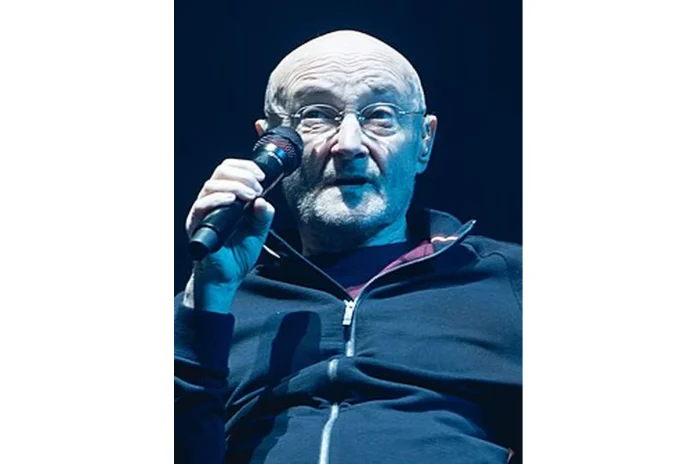
Phil Collins Bio
Philip David Charles Collins (born 30 January 1951) is an English singer, drummer, songwriter, record producer and actor whose career has spanned more than six decades. He first gained international attention as the drummer of the rock band Genesis and later stepped into the role of lead singer, helping the group become one of the defining acts of progressive and pop rock. As a solo artist, Collins became one of the most successful pop and adult contemporary performers of the 1980s and 1990s, known for songs such as “In the Air Tonight,” “Against All Odds (Take a Look at Me Now),” “Sussudio,” and “Another Day in Paradise.” His distinctive gated reverb drum sound influenced a generation of producers, and he has sold an estimated 150 million records worldwide across his work with Genesis and as a solo artist.
Early Life and Background
Philip David Charles Collins was born on 30 January 1951 at Putney Hospital in the present-day Borough of Wandsworth in south-west London, England. He is the youngest of three children. His mother, June Winifred (née Strange), worked in a toy shop and later as a theatrical agent at the Barbara Speake Stage School, an independent performing arts school in East Acton. His father, Greville Philip Austin Collins, was an insurance agent for London Assurance. The family settled at 453 Hanworth Road in the Municipal Borough of Brentford and Chiswick when Collins was three years old, and he was raised in West London.
Collins was given a toy drum kit for Christmas at the age of five, and his two uncles later made him a makeshift set with triangles and tambourines that fitted into a suitcase. He practised by playing along to music on the television and radio, citing The Beatles, and especially their drummer Ringo Starr, as a major early influence. He also followed the London band the Action, whose work introduced him to the soul music of Motown and Stax Records, and later drew inspiration from the jazz and big band drummer Buddy Rich. He received basic piano and music tuition from his father’s aunt at around the age of 12, and studied drum rudiments under Lloyd Ryan and later Frank King.
Collins attended Nelson Primary School in Twickenham before moving on to Chiswick County Grammar School in 1962. There, he took to football and formed the school band the Real Thing, which featured his future wife Andrea Bertorelli and friend Lavinia Lang as backup singers. His next group was the Freehold, with whom he wrote his first song, “Lying, Crying, Dying.” As a child, he was childhood friends with actor Jack Wild, and both attended the Barbara Speake Stage School, which shaped his early interest in performance.
Path to Music
Collins quit school at the age of 14 to become a full-time pupil at the Barbara Speake Stage School. He had an uncredited part as an extra in the Beatles’ film A Hard Day’s Night (1964) and was later cast as the Artful Dodger in two West End runs of the musical Oliver!, a role he has called “the best part for a kid in all London.” He also starred in Calamity the Cow (1967), a film produced by the Children’s Film Foundation. After a falling out with the director, Collins decided to quit acting to pursue music.
His enthusiasm for music grew during his acting years, and he frequented the Marquee Club on Wardour Street so often that the managers asked him to set out the chairs, sweep the floors, and assist in the cloakroom. He saw the Action and newcomers Yes perform at the club, which greatly influenced his musical direction. After unsuccessful auditions for Vinegar Joe and Manfred Mann Chapter Three, Collins secured a position in the Cliff Charles Blues Band, followed by a stint in the Gladiators, a backing band for a black vocal quartet that included his schoolmate Ronnie Caryl on guitar.
In 1969, Collins and Caryl joined John Walker’s backing band for a European tour, after which the quartet formed the rock band Hickory. They were renamed Flaming Youth, signed to Fontana Records, and recorded the concept album Ark 2 (1969), which tells the story of humanity’s evacuation from a burning Earth. In July 1970, after Flaming Youth split, Collins answered a Melody Maker advertisement placed by the rock band Genesis and became their fourth drummer on 8 August 1970.
Phil Collins Career
Early Career (1970-1980)
From 1970 to 1975, Collins played drums, percussion, and backing vocals on Genesis albums and concerts. He quickly became the group’s primary backing vocalist and participated in the songwriting jams that produced much of the band’s material. His more notable contributions during this period include composing the staccato rhythm that acts as the main theme of the live favourite “Watcher of the Skies” and singing lead on “For Absent Friends” from the album Nursery Cryme. He sang “More Fool Me” on the 1973 album Selling England by the Pound and on the subsequent tour, marking the first time he assumed the role of Genesis lead vocalist in a live setting.
In August 1975, Peter Gabriel’s departure from the band was publicly announced, and Collins became the group’s lead vocalist during the recording of their album A Trick of the Tail. The album reached number three in the UK Albums Chart and 31 in the US, and the band recruited Bill Bruford and later Chester Thompson to handle drums so Collins could sing. In 1976, Collins also replaced Phil Spinelli of the jazz fusion group Brand X, recording their first two albums Unorthodox Behaviour and Moroccan Roll. When Collins, Tony Banks, and Mike Rutherford decided to continue Genesis as a trio in 1977, they recorded …And Then There Were Three…, which included the band’s first UK Top 10 and US Top 40 single, “Follow You Follow Me.” Their 1980 album Duke became the group’s first UK number one album.
Breakthrough (1981-1989)
In February 1981, Collins released his debut solo album Face Value, signing with Virgin Records and WEA for American distribution. He oversaw every step of its production and co-produced it with Hugh Padgham. The album reached number one in seven countries, including the UK, and number seven in the US, where it sold five million copies. Its lead single “In the Air Tonight” reached number two in the UK singles chart and is famous for the gated reverb effect used on Collins’s drums, a technique developed by Padgham.
Collins’s second solo album, Hello, I Must Be Going!, was released in November 1982 and reached number two in the UK and number eight in the US. Its second single, a cover of “You Can’t Hurry Love” by the Supremes, became his first UK number one single. In 1984, he wrote and recorded “Against All Odds,” the main theme for the American romantic film of the same name, which became the first single of his solo career to reach number one on the Billboard Hot 100. The song earned him an Academy Award nomination for Best Original Song and a Grammy Award for Best Pop Vocal Performance, Male.
His third album, No Jacket Required, was released in February 1985 and became a huge worldwide success, reaching number one in several countries. “Sussudio” and “One More Night” topped the US singles chart, and “Don’t Lose My Number” and “Take Me Home” also made the US top ten. The album sold over 12 million copies in the US, where it was certified diamond, and 1.9 million in the UK, where it was the second-best-selling album of 1985. No Jacket Required earned Collins the first two of his six Brit Awards, winning Best British Male and Best British Album, and won three Grammy Awards, including Album of the Year.
On 13 July 1985, Collins took part in the Live Aid concerts, performing at both the London concert at Wembley Stadium and the US concert at JFK Stadium in Philadelphia on the same day, the only performer to do so. He flew to Philadelphia on a Concorde to perform his solo material, play drums for Eric Clapton, and drum with Robert Plant and Jimmy Page for a Led Zeppelin reunion. He also released “Separate Lives,” a duet with Marilyn Martin for the film White Nights, which became a US number one hit. By the end of 1985, the music press noted that Collins’s astronomical success as a solo artist had made him more popular than Genesis. He then reunited with Banks and Rutherford to record Genesis’s thirteenth album, Invisible Touch (1986), which became the group’s biggest-selling album, with six million copies sold in the US.
Notable Works and Milestones
From April to October 1989, Collins recorded his fourth album …But Seriously, which saw him address social and political themes. The album spent fifteen weeks at No. 1 in the UK and was the UK’s best-selling album of 1990. Its lead single “Another Day in Paradise,” an anti-homelessness song featuring David Crosby on backing vocals, became the final number one single of the 1980s in the US and won the Grammy Award for Record of the Year in 1991. He also took on his first major acting role since the late 1960s, starring as Buster Edwards in the film Buster (1988), for which his rendition of “A Groovy Kind of Love” became his only single to reach No. 1 in both the UK and the US, and the song “Two Hearts” won a Golden Globe for Best Original Song and an Oscar nomination in the same category.
Phil Collins Award Nominations
Phil Collins has received multiple high-profile nominations across his career in music, film, and songwriting. His song “Against All Odds (Take a Look at Me Now)” earned an Academy Award nomination for Best Original Song in 1985, and his song “Two Hearts,” co-written with Lamont Dozier, received an Oscar nomination in the same category in 1989. Collins has also been recognised by the British Academy of Songwriters, Composers and Authors with several Ivor Novello Awards, and he received a star on the Hollywood Walk of Fame in 1999. In 2010, he was inducted into the Rock and Roll Hall of Fame as a member of Genesis, and he was also nominated for induction as a solo artist.
Phil Collins Awards Won
Throughout his career, Phil Collins has amassed an impressive collection of major awards. He has won eight Grammy Awards, six Brit Awards (including Best British Male Artist three times), two Golden Globe Awards, one Academy Award for Best Original Song for “You’ll Be in My Heart” from Disney’s Tarzan, and a Disney Legend Award. He has also been honoured with six Ivor Novello Awards from the British Academy of Songwriters, Composers and Authors, including the International Achievement Award. He was inducted into the Songwriters Hall of Fame in 2003, the Modern Drummer Hall of Fame in 2012, and the Classic Drummer Hall of Fame in 2013.
| Award | Wins | Year |
|---|---|---|
| Grammy Awards | 8 | 1985-1991 |
| Brit Awards | 6 | 1985-1992 |
| Golden Globe Awards | 2 | 1989, 2000 |
| Academy Award (Best Original Song) | 1 | 2000 |
| Disney Legend Award | 1 | 2002 |
| Ivor Novello Awards | 6 | 1988-2008 |
Phil Collins Family
Phil Collins is the youngest of three children. His sister, Carole, competed as a professional ice skater and later followed their mother June’s footsteps as a theatrical agent, while his brother, Clive Collins, was a cartoonist. Clive was awarded an MBE for services to art in 2012, and Phil appeared at his investiture ceremony at Buckingham Palace. Collins has five children: Joely (born 1972), whom he adopted during his first marriage and who became an actress and film producer; Simon (born 1976), a former vocalist and drummer of the progressive rock band Sound of Contact; Lily (born 1989), an actress; and two sons, Nicholas and Mathew, from his third marriage.
Personal Life
Phil Collins has been married three times. From 1975 to 1980, he was married to Andrea Bertorelli, whom he met as an 11-year-old in a London drama class. In 1984, he married American Jill Tavelman, with whom he had daughter Lily. Their divorce was finalised in 1996, and Collins paid £17 million as part of the settlement. In 1999, he married Orianne Cevey, a Swiss national who had worked as his translator. They had two sons, Nicholas and Mathew, and divorced in 2006, with Collins paying £25 million, the largest settlement in a British celebrity divorce at the time. From 2007 to 2016, Collins was in a relationship with American news anchor Dana Tyler. He later reunited with Cevey in 2016, and they lived together in Miami Beach before separating again in 2020. Collins has resided in Féchy, Vaud, Switzerland.