
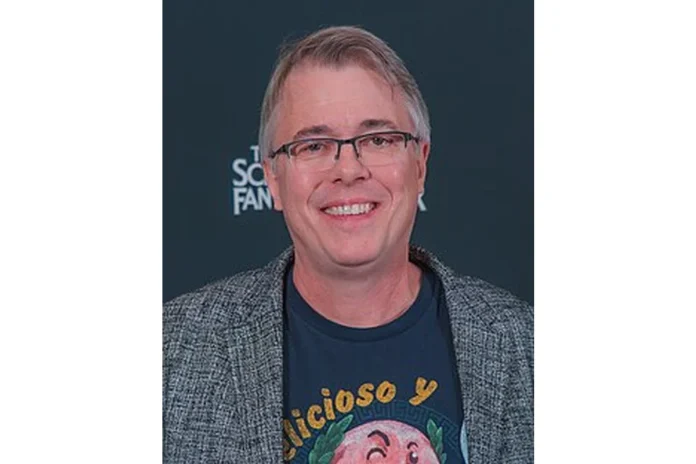
Vince Gilligan Bio
George Vincent Gilligan Jr., known professionally as Vince Gilligan, is an American screenwriter and filmmaker born on February 10, 1967, in Richmond, Virginia. He is best known as the creator, showrunner, and executive producer of the AMC crime drama Breaking Bad (2008–2013) and its prequel spin-off Better Call Saul (2015–2022). Over the course of his career, Gilligan has also written, directed, and produced episodes of The X-Files (1993–2002), co-written the superhero film Hancock (2008), and created the Apple TV+ science fiction series Pluribus (2025–present).
His work has earned widespread critical praise and major industry recognition, including four Primetime Emmy Awards, six Writers Guild of America Awards, two Critics’ Choice Television Awards, two Producers Guild of America Awards, a Directors Guild of America Award, and a BAFTA Television Award. He is widely regarded as one of the most influential writer-producers in modern television, with a body of work that has shaped the contemporary prestige drama landscape.
Early Life and Background
George Vincent Gilligan Jr. was born in Richmond, Virginia, on February 10, 1967, to Gail, a grade school teacher, and George Vincent Gilligan Sr., an insurance claims adjuster. His parents divorced in 1974, and he and his younger brother Patrick were raised in Farmville and Chesterfield County. The brothers attended the J.P. Wynne Campus School, the laboratory school run by Longwood College (now Longwood University), where their mother also taught. Decades later, Gilligan borrowed the J.P. Wynne name for the fictional high school where Walter White teaches in Breaking Bad. His grandfather, Vincent T. Gilligan, was a well-known Richmond book shop owner.
Gilligan’s interest in film began in childhood through his close friendship with Angus Wall, who later became a film editor and title designer. Wall’s mother, Jackie, who taught at J.P. Wynne, loaned Gilligan her Super 8 camera, and he used it to make amateur science fiction films with his brother Patrick, including an early short titled Space Wreck. He later won first prize in his age group at a University of Virginia film competition, and Jackie continued to encourage both boys to pursue careers in the arts. His father introduced him to film noir classics and the Western films of John Wayne and Clint Eastwood, shaping his storytelling sensibilities from a young age.
Recognized early for his creativity, Gilligan won a scholarship to the Interlochen Center for the Arts. After eighth grade, he returned to Chesterfield to attend L. C. Bird High School, graduating in 1985. He then enrolled at New York University’s Tisch School of the Arts on a scholarship, earning a Bachelor of Fine Arts in film production. While at NYU, he wrote the screenplay for Home Fries, which won the Virginia Governor’s Screenwriting Award in 1989, and was later produced as a feature film.
Path to Celebrity
Gilligan’s first professional screenplay to be produced was the 1993 romantic comedy Wilder Napalm. He soon shifted his focus to television, drawn to the Fox science fiction series The X-Files. As a fan of the show, he submitted a script that became the second-season episode “Soft Light,” launching a long and defining collaboration with creator Chris Carter.
His work on The X-Files expanded rapidly. He went on to write 30 episodes of the series, including fan favorites, and rose through the producing ranks as co-producer, supervising producer, co-executive producer, and executive producer on dozens of episodes. He also co-created the spin-off series The Lone Gunmen, which aired for a single thirteen-episode season in 2001.
During his time on The X-Files, Gilligan continued to develop feature work, including the screenplay for Home Fries, released in 1998 and starring Drew Barrymore and Luke Wilson. He was also hired as a consulting producer on Chris Carter’s short-lived series Harsh Realm and wrote episodes of Robbery Homicide Division and Night Stalker, broadening his résumé across both film and television.
Vince Gilligan Career
Early Career (1992–2002)
Gilligan’s early career was anchored by his years on The X-Files, where he earned a reputation as one of the series’ most reliable and imaginative writers. His promotion through the producing ranks reflected both his storytelling ability and his collaborative instincts on a long-running series. In 2001, he expanded the franchise by co-creating The Lone Gunmen, an X-Files spin-off that, while short-lived, demonstrated his interest in building serialized worlds.
He balanced his television work with feature screenwriting, producing the screenplay for Home Fries in 1998. These years established the rhythm that would define his career: steady episode work combined with long-term development of larger original ideas, including the crime premise that would eventually become Breaking Bad.
Breakthrough (2008–2013)
Gilligan’s defining achievement arrived with Breaking Bad, which he created, wrote, directed, and produced for AMC. Premiering in 2008 and concluding in 2013, the series followed a high school chemistry teacher turned methamphetamine manufacturer and became one of the most celebrated dramas in television history.
Breaking Bad earned Gilligan four Writers Guild of America Awards in straight succession from 2012 to 2014, including an individual award for writing the episode “Box Cutter.” He received two Primetime Emmy Awards in 2013 and 2014 for his work as a producer on the series. In 2014, he won the Directors Guild of America Award for Outstanding Directing in a Drama Series for directing the series finale “Felina.”
Notable Works and Milestones
Following the success of Breaking Bad, Gilligan co-created the prequel series Better Call Saul with Peter Gould. Premiering on February 8, 2015, the series starred Bob Odenkirk reprising his role as Saul Goodman and ran for six seasons. Gilligan directed and co-wrote the first episode “Uno,” served as co-showrunner, and continued to direct and consult on the series through its conclusion in 2022. He also wrote, directed, and produced the feature film El Camino: A Breaking Bad Movie, released on Netflix in October 2019 to wrap up the story of Jesse Pinkman. His current major project is the Apple TV+ science fiction series Pluribus (2025–present), which stars Rhea Seehorn.
Vince Gilligan Award Nominations
Vince Gilligan has received numerous nominations across the major American television and film awards, recognizing his work as a writer, producer, and director on Breaking Bad, Better Call Saul, The X-Files, and El Camino. His nominations span the Primetime Emmy Awards, Writers Guild of America Awards, Critics’ Choice Television Awards, Producers Guild of America Awards, Directors Guild of America Awards, and the BAFTA Television Awards, reflecting sustained recognition from the industry’s principal voting bodies.
Vince Gilligan Awards Won
Gilligan has won four Primetime Emmy Awards, six Writers Guild of America Awards, two Critics’ Choice Television Awards, two Producers Guild of America Awards, a Directors Guild of America Award, and a BAFTA Television Award. His Emmys and two of his Producers Guild awards were earned for his producing work on Breaking Bad, while his individual WGA win came for writing the episode “Box Cutter.” His Directors Guild Award recognized his direction of the Breaking Bad finale “Felina.” Together, these honors place him among the most decorated writer-producers of his generation.
Vince Gilligan Family
Gilligan was born to Gail, a grade school teacher, and George Vincent Gilligan Sr., an insurance claims adjuster. His parents divorced in 1974, and he was raised alongside his younger brother, Patrick, with whom he made amateur science fiction films as a child. His paternal grandfather, Vincent T. Gilligan, was a well-known Richmond book shop owner, and the family has deep roots in the Richmond, Virginia, area.
Personal Life
Gilligan has been in a relationship with Holly Rice since 1991 and referred to her as his wife in 2022. The couple has no children. Raised Catholic, Gilligan has since described himself as agnostic, and he has publicly spoken out against the use of artificial intelligence in the arts.