
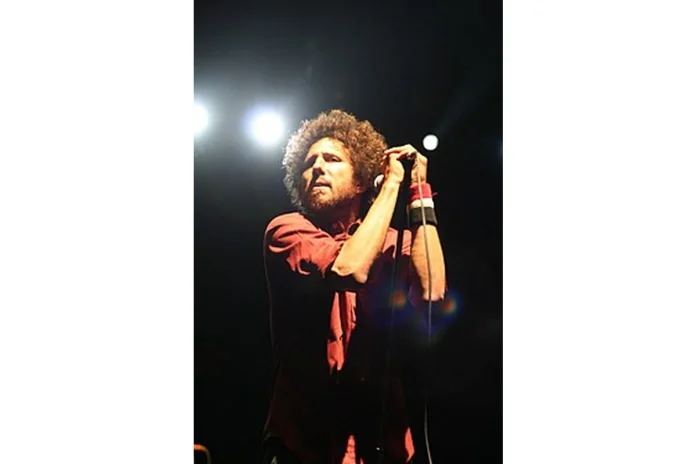
Zack de la Rocha Bio
Zacharias Manuel de la Rocha, known professionally as Zack de la Rocha, is an American musician, rapper, singer, songwriter, and political activist born on January 12, 1970, in Long Beach, California. He is best known as the vocalist and lyricist of the rock band Rage Against the Machine, a group that fused rap, metal, and hardcore punk while promoting left-wing political messages. Across his career, de la Rocha has used his platform to oppose corporate America, the military-industrial complex, and government oppression.
Beyond his work with Rage Against the Machine, de la Rocha has performed with bands such as Hard Stance, Inside Out, Farside, and One Day as a Lion, and has collaborated with artists including DJ Shadow, Trent Reznor, El-P, and Roni Size. He has remained an outspoken activist, advocating for causes tied to indigenous rights, prison reform, and humanitarian issues in the United States and abroad.
Early Life and Background
Zack de la Rocha was born on January 12, 1970, in Long Beach, California, to Robert “Beto” de la Rocha and Olivia Lorryne Carter. His father is a Mexican-American muralist and a member of Los Four, the first Chicano art collective to be exhibited at a museum when it showed at the Los Angeles County Museum of Art in 1973. His mother earned a PhD in anthropology from the University of California, Irvine. De la Rocha’s great-grandfather, Jose Isaac de la Rocha Acosta, was a Mexican revolutionary who fought in the Mexican Revolution, while his maternal grandfather, Manuel García, worked as an agricultural laborer in the United States after arriving from Sonora, Mexico.
De la Rocha’s parents divorced when he was six, and he moved from East Los Angeles to Irvine with his mother. He later described Irvine as “one of the most racist cities imaginable” and said that being Mexican in the city often meant being viewed as a laborer. Despite the challenges of his upbringing, de la Rocha found inspiration in his family’s deep Mexican-American roots and the cultural heritage passed down through generations.
De la Rocha’s early exposure to music came through his father’s artistic world and through the punk rock movement that was gaining traction in Southern California. He became drawn to bands like The Clash, The Misfits, Sex Pistols, Bad Religion, Minor Threat, Bad Brains, and The Teen Idles, influences that would later shape his approach to music and political expression.
Path to Music
De la Rocha began his musical career in the late 1980s while still in junior high school, when he and Tim Commerford played guitar together in a band called Juvenile Expression. In 1987, he joined the straight edge hardcore punk band Hard Stance, and in 1988 he took on lead vocals for the group after the departure of singer Eric Ernst. That same year, he briefly played drums for the hardcore punk band No For An Answer. By 1989, he had joined Farside as a guitarist, where he remained until 1991.
During this period, de la Rocha became increasingly interested in the youth crew movement, a subculture within hardcore punk that emphasized straight edge values. He joined Inside Out, a band heavily inspired by acts like Minor Threat and Bad Brains. Inside Out released the 1990 EP No Spiritual Surrender through Revelation Records. As the band progressed, de la Rocha’s writing grew more political and increasingly absorbed influences from hip hop, particularly Run-DMC, which created tension with guitarist Vic DiCara. This creative conflict led to the band’s breakup in 1991, though Inside Out briefly reunited in 1993.
After Inside Out dissolved, de la Rocha immersed himself in hip hop and began freestyling at local clubs. It was at one of these clubs that he was approached by guitarist Tom Morello, who was impressed by his lyrics. Morello convinced de la Rocha to form a new band, and together they recruited drummer Brad Wilk and bassist Tim Commerford. The group adopted the name Rage Against the Machine, taken from an unreleased Inside Out record, setting the stage for one of the most politically charged bands of the 1990s.
Zack de la Rocha Career
Early Career (1987–1991)
De la Rocha’s early career was rooted in the Southern California hardcore punk scene. His time with Hard Stance, No For An Answer, Farside, and Inside Out gave him a foundation in the youth crew movement and exposed him to the DIY ethics of underground music. Inside Out’s 1990 EP No Spiritual Surrender became a defining document of his early lyricism, blending personal frustration with political critique.
During these formative years, de la Rocha developed the vocal intensity and confrontational stage presence that would later define his work. His growing interest in hip hop, especially the bold rhythmic delivery of Run-DMC, began to influence his approach to songwriting and foreshadowed the rap-metal fusion that would emerge with his next band.
Breakthrough (1992–2000)
Rage Against the Machine released their self-titled debut album in 1992 to critical and commercial success, blending rap, metal, and hardcore punk in a way that few bands had attempted. By 1993, the band was performing on the main stage at Lollapalooza, and they became one of the most politically charged acts to receive extensive airplay on radio and MTV.
The band’s second and third albums, Evil Empire and The Battle of Los Angeles, both peaked at number one in the United States. Despite this commercial success, de la Rocha became increasingly frustrated that the music was not translating into the political action he had hoped for. He began collaborating with hip hop artists like KRS-One, Chuck D, and Public Enemy, expanding his activism beyond the band.
In October 2000, de la Rocha left Rage Against the Machine, citing “creative differences” related to the release of the covers album Renegades. The remaining members eventually joined forces with Chris Cornell of Soundgarden to form Audioslave.
Notable Works and Milestones
De la Rocha’s signature contributions include his lyrical work on Rage Against the Machine’s self-titled debut, Evil Empire, and The Battle of Los Angeles, which contained politically charged tracks inspired by the Zapatista movement, including “People of the Sun” and “War Within a Breath.” His performance at the 2007 Coachella Valley Music and Arts Festival, where Rage Against the Machine headlined in front of a Zapatista Army of National Liberation backdrop, marked a defining moment in the band’s reunion era.
Zack de la Rocha Award Nominations
Specific nominations received by Zack de la Rocha as an individual artist are not clearly documented in available verified sources, and any detailed summary of nominations across his career is therefore omitted to avoid speculation.
Zack de la Rocha Awards Won
Specific award wins attributed solely to Zack de la Rocha as an individual artist are not clearly documented in available verified sources, and a detailed summary of individual awards is therefore omitted.
Zack de la Rocha Family
Zack de la Rocha is the son of Robert “Beto” de la Rocha, a Mexican-American muralist and member of Los Four, and Olivia Lorryne Carter, who earned a PhD in anthropology from the University of California, Irvine. His father is of Mexican-American heritage with distant African and Sephardi Jewish roots, while his mother was born to Manuel García Urias, a Mexican-American, and Olive Pearl Fleming, who was of German and Irish descent. De la Rocha’s great-grandfather, Jose Isaac de la Rocha Acosta, was a Mexican revolutionary who fought in the Mexican Revolution, and his maternal grandfather, Manuel García, was originally from Sonora and worked as an agricultural laborer in the United States. His parents divorced when he was six, after which he moved with his mother to Irvine, California.
Personal Life
De la Rocha is known for his vegetarianism, a position he has publicly supported in interviews, citing concern for the suffering of animals in the slaughterhouse process. Beyond his musical career, he has remained deeply engaged in political activism, advocating for Leonard Peltier, Mumia Abu-Jamal, and the Zapatista movement in Mexico, and he has spoken on the floor of the United Nations in support of these causes. In November 2023, he attended a pro-Palestinian protest in Washington, D.C., and signed an open letter calling for a ceasefire in the Gaza war. Details about his romantic partners and children are not clearly documented in available verified sources.